|
Kaiser Permanente will pay a $31 million settlement with the federal government over the company’s mental health care practices, according to an agreement reached this week that followed an investigation into the company’s compliance with mental health laws.
But the therapists and other mental health workers employed by the health care provider said they remain concerned that patients in California are still struggling to get the timely help they need.
On Tuesday, the U.S. Department of Labor announced it ordered the Oakland-based health care giant to reimburse Kaiser members in the Golden State for more than $28 million in costs incurred when seeking out-of-network mental health and substance use disorder treatment — saying in a statement that the company failed “to provide timely and appropriate access” to those services between January 2021 and September 2024. Kaiser will also pay a $2.8 million penalty to the federal government.
Critics for years have alleged that Kaiser has not maintained adequate provider networks for mental health and substance use disorder care, forcing many patients to pay for health care services out of pocket. Mental health care workers said they first took their concerns to Kaiser management, where they were not addressed, then brought them to the attention of the federal labor agency.
In a statement, Kaiser attributed the lack of consistent access to care to surges in demand for mental health care treatment over the past six years, triggered by the pandemic.
“These challenges made it very difficult for our members to get consistent access to the care they needed when they needed it,” spokesperson Lena Howland said. “We are committed to reimbursing those members who tried but may have been unable to get timely care from Kaiser Permanente in that time.”
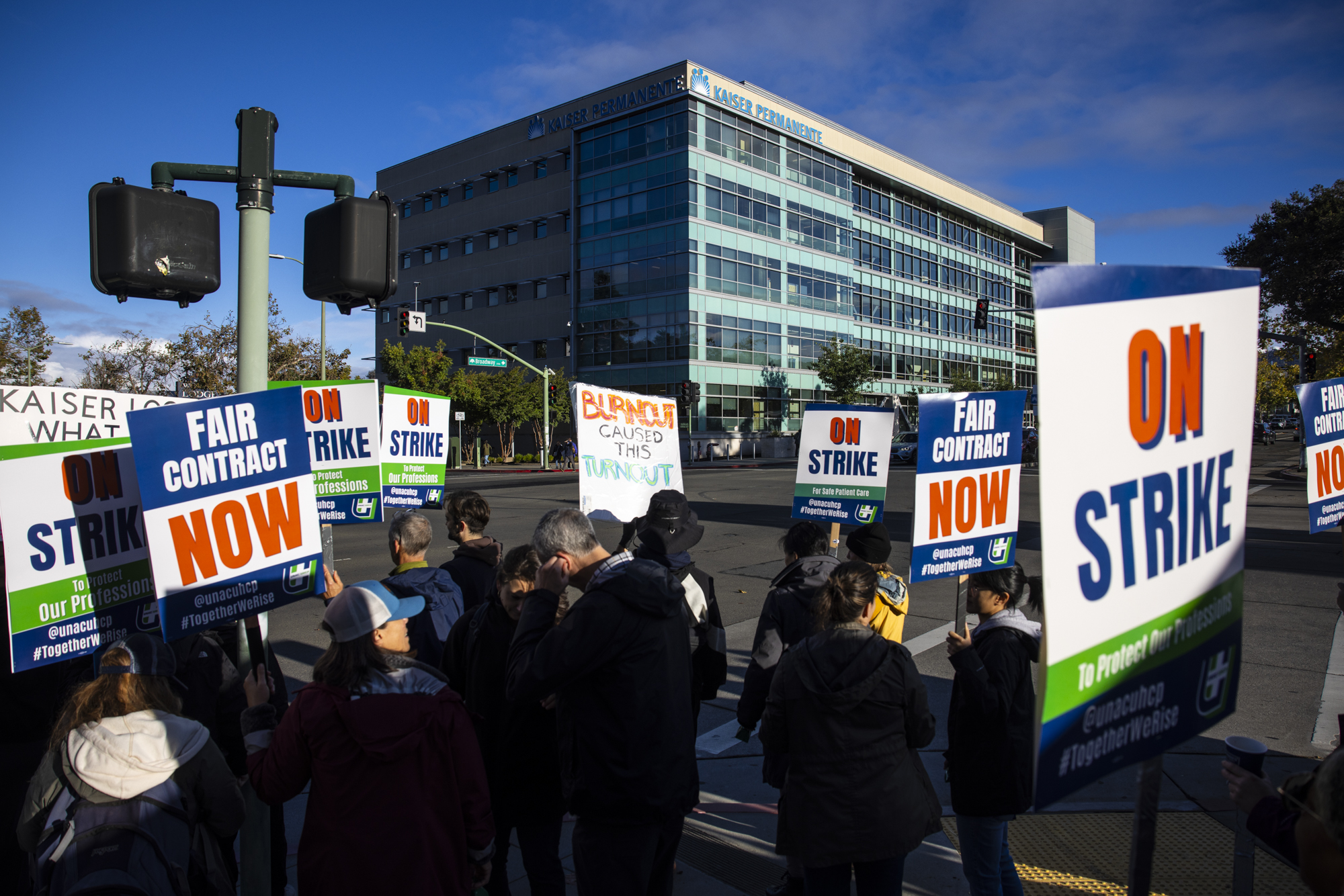 Workers strike outside of the Kaiser Permanente Oakland Medical Center in Oakland on Oct. 14, 2025. (Martin do Nascimento/KQED) Workers strike outside of the Kaiser Permanente Oakland Medical Center in Oakland on Oct. 14, 2025. (Martin do Nascimento/KQED)
In the midst of a national mental health crisis, finding a therapist, especially one who accepts insurance, has become notoriously difficult as the field struggles with workforce shortages and low reimbursement rates.
Kaiser has grappled with these industry-wide challenges for over a decade. California regulators have repeatedly cited the company for making patients wait too long for mental health appointments, ordering Kaiser to address persistent issues.
The National Union of Healthcare Workers, which represents Kaiser Permanente’s 4,800 mental health professionals in California and Hawaii, said Friday that the health care giant’s proposals in ongoing contract negotiations indicate that patients hoping for shorter wait times and greater access to therapists may expect business as usual.
“A lot of our therapists still can’t see patients for weeks at a time,” said Matthew Artz, a union spokesperson. “Some of them can’t ‘refer out’ to outside providers. And even if Kaiser is increasing its network, it’s doing other things to diminish care.”One of the major points of contention is Kaiser’s use of telephone operators and artificial intelligence to triage and treat mental health patients. Kaiser uses those intermediaries, the union said, to determine how quickly a patient needs care.
In contract negotiations with therapists in Northern California, the union said Kaiser is seeking free rein to push patients into AI-based therapy protocols that Artz argued would diminish the quality of care. However, the company has said its AI tools don’t make medical decisions or replace human care.
“Kaiser is not acting like a health care provider that has seen the errors of its ways and wants to provide better mental health care,” Artz said. “It’s really acting like an insurance company that still wants to spend as little money as possible on mental health and just try to avoid getting in trouble.”
The settlement comes less than three years after Kaiser agreed to pay a $200 million penalty, including a historic $50 million fine, as part of a settlement related to California’s 2021 parity law, designed to provide equal access to mental and physical health. As part of that agreement, Kaiser acknowledged at that time that it lacked “sufficient behavioral health providers” and that “this lack of clinical staff has resulted in excessive wait times for enrollee individual therapy appointments.”
Tens of thousands of Kaiser Permanente nurses, pharmacists and other physical health care workers are on strike across the state over stalled contract talks, staffing levels and pay. NUHW members, who went on a 10-week strike in 2022, are voting on whether to join their colleagues on the picket lines.
“Kaiser therapists have been very willing to go on strike in order to advocate for better patient care and better working conditions,” Artz said.
KQED’s Desmond Meagley contributed to this report. |



.png)
 More
More
 Religion & Spirituality
 Education
 Arts and Design
 Health
 Fashion & Beauty
 Government & Organizations
 Kids & family
 Music
Music News & Politics
 Science & Medicine
 Society & Culture
 Sports & Recreation
 TV & Film
 Technology
 Philosophy
 Storytelling
 Horror and Paranomal
 True Crime
 Leisure
 Travel
 Fiction
 Crypto
 Marketing
 History
 Comedy
 Arts
Arts Games & Hobbies
 Business
 Motivation