|
An Alameda County judge allowed a case against a former San Leandro police officer to proceed to trial on Friday after a dramatic hearing in which three former prosecutors invoked the Fifth Amendment and the current deputy district attorney acknowledged “outrageous prosecutorial misconduct” by his own office.
Judge Thomas Reardon denied a defense motion to dismiss charges against former San Leandro police officer Jason Fletcher, 55, accused of killing Steven Taylor, 33, inside a Walmart in 2020.
Fletcher was the first officer to arrive at the store after a security guard reported that Taylor tried to leave without paying. Fletcher moved toward Taylor and tried to grab an aluminum baseball bat out of his hand.
He first used his Taser, causing Taylor to stumble forward, and then shot him in the chest — all within 40 seconds.
Then-District Attorney Nancy O’Malley filed charges in 2020, one of the first cases charged under a change in California law that raised the legal threshold for justified police use of deadly force.
When Pamela Price succeeded O’Malley three years later, Fletcher’s lawyer, Mike Rains, filed a motion asking that the case be turned over to California Attorney General Rob Bonta’s office.
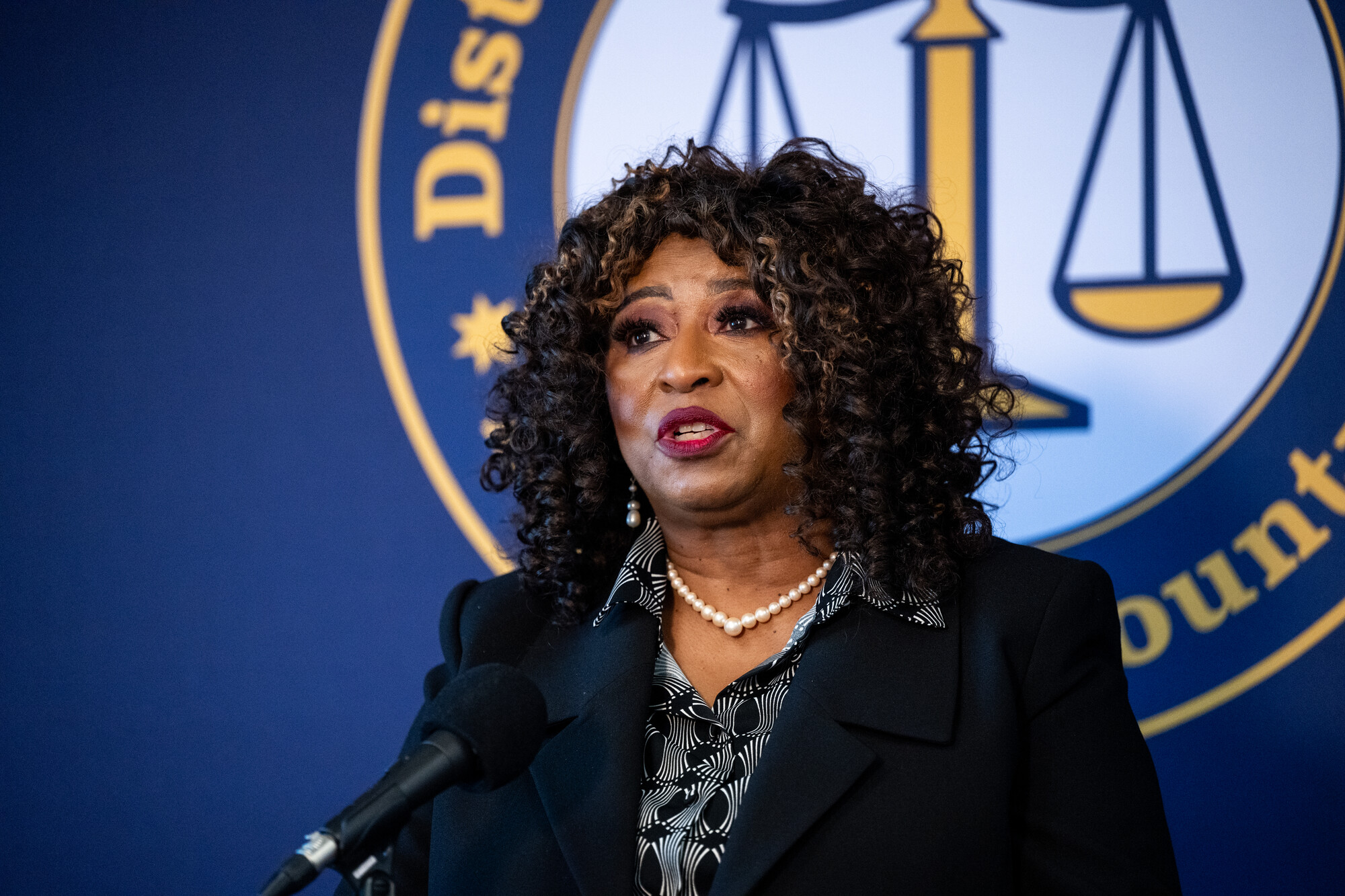 Former Alameda County District Attorney Pamela Price speaks to reporters during a briefing in Oakland on Oct. 21, 2024. (Beth LaBerge/KQED) Former Alameda County District Attorney Pamela Price speaks to reporters during a briefing in Oakland on Oct. 21, 2024. (Beth LaBerge/KQED)
Rains argued that Fletcher didn’t stand to have a fair trial under Price, who had worked as a progressive prosecutor before taking over the district attorney’s office.
The motion was granted in March 2024, but the case returned to Alameda County this year when Reardon pointed out that voters had recalled Price.
After current District Attorney Ursula Jones Dickson inherited the case earlier this year, her office discovered that prosecutors under Price had sought opinions from several police use-of-force experts who concluded Fletcher’s actions were not criminal, according to court filings.
Those opinions were not disclosed to the defense — a violation of the district attorney’s discovery obligations, both sides now agree.
Fletcher’s defense filed a voluminous motion to dismiss in August, which was heard on Friday.
Three former employees under Price invoked their Fifth Amendment right against self-incrimination at the start of the hearing, including Zachary Linowitz, who previously oversaw the case, and James Conger, the former head of the unit in charge of cases against public officials.
“I stand before you in a position where I’ve never stood before,” Deputy District Attorney Casey Bates told the judge, “bringing forth what appears to be misconduct of others in my office. I’ve never been in a court where colleagues of mine asserted their right against self-incrimination. But that happened not just once, but three times.”
Referring to one of the suppressed expert opinions, Bates said, “Your honor, I believe they received information they didn’t want to hear.”
“I don’t know where you get that,” Reardon said, repeatedly indicating that he was unconvinced that former prosecutors had committed any so-called Brady violations for failing to disclose evidence to the defense.
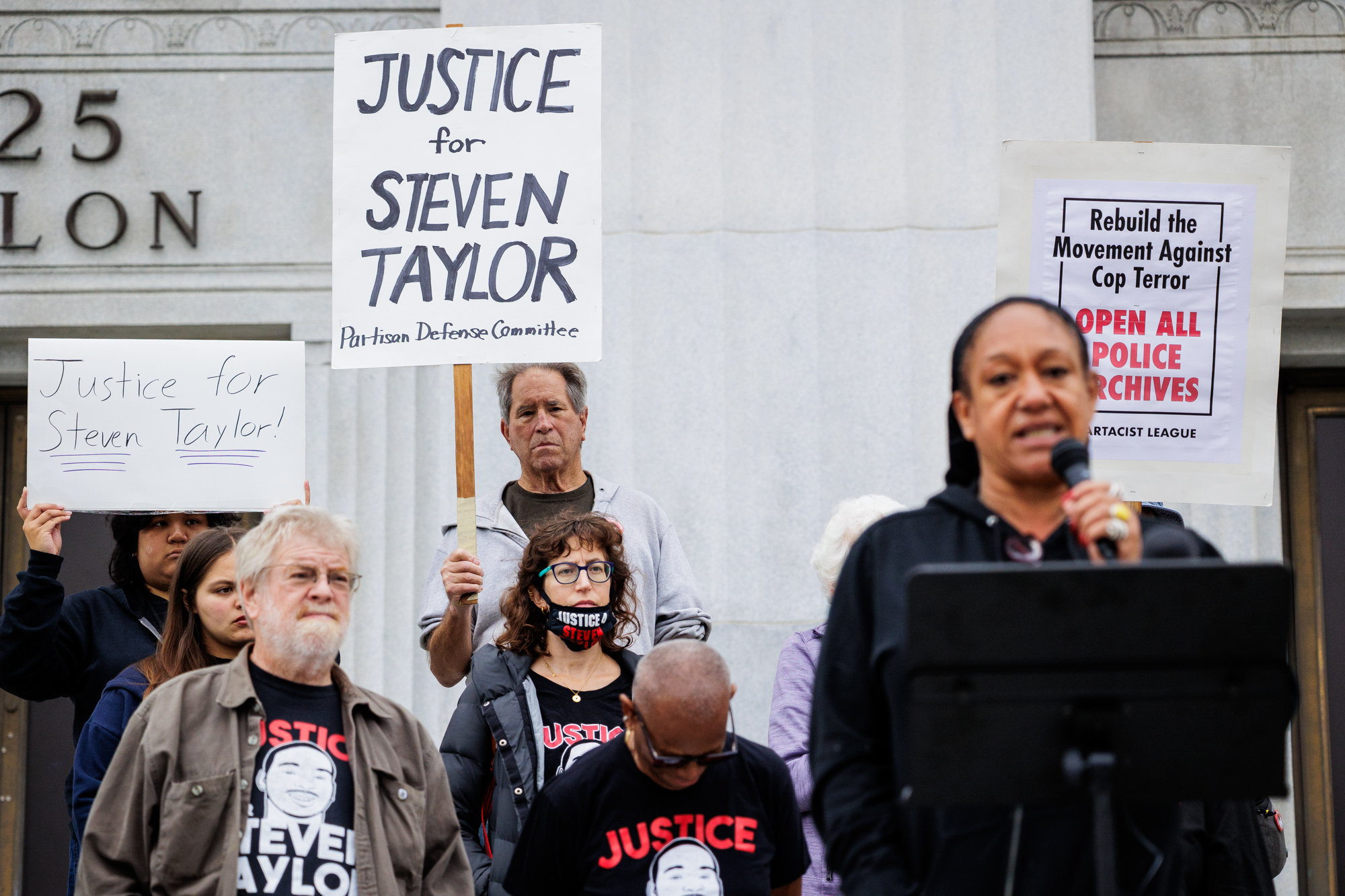 Cat Brooks speaks at a rally in front of the Rene C. Davidson Courthouse in Oakland on Sept. 12, 2025. (Martin do Nascimento/KQED) Cat Brooks speaks at a rally in front of the Rene C. Davidson Courthouse in Oakland on Sept. 12, 2025. (Martin do Nascimento/KQED)
Reardon grilled Bates on whether the district attorney’s office agreed with the defense on any of three reasons to dismiss the case: due process violations, gross governmental misconduct or “in the interests of justice.”
“I agree that there has been outrageous prosecutorial misconduct,” Bates said. “I don’t know if it rises to the level of dismissal. I think that’s for the court to decide.”
The judge became more terse when Bates declined to state a clearer position. “You won’t answer the court’s question, so I think I’m done with you,” he said.
Taylor’s mother and grandmother said after the hearing that they were grateful for the judge.
“The judge did the DA’s job,” Taylor’s grandmother, Addie Kitchen, said. “The judge had to step up and do his damn job.”
Reardon ultimately found there had been no Brady violation and ruled that any misconduct did not warrant dismissing the case. He also declined to use his discretion to end the prosecution.
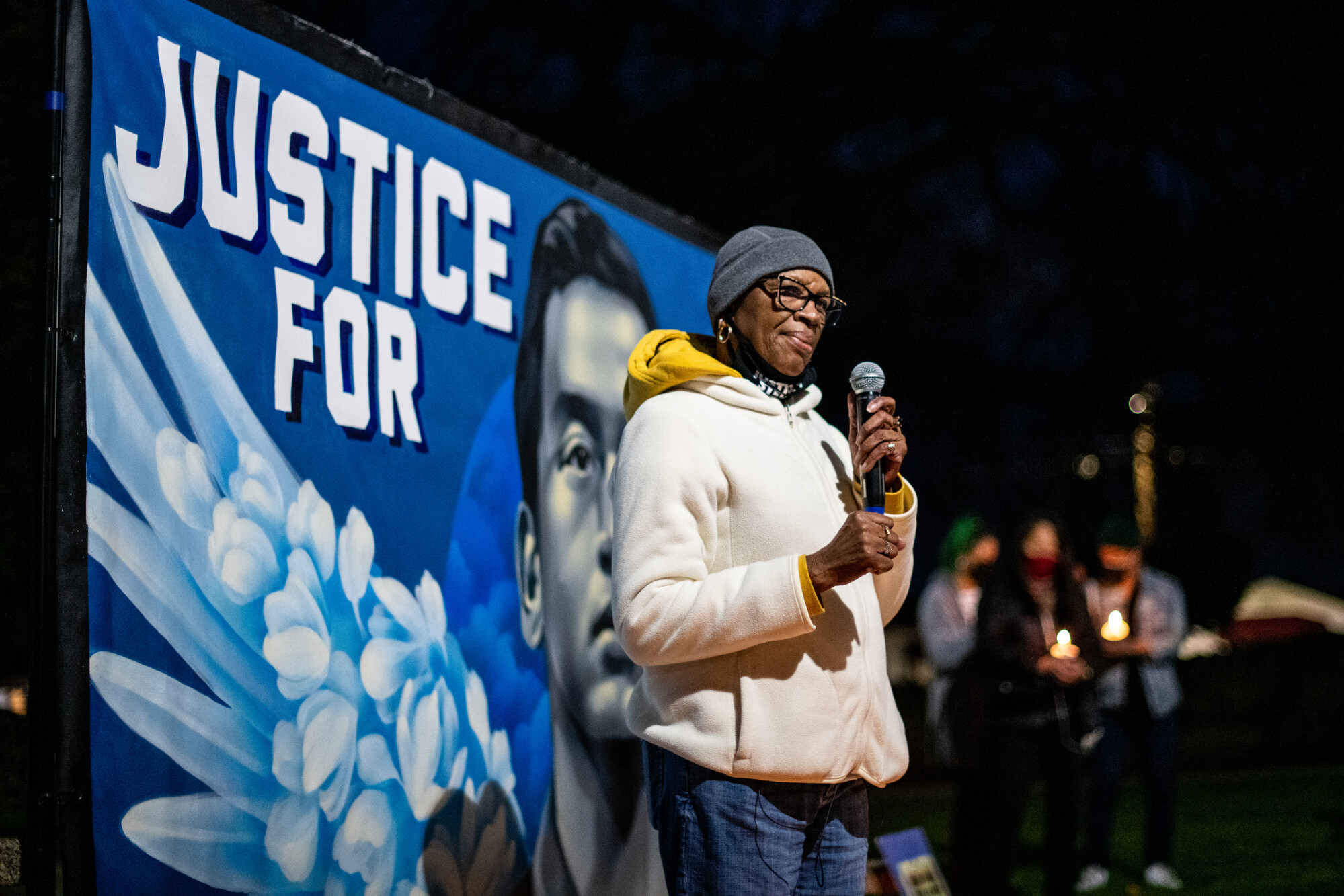 Addie Kitchen, Grandmother of Steven Taylor, speaks during a candlelight vigil in remembrance of Angelo Quinto at Antioch City Park on March 10, 2021. Quinto died last December after his family says Antioch Police kneeled on his neck. (Beth LaBerge/KQED) Addie Kitchen, Grandmother of Steven Taylor, speaks during a candlelight vigil in remembrance of Angelo Quinto at Antioch City Park on March 10, 2021. Quinto died last December after his family says Antioch Police kneeled on his neck. (Beth LaBerge/KQED)
“I want 12 citizens of the county to opine,” he said. “They may just have a difficult case, and they may just have to try it.”
Taylor’s family and civil rights groups, including the Oakland-based Anti Police-Terror Project, accused the District Attorney’s Office of “not seeking justice for Steven Taylor but … instead protecting the officer who killed him” in the days leading up to the hearing.
“I have no confidence in Mr. Bates,” Kitchen said. “I’m glad that the judge felt the need to present the case to a jury. Let the jury make a decision.”
KQED’s Katie DeBenedetti contributed to this story. |



.png)
 More
More
 Religion & Spirituality
 Education
 Arts and Design
 Health
 Fashion & Beauty
 Government & Organizations
 Kids & family
 Music
Music News & Politics
 Science & Medicine
 Society & Culture
 Sports & Recreation
 TV & Film
 Technology
 Philosophy
 Storytelling
 Horror and Paranomal
 True Crime
 Leisure
 Travel
 Fiction
 Crypto
 Marketing
 History
 Comedy
 Arts
Arts Games & Hobbies
 Business
 Motivation