|
If you’re one of the 5.5 million Californians who use CalFresh — the state’s version of the Supplemental Nutrition Assistance Program, sometimes referred to as food stamps — you should now expect your November SNAP payments on your EBT card to be “delayed” due to the ongoing federal government shutdown, according to the state.
Gov. Gavin Newsom’s office had warned Monday that the shutdown would “likely delay food benefits” in November for CalFresh recipients “if President Trump and Congress do not reopen the federal government by October 23, or take action to fund benefits.”
Around the state, food banks are now preparing to meet the needs of people who will almost certainly see their access to food greatly reduced over the next few weeks, with the Thanksgiving holidays fast approaching.
Jump straight to:
What should people on CalFresh know right now?
Bacho said the current situation mirrors the jump in demand she and her colleagues saw in 2023, when COVID-19 era emergency allotments were removed from SNAP benefits. “That’s really concerning, because we already are serving 1 in 6 of our neighbors,” she said.
“We’re back up to serving the same number of people we served at the height of the pandemic, about a half million people a month,” said Bacho.
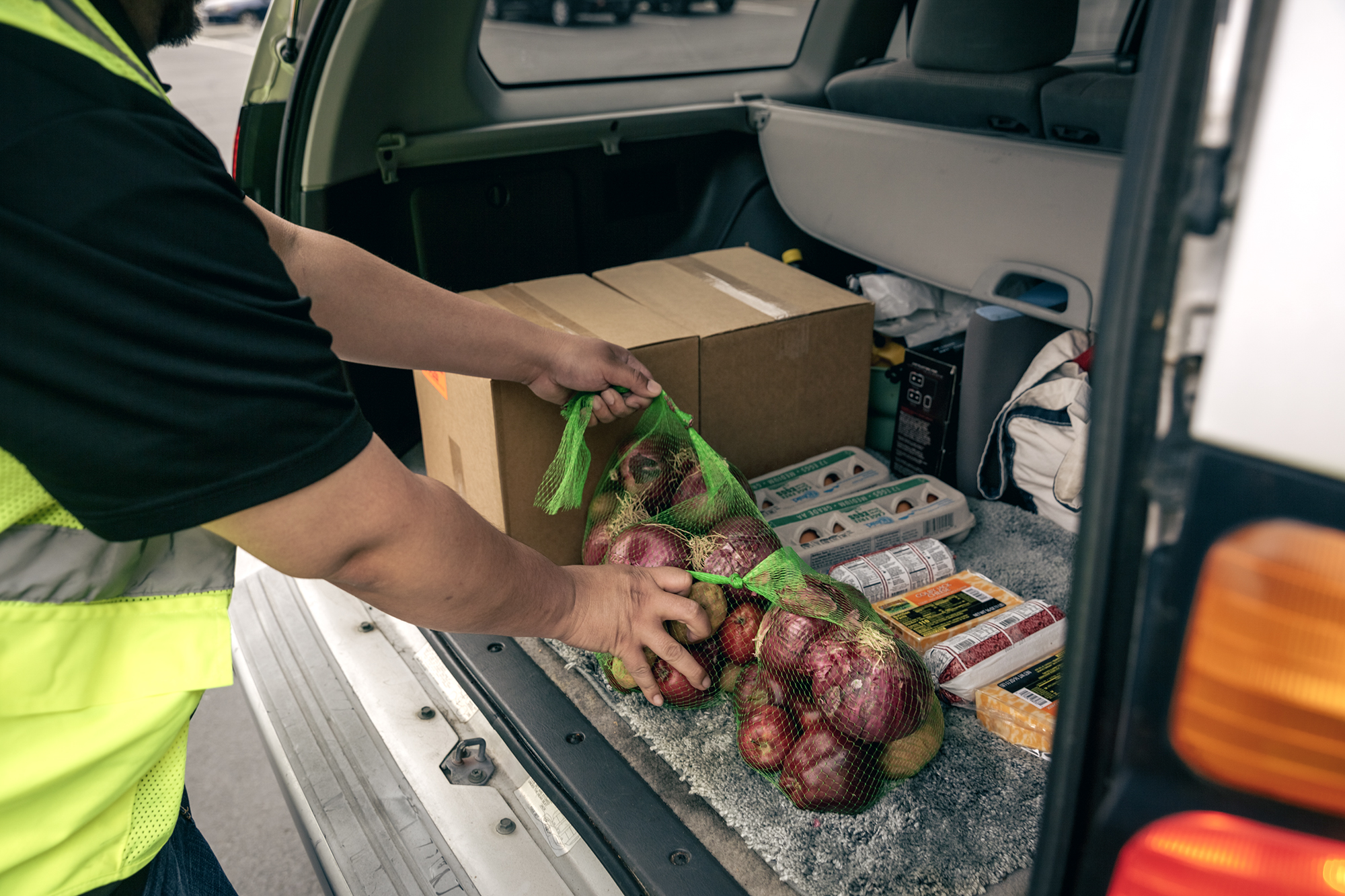 Food Bank of Contra Costa and Solano volunteers and staff load groceries into cars in Vallejo on June 7, 2023. (Shelby Knowles/CalMatters) Food Bank of Contra Costa and Solano volunteers and staff load groceries into cars in Vallejo on June 7, 2023. (Shelby Knowles/CalMatters)
Keep reading for where to find a food bank near you at this time, as well as what staff want you to know about using a food bank if it’s your first time.
(And if you’d like to volunteer at a food bank to support their efforts right now, read our guide to what nonprofits say helps them most when it comes to volunteering.)
What to know about your first food bank visit
Make the most of helplines and online “find food” tools
Many food banks have phone hotlines that can assist callers in finding food nearby. ACCFB’s helpline — 1-510-635-3663, open Mon-Fri 9 a.m.–4 p.m. — is available in multiple languages and promises to connect callers “to a source for groceries or a hot meal the same day you call us.” You can also search online using ACCFB’s FoodNow.net tool for food sources near you.
Second Harvest similarly has a Find Food online search tool, and you can call their Food Connection helpline at 1-800-984-3663 (or email foodconnection@shfb.org.)
Helplines like ACCFB and Second Harvest’s can help you find other sources of food nearby beyond the bigger food banks. “Definitely utilize the resources in the community, like our food pantries, if you can go,” said Maria Gutierrez, outreach associate at ACCFB.
Be aware of any guidelines or limits on how many times you can visit
Different food banks and pantries may have different rules on how often a person can pick up food, although some have no limits.
“I know for most of the pantries that we refer clients to, they can go once or twice a month,” said Gutierrez.
Know about home delivery options
Some food banks, including ACCFB, will make home deliveries if you’re physically unable to get to the food bank location.
Don’t be deterred or feel you shouldn’t use a food bank
“I would say to not be afraid to ask for resources,” said Gutierrez. “I know that there’s a lot of stigma around utilizing these resources.”
“Just go, take advantage of the resources that are available to you,” she advised. “Stay positive and in community.”
Gomez wants first-time visitors to food banks to know that staff and volunteers that work at food banks “are providing the assistance with love and empathy,” she said.
“There are a lot of people that have big hearts and are doing everything that we can to ensure that people don’t miss meals,” said Gomez.
Gomez also confirms that you won’t be asked about your documentation status in the U.S. when using ACCFB, and that you can request information via their hotline and the FoodNow.net tool anonymously.
You may see the California National Guard behind the scenes
Gov. Gavin Newsom has activated the California National Guard to support some food banks around the state during the federal government shutdown. This is similar to how the National Guard were used to assist California food banks in March 2020 at the start of the COVID-19 pandemic, said Major General Matthew P. Beevers, adjutant general for the California National Guard. “The California Military Department, under the direction of the Governor’s Office, is proud to support food bank operations across the state,” said Beevers.
Assemblymember Alex Lee (D-San José), who chairs the state Legislature’s Human Services Committee with oversight of CalFresh policy, said that per Newsom’s office, the state guard “won’t be armed” when serving at food banks and will be more in behind-the-scenes logistical roles rather than being “civilian-facing.”
Lee said he also anticipated that the state guard would be “very few in numbers” at each food bank, because of the sheer number of organizations around the state needing help. And people there to use the food bank’s services “should not confuse [them] with federal troop deployment, federal agents, or ICE,” he said.
The California National Guard won’t be at every food bank, either. For example, Gomez confirms that right now, “ACCFB is not planning to utilize that resource.”
Check if you’re eligible for food assistance through WIC too
The Women, Infants and Children Supplemental Nutrition Program (WIC) provides food assistance to lower-income families who have young children or are expecting a new child, including grandparents. Like CalFresh, it’s federally funded and income-based, and you can receive WIC benefits on top of your CalFresh benefits — but unlike CalFresh, the state has confirmed that November WIC payments won’t be affected during the shutdown.
See if you qualify for WIC.
Where can I find a food bank near me?
Most food banks are not the actual site to get your meals, but rather a distributor to participating organizations, nonprofits and churches.
Major food banks, like the SF-Marin Food Bank or the California Association of Food Banks, will likely have a tool online that can help you locate food resources near you. These maps or search engines can list locations ranging from large operations to small community fridges.
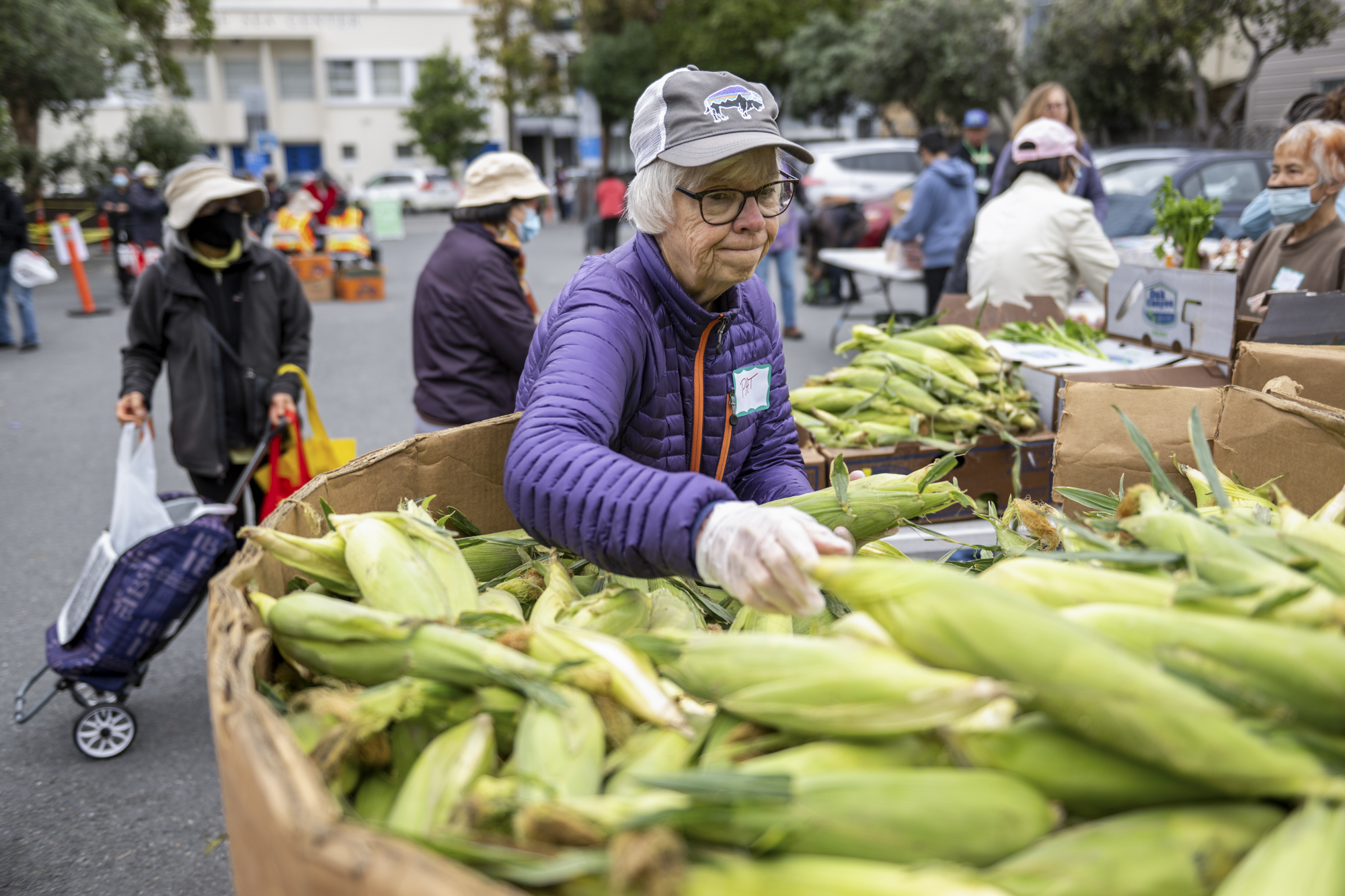 Volunteers distribute food items at a San Francisco-Marin Food Bank pop-up pantry in the Richmond District of San Francisco on June 13, 2023. (Beth LaBerge/KQED) Volunteers distribute food items at a San Francisco-Marin Food Bank pop-up pantry in the Richmond District of San Francisco on June 13, 2023. (Beth LaBerge/KQED)
Another way to find a food bank or distribution center is to call the state’s 211 hotline.
Once you find a spot, be sure to check out the food bank or pantry online before heading out. Note what hours they are open, and for how long. Some locations are open to anyone and to walk-ins, but some may require people to register for a spot beforehand or live in a specific zip code.
Here are just some of the food banks and pantries around the Bay Area:
San Francisco
East Bay
North Bay
South Bay
KQED’s Nastia Voynovskaya and Amanda Hernandez contributed reporting to this story. |



.png)
 More
More
 Religion & Spirituality
 Education
 Arts and Design
 Health
 Fashion & Beauty
 Government & Organizations
 Kids & family
 Music
Music News & Politics
 Science & Medicine
 Society & Culture
 Sports & Recreation
 TV & Film
 Technology
 Philosophy
 Storytelling
 Horror and Paranomal
 True Crime
 Leisure
 Travel
 Fiction
 Crypto
 Marketing
 History
 Comedy
 Arts
Arts Games & Hobbies
 Business
 Motivation