|
The man shot near San Francisco’s Civic Center Plaza on Friday was on the job as a street ambassador for Urban Alchemy — a nonprofit contracted by the city to help improve safety and cleanliness on downtown streets.
His death marks the latest in a series of difficulties that the organization, once heralded for its breakthrough community-centered approach to tackling homelessness and drug use, has faced in recent years.
Joey Alexander, 60, was manning his usual post outside San Francisco’s main public library on Larkin Street just before 5 p.m. Friday when he was shot during an exchange with a man allegedly using drugs on the street.
The nonprofit said Alexander approached Edmund Bowen, 42, and asked him not to use drugs in the public space. Bowen then allegedly pulled a shotgun out of his bag, said “F— Urban Alchemy, and shot Alexander at close range.
“Mr. Alexander was a beloved member of our team, and it’s a devastating loss,” said Jess Montejano, a spokesperson for the nonprofit. “[He] was an exceptional employee, … loved his job, loved giving back and serving the community and doing his work. [He was] just beloved among everyone that worked with him and that knew him.”
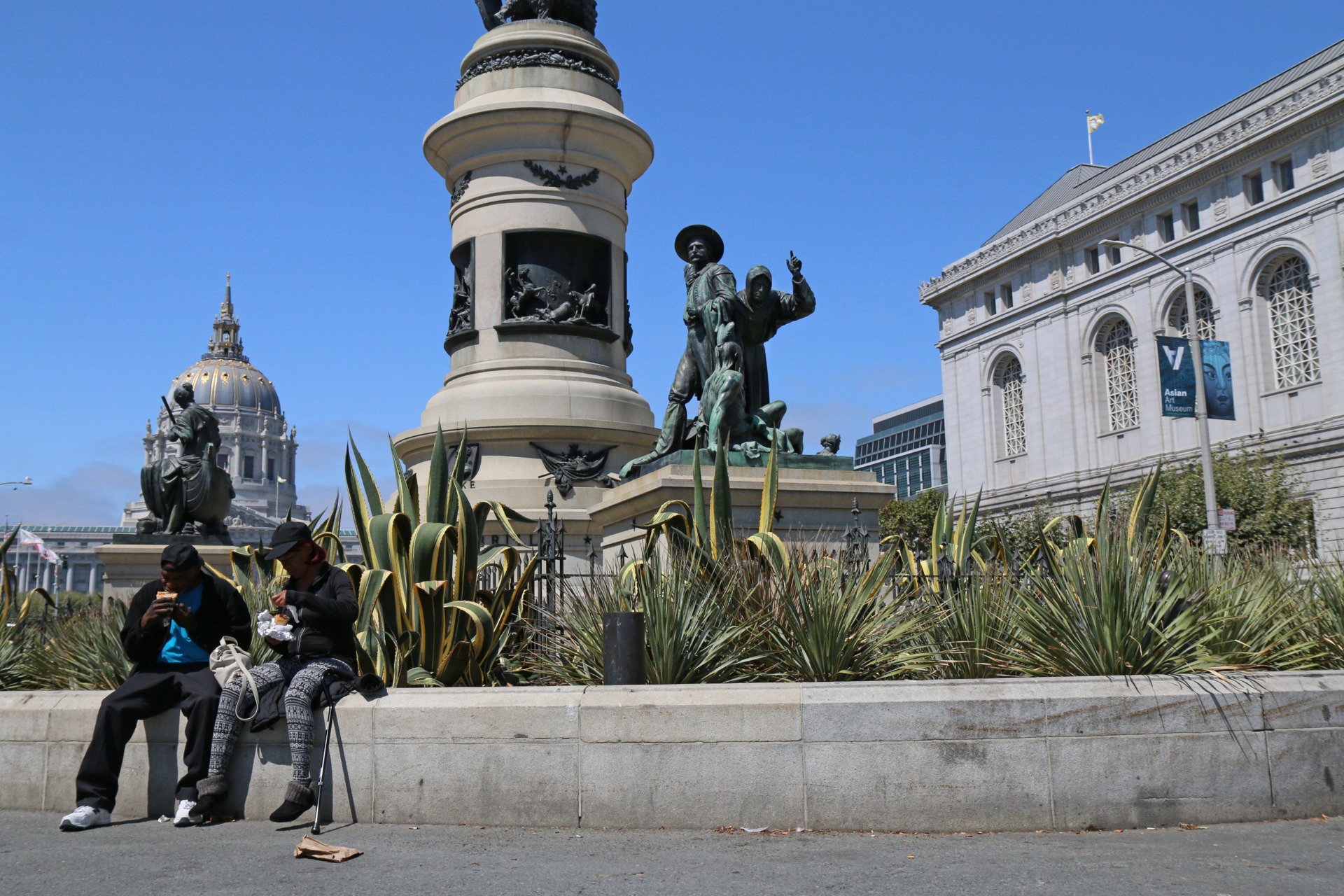 Two people sit on the base of the Pioneer Monument in the Civic Center on Aug. 22, 2017. (Arash Malekzadeh/KQED) Two people sit on the base of the Pioneer Monument in the Civic Center on Aug. 22, 2017. (Arash Malekzadeh/KQED)
Like many Urban Alchemy employees, Alexander had lived through some of the same challenging experiences — like homelessness, addiction and incarceration — as the people he aimed to serve, Montejano said.
According to the San Francisco Chronicle, Alexander had previously spent 23 years in prison. Now an Oakland resident, Alexander worked for Urban Alchemy as a “street practitioner” for more than two years.
“Our entire team really shares a higher purpose of giving back to the community and serving these vulnerable populations because many of them share that same experience that these people in crisis are going through themselves,” Montejano said.
While many street practitioners are able to connect with people and manage crises based on their own life experience, Montejano said the employees, who do not have law enforcement training, are sometimes put in dangerous situations.
Alexander is at least the third Urban Alchemy employee to be shot on the job. Montejano said he believes he’s the first to die from related injuries.
“Our practitioners serve some of the most tough neighborhoods impacted by addiction, poverty, homelessness and crime in San Francisco,” he said. “They are trained with their lived experience … to bring more peace, safety and cleanliness on the streets. It’s an unfortunate reality that, yes, we do experience hate and sometimes violence in the line of work that we do.”
Alexander was rushed to the hospital after the shooting and received treatment for multiple days before he passed away on Tuesday, Montejano said. Bowen was arrested shortly after the shooting and has remained in custody since. After Alexander’s death, SFPD said it was working with investigators to update the charges against him to reflect the murder.
The shooting comes at an inflection point for Urban Alchemy.
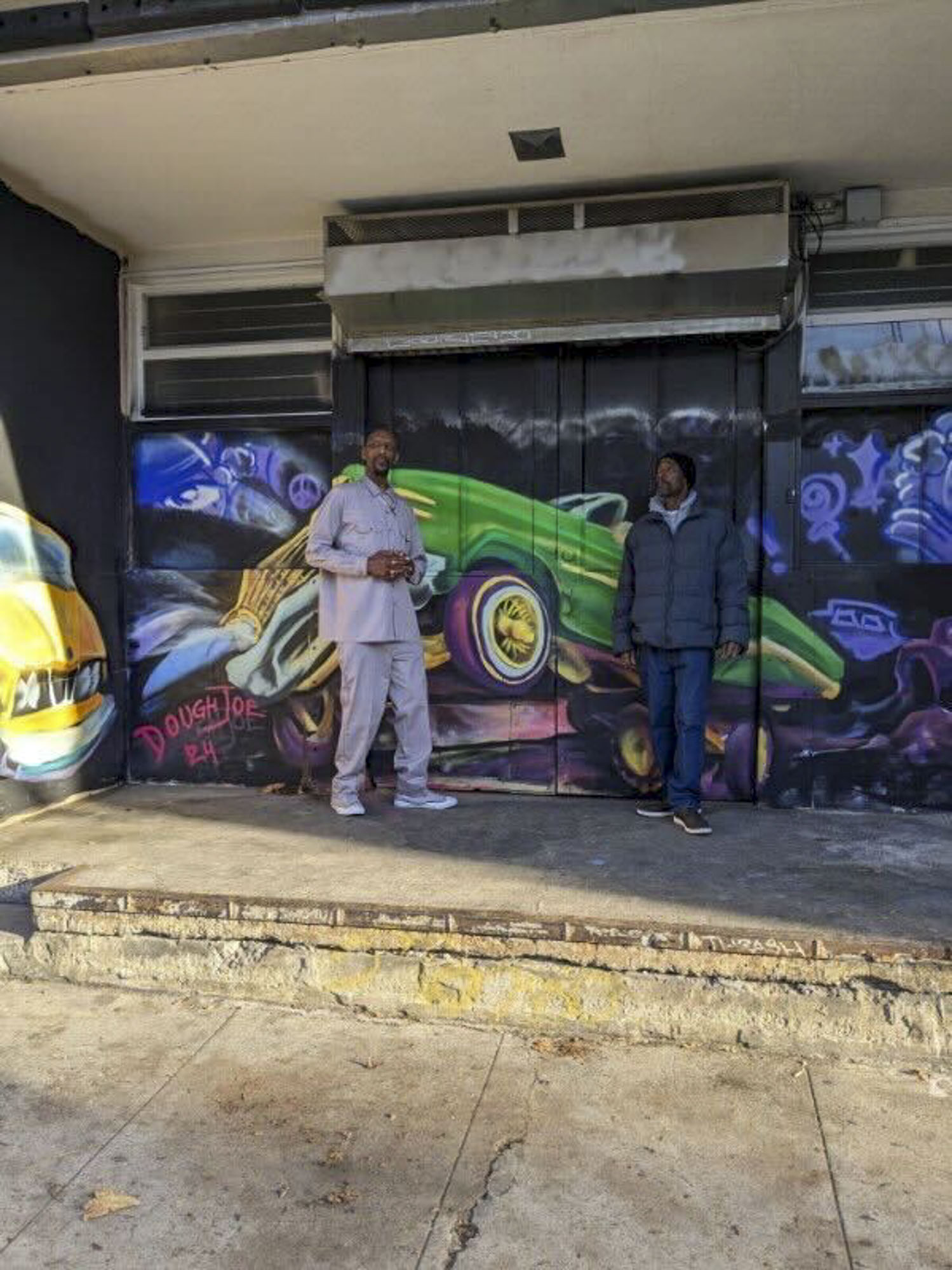 Colleagues said Joey Alexander, left, was a beloved coworker and friend. (Courtesy of Urban Alchemy) Colleagues said Joey Alexander, left, was a beloved coworker and friend. (Courtesy of Urban Alchemy)
San Francisco first contracted with a predecessor of the nonprofit, Hunters Point Family, then led by Urban Alchemy’s Executive Director, Dr. Lena Miller, in 2014. At the time, it was tasked with operating and cleaning public toilets throughout the city overnight.
Since its founding in 2018, Urban Alchemy’s responsibilities have steadily mounted, from stationing practitioners during daytime hours downtown to dissuade public drug use and clean up streets to operating safe RV parking sites and homeless shelters.
The organization has expanded to nine cities in six states, and received praise from former Mayor London Breed and community activists in the Tenderloin. A 2024 Stanford University study found that when its practitioners are present on street corners, crime dropped significantly.
But it’s also struggled to live up to its lofty mission in recent years. Friday’s tragic incident comes as the nonprofit has faced backlash for overspending, management struggles and employee misconduct allegations.
In April, Urban Alchemy lost contracts with Bay Area Rapid Transit to provide bathroom and elevator attendants at San Francisco stations and in August, the city placed it on a nonprofit “watch list,” citing serious fiscal or programmatic concerns.
In September, the San Francisco Chronicle reported that the organization gave staff pay raises that overspent its contract to operate a shelter in Lower Nob Hill by about $800,000, despite warnings not to by city analysts. The nonprofit disputed the claim, saying it requested $800,000 in budget increases after being asked to run a larger operation but overspent by only $336,000.
At the end of last month, Austin, Texas, opted not to renew contracts with the company to operate emergency centers after finding it misrepresented client exit data, according to the Austin American-Statesman.
 The dormitory at the Embarcadero SAFE Navigation Center at the corner of Embarcadero and Beale Street in San Francisco on Jan. 30, 2020. San Francisco plans to expand a program pairing shelter beds at the Adante Hotel on Geary Street in Lower Nob Hill with access to addiction treatment, to intervene in the city’s drug crisis. (Beth LaBerge/KQED) The dormitory at the Embarcadero SAFE Navigation Center at the corner of Embarcadero and Beale Street in San Francisco on Jan. 30, 2020. San Francisco plans to expand a program pairing shelter beds at the Adante Hotel on Geary Street in Lower Nob Hill with access to addiction treatment, to intervene in the city’s drug crisis. (Beth LaBerge/KQED)
Last year, the city controller in Los Angeles, another of Urban Alchemy’s outposts, launched an investigation into the organization after a video circulated of an employee spraying water toward an unhoused person as they scrambled to collect their things on a sidewalk in the Skid Row neighborhood, the Los Angeles Times reported. Urban Alchemy denounced the incident at the time and said that it had fired the involved employee.
Last February, a man who had lived at a homeless encampment in Sausalito managed by Urban Alchemy filed a lawsuit alleging that an employee assaulted him after raising concerns that the nonprofit’s staff had engaged in dealing methamphetamine and sexually exploited unhoused residents. Urban Alchemy said it is seeking to have the suit dismissed and noted the court has already dismissed multiple of the initial complaints.
Montejano said the nonprofit’s “community-based” safety models are proven and data-driven. He said he doesn’t expect Alexander’s death to mean any change in the way it operates.
“We’re doubling down on the mission and the model, and we’re making sure that Mr. Alexander’s death isn’t in vain,” he told KQED. “We always train our employees to be safe; we are not the police. But we’re going to continue to work on our mission, our model that we know is effective, and providing safety, cleanliness and connections to care and support, and housing in some instances, for the communities that we serve.” |



.png)
 More
More
 Religion & Spirituality
 Education
 Arts and Design
 Health
 Fashion & Beauty
 Government & Organizations
 Kids & family
 Music
Music News & Politics
 Science & Medicine
 Society & Culture
 Sports & Recreation
 TV & Film
 Technology
 Philosophy
 Storytelling
 Horror and Paranomal
 True Crime
 Leisure
 Travel
 Fiction
 Crypto
 Marketing
 History
 Comedy
 Arts
Arts Games & Hobbies
 Business
 Motivation