|
Despite Californians widely demanding action on homelessness, the budget state lawmakers are close to passing for the next fiscal year includes almost nothing to fund homelessness services.
As the state faces a $12 billion shortfall, the current budget guts the Homeless Housing, Assistance and Prevention grant program — which many housing advocates consider one of the most critical state-led programs funding homelessness services.
“We’re just not going to be able to sustain the solutions that we already have in place,” Edie Irons, a spokesperson for housing advocacy group All Home, told KQED. “Shelters will close, services will end, folks won’t get the help that they need that they’re currently able to get.”
Last year, Gov. Gavin Newsom urged local governments across the state to crack down on homeless encampments following a Supreme Court ruling expanding cities’ ability to fine and jail people living outside, even if no shelter is available. The cuts come as Newsom calls for cities and municipalities to take responsibility for funding and managing homelessness services.
“The fact is, addressing homelessness is primarily a local issue,” Tara Gallegos, deputy director of communications for Gov. Gavin Newsom, said in a statement to KQED, responding to questions from cities about the elimination of HHAP funding.
 Gov. Gavin Newsom discusses his revised 2024–25 state budget during a news conference in Sacramento, California, on May 10, 2024. (Rich Pedroncelli/AP Photo) Gov. Gavin Newsom discusses his revised 2024–25 state budget during a news conference in Sacramento, California, on May 10, 2024. (Rich Pedroncelli/AP Photo)
Since its inception six years ago, the HHAP program has provided funding to support constructing permanent housing, improving shelters and incentivizing landlords to rent to people experiencing homelessness, among other services. Carolyn Coleman, CEO and executive director for the League of California Cities, said the program has become an important tool for cities because its funding can support a variety of services.
“One of the reasons why HHAP has been so effective is because it has some flexibility that can be tailored to fit the local circumstances,” she said.
Luis Alejo, a Monterey County supervisor, said his county has used the grant funding for a number of projects — most recently to partner with the city of Watsonville and open a navigation center there, which would provide people experiencing homelessness room and board while they get help from case workers connecting them with public benefits and healthcare. The center is scheduled to open later this year, but Alejo said the project could be at risk if funding dries up.
“We had to build working relationships, we had to build trust, but having the resources helped us to help that collaboration transition … into shelters and permanent supportive housing,” he said. “If the legislature continues not having a single dollar for the next round of homelessness funding through HHAP, all these projects and all this collaboration will definitely be at risk in the coming months ahead of us,” he said.
According to state data, local governments received more than $600 million during the first round of HHAP funding in 2019. Most of those dollars went toward opening navigation centers and operating costs for new and existing housing and shelters.
During the fifth and latest cycle of funding, the state awarded almost $870 million, though only half of that money has been earmarked for specific uses and a little more than a tenth has been spent already. State officials told KQED the sixth round of grants will be awarded to cities later this year.
Newsom wants local governments to use the money that has been doled out before the state sets aside additional funds. So far, the state has awarded more than $3 billion to the program, with only $1.9 billion spent so far.
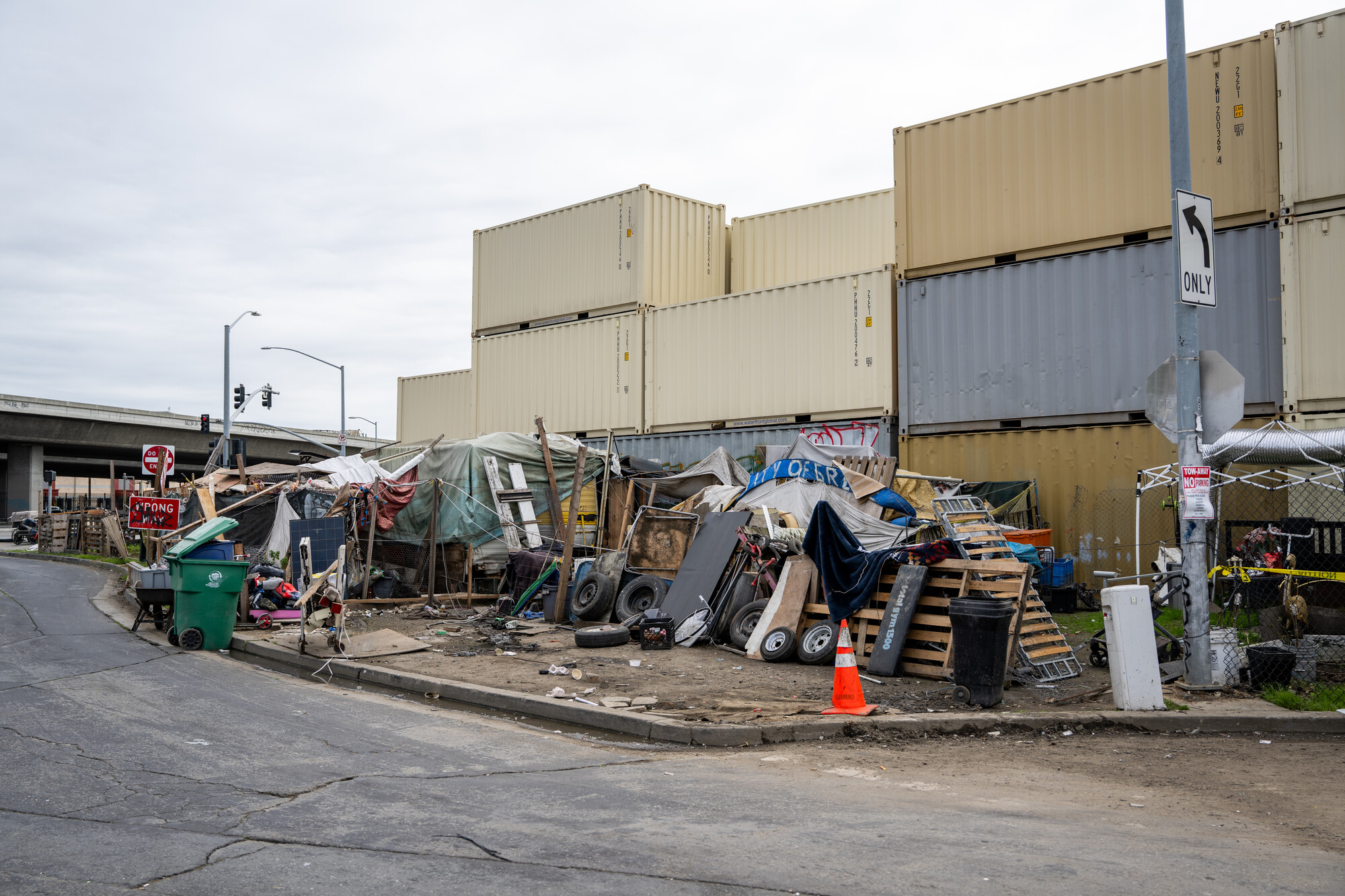 A section of an encampment on Alameda Avenue in Oakland is cleared on March 4, 2025. A shipping container barrier now surrounds the property. (Beth LaBerge/KQED) A section of an encampment on Alameda Avenue in Oakland is cleared on March 4, 2025. A shipping container barrier now surrounds the property. (Beth LaBerge/KQED)
“The Governor expects local governments to use the unprecedented funding already provided to them — including the billions in funding that has been allocated to locals but not yet spent — to get people off the streets and connected to the help they need,” Gallegos said.
Earlier this year, Newsom announced that California had dramatically slowed the growth of homelessness to a statewide increase of 3%. While the state is still home to the largest number of people experiencing homelessness, according to federal data, its rate is far lower than the national rate of 18%.
“It’s not great news — we want to see an actual reduction,” Irons said. “But holding the line in the state with the largest homeless population in the country is an accomplishment, sadly. And we won’t be able to sustain that progress or improve upon it without more funding to continue the solutions that are working.”
In the remaining weeks before the budget is finalized, housing advocates are hoping to strike the right deal with lawmakers and the governor to secure HHAP funding for the future. |



.png)
 More
More
 Religion & Spirituality
 Education
 Arts and Design
 Health
 Fashion & Beauty
 Government & Organizations
 Kids & family
 Music
Music News & Politics
 Science & Medicine
 Society & Culture
 Sports & Recreation
 TV & Film
 Technology
 Philosophy
 Storytelling
 Horror and Paranomal
 True Crime
 Leisure
 Travel
 Fiction
 Crypto
 Marketing
 History
 Comedy
 Arts
Arts Games & Hobbies
 Business
 Motivation