|
Dive teams on Sunday night recovered the body of one of two people who were missing after a power boat capsized on Lake Tahoe during a powerful weekend storm, authorities said, bringing the death toll to seven.
Ten people were on the 27-foot Chris-Craft Launch 27 when it flipped near D.L. Bliss State Park amid the surprise storm on Saturday afternoon. Two were rescued and taken to a hospital, and one is still missing.
The El Dorado County Sheriff’s Office said it is continuing search and rescue efforts on Monday, coordinating with the Washoe County, Nevada, and San Joaquin County sheriff’s offices in hopes of finding the final missing adult after the U.S. Coast Guard suspended its search on Sunday morning.
The identities of the deceased boaters will not be released until proper notifications are made, the department said in a statement.
Sheriff’s officials initially found six dead adults and two survivors after responding shortly after 3 p.m. Saturday to reports that a boat had flipped in the waters just northwest of Emerald Bay. That was just about an hour after a strong storm, known as a microburst storm, suddenly began to blow through the region, according to Coast Guard Petty Officer 3rd Class Hunter Schnabel.
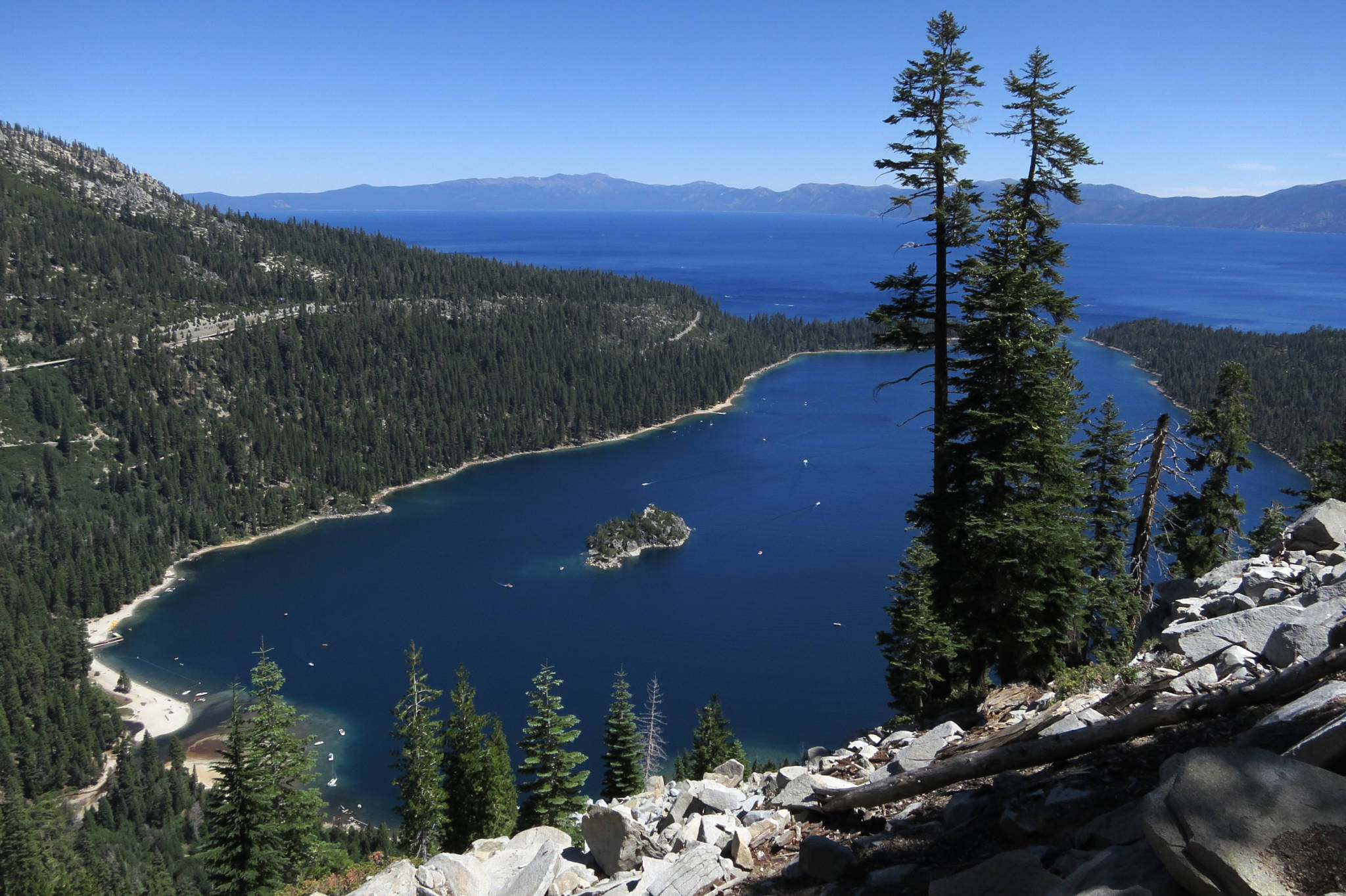 Emerald Bay lies under blue skies at Lake Tahoe. (Sean Gallup/Getty Images) Emerald Bay lies under blue skies at Lake Tahoe. (Sean Gallup/Getty Images)
The overturned vessel was roiled by waves up to 10 feet high, and winds were gusting up to 35 mph at the time, the Coast Guard said.
Throughout the previous week, waves had remained below a half-foot near the location of Saturday’s accident, according to data from the UC Davis Tahoe Environmental Research Center.
“Unfortunately, even if you were paying attention to the forecast, you probably would not have seen this coming,” Schnabel said, adding that the speed at which conditions deteriorated was unusual.
So was the storm’s wind pattern, which intensified wave heights, according to Matthew Chyba, a meteorologist in the National Weather Service’s Reno office.
Whereas winds above Lake Tahoe usually blow southwest to northeast, Saturday’s storm brought north-to-south gusts, spanning the longest direction of the oval-shaped lake.
“The winds just push the water from one side of the lake going to the other, and it just builds up and waves’ heights get higher and higher,” Chyba said.
The area where the boat sank, near Emerald Bay, is on the southern end of the 22-mile-long lake.
A sharp drop in temperature in Tahoe allowed for the storm conditions to sweep in so quickly, Chyba said. Throughout the week, he said, temperatures hovered in the mid-70s to 80s, but on Saturday they dropped to between 15 and 25 degrees below average.
“The system came through and just really, really cooled things down and allowed for conditions to bring these kinds of winds,” he told KQED.
Michael Cane, a lab director and boat captain at UC Davis’s Tahoe research center, said the shoreline where the boat was located is also quite rocky and can be hard to access, which could have made it more dangerous for the people on board to get to shore.
He said the storm came up quickly and could have taken boaters by surprise.
“I run a lot of vessels on the lake, and we’re always looking at the weather and the forecast and paying really close attention to that, because even when you’re about to go on a lake and it’s calm, it can change quickly,” he told KQED.
Cane hopes that those who choose to go out on the lake will take proper precautions, like wearing life vests, and come into shore at the first signs of an approaching storm.
“I pay attention to large clouds falling over the mountains, which could signify thunder showers, or look in the distances to see if there’s whitecaps coming towards me and try to pay attention to those things so that I can avoid getting involved in those dangerous situations,” he said. |



.png)
 More
More
 Religion & Spirituality
 Education
 Arts and Design
 Health
 Fashion & Beauty
 Government & Organizations
 Kids & family
 Music
Music News & Politics
 Science & Medicine
 Society & Culture
 Sports & Recreation
 TV & Film
 Technology
 Philosophy
 Storytelling
 Horror and Paranomal
 True Crime
 Leisure
 Travel
 Fiction
 Crypto
 Marketing
 History
 Comedy
 Arts
Arts Games & Hobbies
 Business
 Motivation