|
My Kickstarter campaign for my travel memoir, Pilgrimage, funded within minutes and raised over £26,000 (over US$31,000) for a niche book in a new market. In this episode, I share my lessons learned and tips for a successful campaign.
In the intro, I mention the 6 Figure Author Podcast, The Writers Well Podcast, and Reid Hoffman's new Possible podcast.
Today's show is sponsored by ProWritingAid, writing and editing software that goes way beyond just grammar and typo checking. With its detailed reports on how to improve your writing and integration with Scrivener, ProWritingAid will help you improve your book before you send it to an editor, agent or publisher. Check it out for free or get 25% off the premium edition at www.ProWritingAid.com/joanna
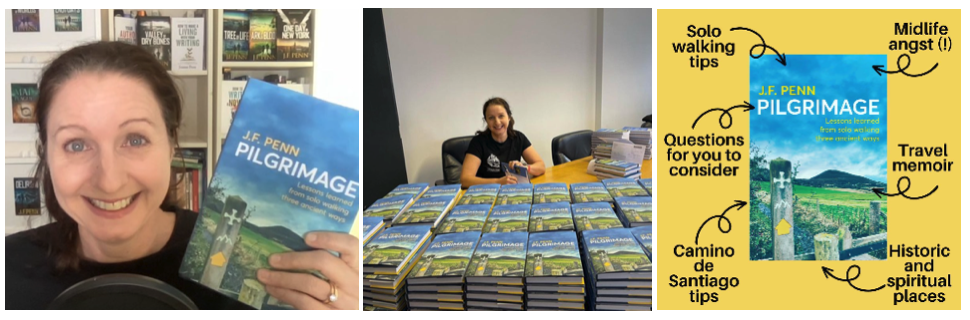
Joanna Penn writes non-fiction for authors and is an award-nominated, New York Times and USA Today bestselling thriller and dark fantasy author as J.F. Penn. She’s also an award-winning podcaster, creative entrepreneur, and international professional speaker. Her latest book is Pilgrimage: Lessons Learned from Solo Walking Three Ancient Ways.
You can listen above or on your favorite podcast app or read the notes and links below. Here are the highlights and the full transcript is below.
Show notes:
- Overview of the Pilgrimage campaign including rewards, add-ons, and the result
- Why Kickstarter for this project, and why now for me
- Tips for success: Learn about the platform beforehand. It is a new ecosystem for authors and different from those we are used to
- Prepare to face your fears
- The importance of getting your costs right in terms of production and international shipping
- Set aside more time than you need
- How did I market the campaign?
- Was it worth it? Will I do another Kickstarter campaign?
- What happens to Pilgrimage now?
If you want to stay in touch, sign up for my free Author Blueprint here, subscribe to The Creative Penn podcast on your favorite app, or follow me on social media.
An overview of the Pilgrimage Kickstarter campaign
I launched my first Kickstarter campaign on 22 January 2023, for my travel memoir, Pilgrimage: Lessons Learned from Solo Walking Three Ancient Ways.
The campaign finished after 14 days on 6 February 2023 with £25,771 (around US$31K) funded from 692 backers.
My initial target was £1000.
I was afraid of failure and not even making that much, plus this book falls between my existing audiences.
It is not a how-to book for authors like my other books as Joanna Penn, and it is not fiction — thriller, dark fantasy, or crime — as J.F. Penn. It was my first memoir, and also about solo walking pilgrimages, which is hardly a mainstream topic!
However, the campaign funded within minutes and it made over £5000 within the first 24 hours. It ended up as 2577% funded at £25,771.
THANK YOU to everyone who supported the campaign. You are amazing and I hope you love the book!
Here’s a graph of the funding and how it went up day by day.
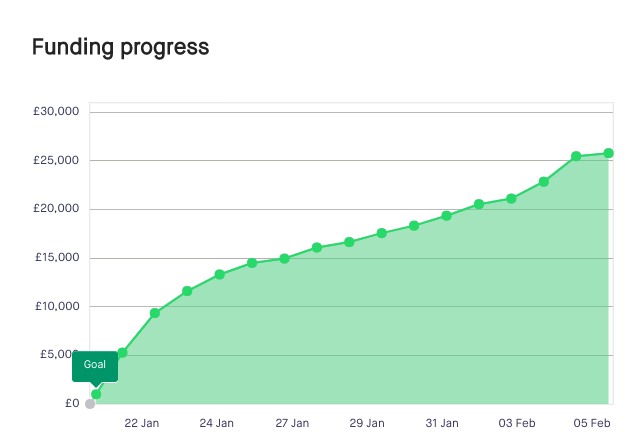 Pilgrimage kickstarter funding progress over the campaign Pilgrimage kickstarter funding progress over the campaign
It went up more steeply at the beginning and then leveled off as expected. Kickstarter has a super useful dashboard view with reporting.
Given how much work the campaign was, I am happy with the two-week period. I don’t think I could have sustained the marketing effort any longer.
What were the different pledge levels and how popular were they?
The different pledge levels were:
No reward, just support for those who wanted to back me but didn't want the book
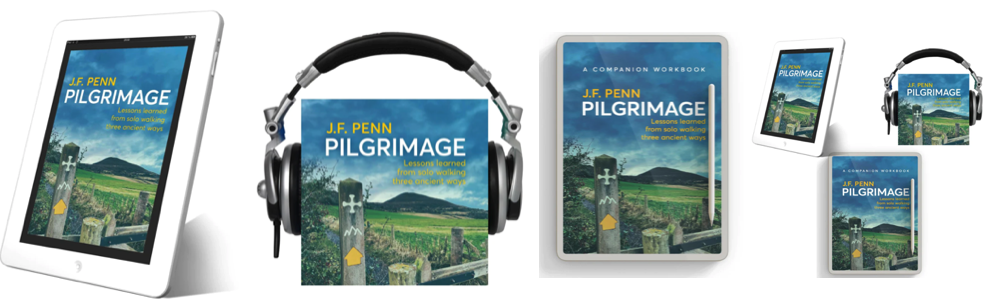 Pilgrimage digital rewards — ebook, audiobook, pdf workbook, digital bundle Pilgrimage digital rewards — ebook, audiobook, pdf workbook, digital bundle
Ebook — delivered by Bookfunnel, read on any device
Audiobook — narrated by me, delivered by Bookfunnel, listen on any device
Digital bundle — includes ebook, audiobook, and digital workbook
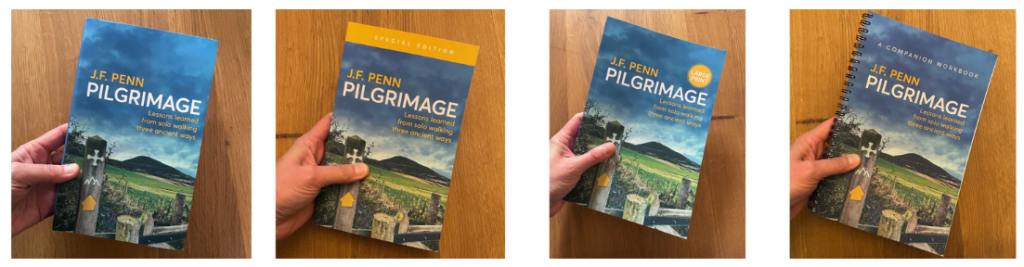
Special edition paperback — this edition with the yellow banner and color interior photos is only available in the Kickstarter and also for sale on my store, CreativePennBooks.com. The paperback version for sale on Amazon and Ingram has a plain B&W interior.
Large print paperback — this edition will be available on all the usual stores
Special edition hardback, signed or unsigned.
This edition has a fly leaf cover, silver foil, and interior color photos. Only available in the Kickstarter and also for sale on my store, CreativePennBooks.com. I will not be doing a hardback through Amazon & Ingram, as the quality is not as good as Bookvault. If you find it for sale elsewhere, then it is a secondhand copy.
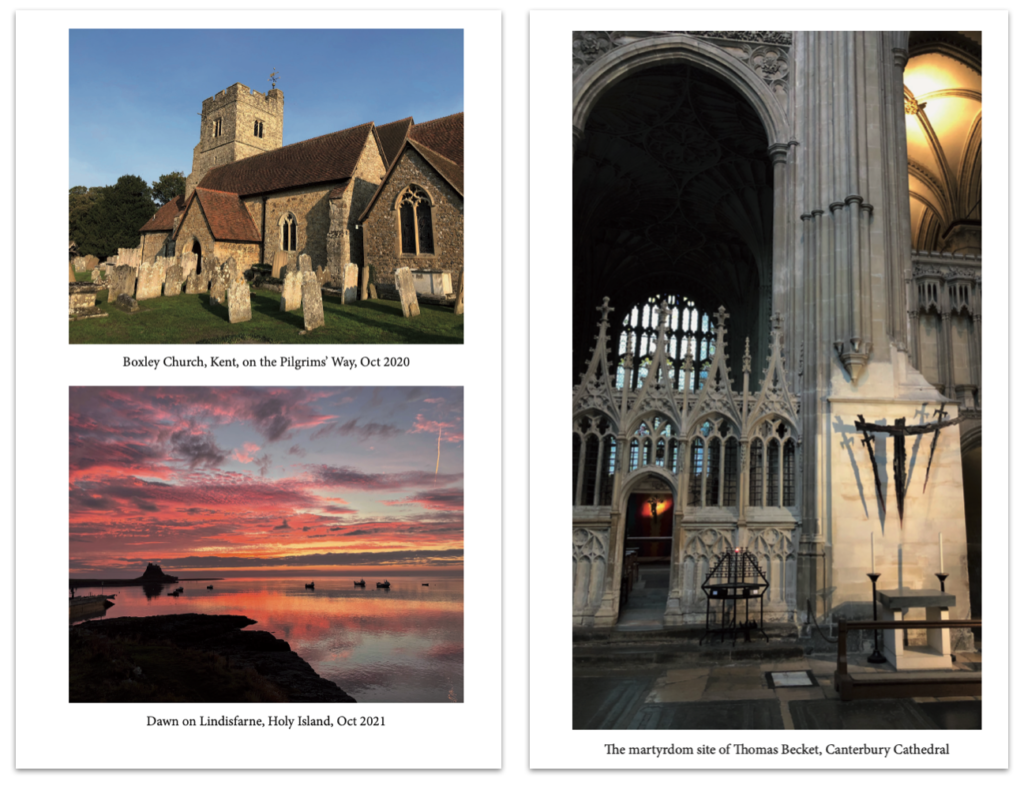 Color interior pages from Pilgrimage Color interior pages from Pilgrimage
Hardback bundle — included signed hardback, spiral-bound workbook, ebook, audiobook, and PDF workbook
Writing Setting Course bundle — included Writing Setting course, and everything in the hardback bundle
Consulting bundle — 90 min zoom consulting call, plus everything in Writing Setting course bundle. Limited to 10.
I also included Add-Ons so people could buy extra editions, or other high-value bundles for my non-fiction and fiction
These included any of the main editions as extra copies as well as the spiral-bound Pilgrimage Workbook, PDF digital Pilgrimage Workbook, and the Writing Setting Course.
I also included bundles for my other books: How to Write Non-Fiction bundle, How to Write a Novel bundle, Mapwalker dark fantasy Trilogy bundle, Brooke & Daniel Crime Thriller Trilogy bundle, and the ARKANE Thriller 12-book ebook bundle.
You can now get all of these on my Bundle page on CreativePennBooks.com in ebook and paperback, and I'm adding audio bundles as well.
This graph shows the pledge levels and the amount of money each level brought in.
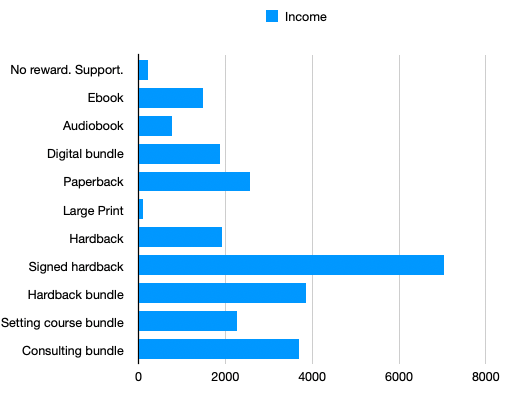 bar chart showing income by reward level bar chart showing income by reward level
The signed hardback, as expected, was the biggest driver of revenue, but that figure also includes shipping costs.
The Large Print edition was not very popular, but I think it’s important to include for accessibility reasons.
I offered the course on Writing Setting and Sense of Place because I was teaching it in Colorado Springs at the Superstars conference, but I hadn’t prepared it in advance.
While I intend to offer courses as part of future projects, I would prepare them in advance next time, as creating this took a lot more time than anticipated after the campaign finished.
I offered 5 consulting sessions initially, but the level sold out straight away, so I raised it to 10, the maximum I want to offer. I will deliver them over the next year.
It was well worth offering all the digital bundles, including the self-help writing and the fiction bundles, as they provided extra revenue during the campaign and were of better value than buying individually on the usual stores.
I’m going to add a lot more bundles to my Shopify store, CreativePennBooks.com in the coming weeks.
How did I do fulfillment?
I used Bookfunnel to deliver all ebooks and audiobooks, as per usual with my direct sales.
I used Teachable for the Writing Setting and Sense of Place course, which is the service I have been using for years now. I created a coupon for 100% off and sent it to the backers at that level.
I used Bookvault.app for the print editions, and they also do the print-on-demand editions for my Shopify store, CreativePennBooks.com.
One of my nightmare scenarios was selling a load of hardback books and then having to spend weeks packaging them up and shipping them around the world.
As much as I wanted to do signed hardbacks, that was a real sticking point, and I even considered not doing it all, or paying someone to come and help me do it. Thankfully, Bookvault helped me out, for which I am very grateful!
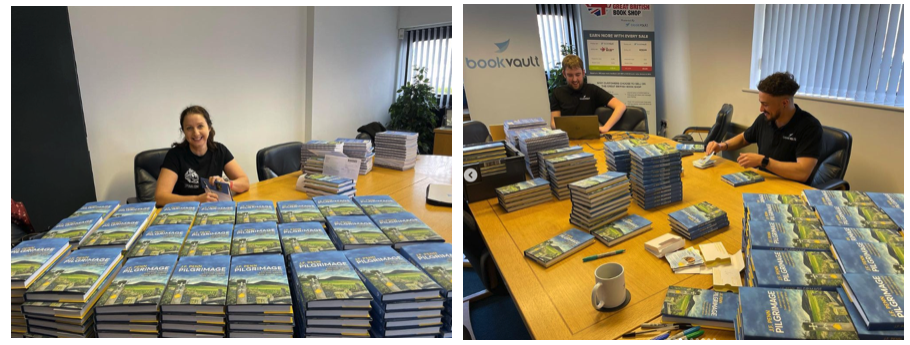 J.F. Penn signing Pilgrimage hardbacks at bookvault, with help from alex and curtis. Thanks guys! J.F. Penn signing Pilgrimage hardbacks at bookvault, with help from alex and curtis. Thanks guys!
They printed the hardbacks and then I drove up to the printing factory in Peterborough (about three hours drive from my house) and we had a signing morning, and then they shipped the books for me.
Yes, I could have printed the books more cheaply if I had done a limited print run in Eastern Europe or China, or even here in the UK, and dealt with the shipping myself, but I love Bookvault, their quality is amazing, and Curtis and Alex from the team helped me out.
This is obviously not a practical thing for everyone to do, but reach out to them if you’re in a similar situation.
How do you communicate with backers?
Kickstarter enables you to post Updates, which can be for backers only or available more widely.
These are essentially blog posts on your Kickstarter campaign, and they are sent to all Backers as well as remaining on the campaign page. I did Updates every few days as the campaign hit various levels and Stretch Goal rewards and then less frequently once fulfillment was complete.
Definitely update backers as much as possible and give them all the info they need to demonstrate you are delivering on your promises.
You can also email backers from the Dashboard, and email them in groups by Reward.
Why Kickstarter and not a usual book launch
I did a video on this topic as part of the marketing campaign in order to educate people about why Kickstarter is so good for them as backers, as well as better for the creator.
As a brief overview:
Benefits for backers
If you back a Kickstarter, you can get special editions, bonus content, interesting merchandise, bundles, digital specials, print specials, and early access to some really cool books from creators you already love and those you’ve never heard of.
Once you start supporting campaigns on Kickstarter, the algorithm will recommend campaigns for you. It is essentially a different way of shopping for very cool books and other products and a way that I now shop for ebooks as well as print and audio.
It’s a form of direct sales and so you have a closer connection with the creator rather than buying through an online retailer or bookstore.
Benefits for creators
You get to know people in a more personal way through the campaign, messaging with people and connecting more than you would when selling through a retailer when you don't know who is buying your books.
As an author, you can make more money more quickly and retain a higher percentage of the royalties rather than wait months or years to get paid and have a large percentage taken out by publishers, platforms, distributors, and retailers.
Brandon Sanderson’s $41 million Kickstarter was clearly the pinnacle of what can be achieved, but many authors are happy making a few thousand for their book project upfront and use campaigns multiple times during the year.
Kickstarter takes 5% for their fee, although of course, you have to factor in the cost of production and marketing, but even then, I make more profit on my book sales through selling ebooks and audiobooks direct, and also printing with Bookvault and than I do with POD through KDP Print or Ingram Spark.
Another way you make more money is that the average order per customer is higher with Kickstarter than with sales on the usual stores. The average order on my campaign was £37.24 ($45.60), about four times higher than I might have made selling Pilgrimage in the usual way on the major retailers.
Some creators use BackerKit to add up-sells, but I decided not to use it this time. One new platform was enough to learn, but I might consider it next time.
You get paid two weeks after the campaign finishes, so the money is in your bank account much faster than if you sell on retailers.
In terms of cashflow, make sure you time your campaign so you get the money before you have to pay for printing, shipping, and any other significant bills.
There are many creators who now make Kickstarter the core of their business. It’s a spike income model, rather than a monthly income which most indie authors are used to.
The monthly income model is fantastic, but it has also had the effect of making indie authors behave as if this is like a normal job, i.e. work every month and get paid every month.
With the Kickstarter model, you can get a bigger chunk of money in one go, so you could potentially move to a big launch and then take more time off, before ramping up to the next launch months later. That kind of launch tempo is a very attractive prospect!
Why Kickstarter now?
I’ve been backing other creators on Kickstarter and other crowdfunding platforms for over a decade. The first Kickstarter campaign I backed was Seth Godin's The Icarus Deception back in Jan 2013.
I’ve interviewed people on my podcast who have done successful campaigns over the years, but I have always resisted doing a campaign myself. There were several good reasons for this.
I knew it would be a lot of work, and I much prefer evergreen marketing to the ‘spike’ approach, which emphasizes limited-time campaigns.
Freedom is also my highest value, and I worried that I would suddenly have all these people who had paid me money and not received what they bought and I might have all kinds of terrible issues doing the fulfillment.
I also didn’t want to handle the potential issues with printing and shipping physical books.
But the publishing landscape has changed.
It is becoming harder to stand out on the big retailers because of the sheer volume of books and also with the rising cost of ads.
I don’t write to market, or rapid release, or publish into KU, which are all some of the effective ways to reach readers. I don’t have any problem with those choices, it’s just not how I like to work.
In mid-2022, I built my Shopify store, CreativePennBooks.com and I am slowly pivoting into selling direct first, which also includes Kickstarter as another direct platform.
I will continue to publish wide, so you can find my books on all stores in all formats regardless, but I will be direct-first and produce direct-only products (e.g. my Pilgrimage hardback and paperback, both with color interior pages and my spiral-bound workbooks are all direct-only.)
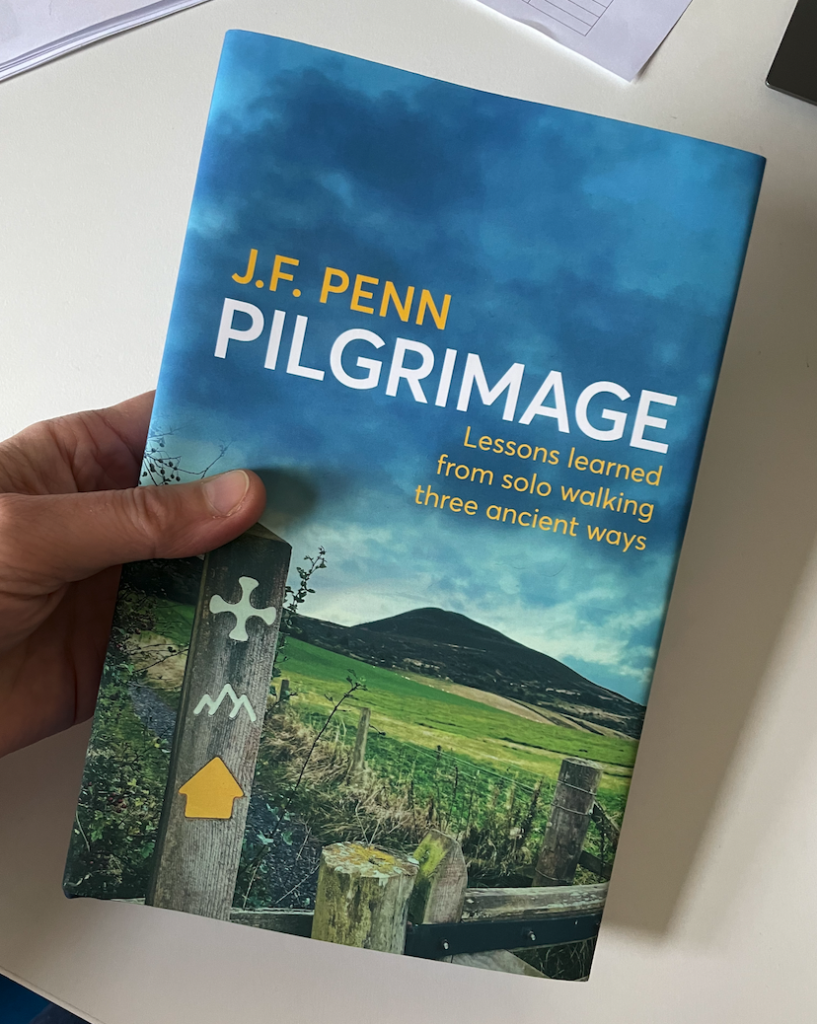 The Pilgrimage hardback with color photos is a direct-only product through kickstarter and shopify The Pilgrimage hardback with color photos is a direct-only product through kickstarter and shopify
With the rise of generative AI, we will see an influx of content onto the main retailers, and building an individual author brand and connecting with readers directly will become ever more important.
Kickstarter is also great for special projects, and Pilgrimage is my first memoir, my first special edition hardback, and a personal book that is not aimed at either of my two main audiences.
It doesn’t fit with my Joanna Penn books — self-help for authors, and it doesn’t fit with J.F. Penn books — thrillers, dark fantasy, crime, horror, short stories and other fiction. Kickstarter seemed like the best option to launch such a different kind of book and hopefully find new readers outside of both niches.
Let’s get into some of my tips and lessons learned.
Learn about the platform from experts
I’ve been publishing and selling books through online retailers as well as my own store since 2008. I know what I’m doing — but I still had a lot to learn with Kickstarter.
It’s essentially a completely different ecosystem with different rules and a different audience, so you have to learn the ropes.
Even if you are super-successful in other places, you might crash and burn on Kickstarter unless you understand how it works and change your approach accordingly.
Start backing campaigns
See how it feels to back Kickstarter campaigns and discover what draws you in as a reader, and a fan of specific things as you might find projects you love outside of books.
You can browse the Publishing category to find new books and also use the Search to find things you might like.
In this way, you can support fellow creators and learn how the Kickstarter site works for discoverability and marketing.
Buy — and read — Get Your Book Selling on Kickstarter by Russell P. Nohelty and Monica Leonelle.
My copy is full of underlining and notes, and it was on my desk for months so Noisette, one of our British short-hair cats, curled up on it a lot.
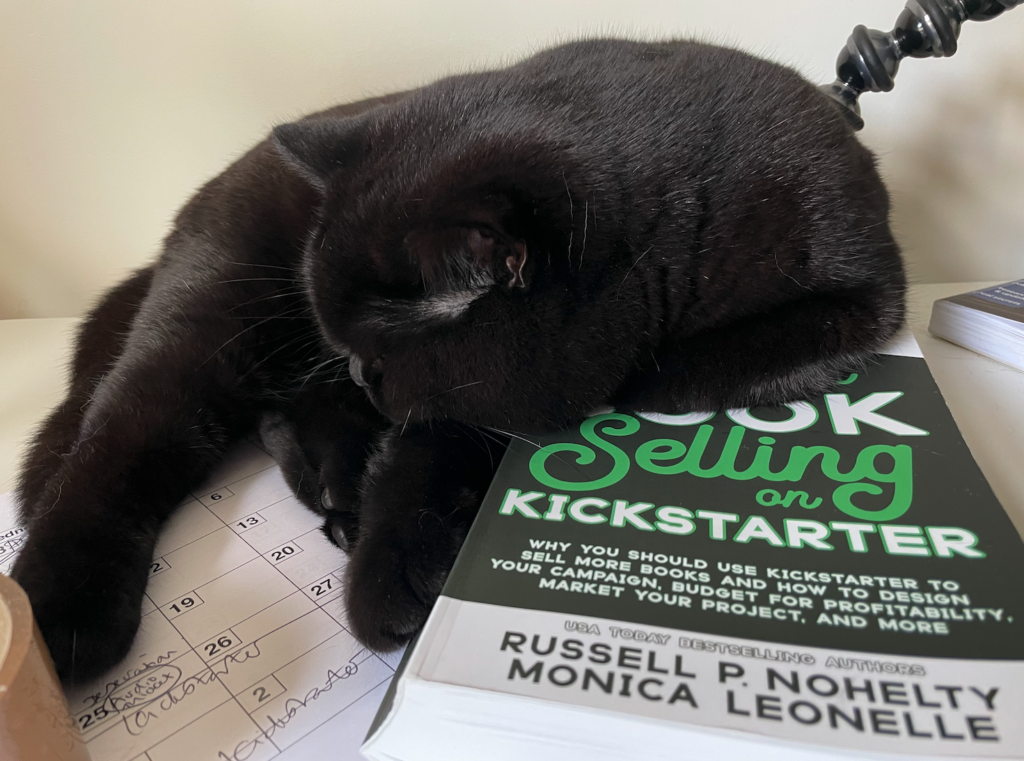 Noisette on Get your book selling on kickstarter Noisette on Get your book selling on kickstarter
Go through the book in detail and note down all the things that can make a campaign successful. It is a great book and this step alone will get you a long way.
Monica and Russell also have a podcast, plus downloadable Kickstarter roadmap, plus courses, and a Facebook group, as well as an accelerator where you can join other creators campaigning and help each other go further.
Just go to KickstartYourNovel.com for all the details, although it’s also relevant for non-fiction authors and creators of other projects. It’s not just for novelists.
Monica also did a great interview on The Creative Penn Podcast about Kickstarter for Authors. Bryan Cohen also shared his tips after a successful non-fiction Kickstarter campaign.
 kickstarter for authors with monica leonelle kickstarter for authors with monica leonelle
WMG Publishing with Dean Wesley Smith and Kristine Kathryn Rusch also have free and premium courses on Kickstarter.
Also, make sure you go through the Kickstarter Creator Resources to get more direction on the campaign. Do not assume you know what you are doing if this is your first campaign! Also, check the Terms of Use as once more, they are different from other platforms.
Ask specific people to review your Campaign page before it launches
You can share a preview prior to launch and get feedback on your page. This helps you refine your Story and the Rewards, answer any questions before the campaign goes live, and can also help pique the interest of your audience.
I asked specific people who had done Kickstarter campaigns for help at different stages of the process. Thanks to Holger Nils Pohl, Guy Windsor, Sara Rosett, and Dean Wesley Smith, who all checked the Preview of my campaign and gave me valuable feedback, which I was able to incorporate pre-launch.
Thanks in particular to Russell Nohelty who did a review of my page just prior to launch and gave me specific tips that I implemented.
He suggested that I change the title and sub-title so it was not repetitive and made better use of the SEO aspects of Kickstarter. He said I should move the ‘why' toward the front of my sales video and further up the sales page, emphasizing why the book is important to me and why others might find it useful, as well as bringing more emotion into the page, instead of primarily focusing on formats.
Plus, he suggested moving the sample of the text and audio up the page so people could find that sooner, and adding a Specification section with the different books available and how many pages they were, the size, and listening time for audio.
Thanks also to my patrons on Patreon.com/thecreativepenn who helped me refine the page language so it wasn’t confusing, and through this, I was able to answer all questions before the campaign launched. Some of those who reviewed the page went on to buy.
Review common mistakes from other campaigns
If you examine how others made mistakes, you can learn from them. The most common seem to be:
- Not finishing the book before the campaign
- Getting the financials wrong — for production, shipping, and for any other rewards. I know some authors who have ended up merely breaking even or sometimes out of pocket from campaigns. Don’t do that!
- Not making the most of the Story sales page and including everything necessary so Backers understand and want to support the campaign
- Setting unrealistic goals, like expecting to make six figures on a first campaign
- Not allowing enough time for everything
- Not seeking feedback from people who have done it before
- Not marketing the campaign enough
- Over-promising and under-delivering
- Poor communication with backers about the status of rewards
Prepare to face your fears
This entire experience thrust me out of my comfort zone and into a new way of creating, launching, and connecting with readers.
Pilgrimage is my first memoir, my first special hardback with color photos, and my first Kickstarter crowdfunding campaign.
The book is very personal and I bare my soul about some dark times, so that was terrifying in itself, let alone trying a new product edition and publishing platform.
On the evening I clicked the Launch button — and yes, you have to click an actual button — my heart was hammering out of my chest.
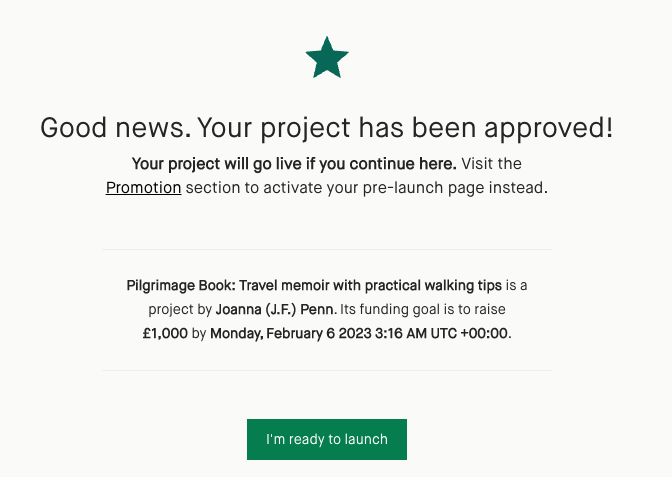 You have to click the launch button to go live — heart-hammering! You have to click the launch button to go live — heart-hammering!
I was afraid of failure.
I was afraid of being embarrassed if my campaign didn’t fund. I wrote a book on marketing, How to Market a Book, so I would have been mortified if I had not funded. I even changed my target from £5000 to £1000 the night before, as I was so terrified it wouldn’t fund.
I was afraid of getting something terribly wrong and ending up out of pocket through issues with printing and shipping.
I was afraid of letting backers down by promising something I might not be able to deliver.
I was afraid I had over-committed myself to a whole load of work I would resent doing. I am a one-person business, and although I work with freelancers, I still do pretty much everything myself.
So yes, there was a lot of apprehension and fear. You can listen to an excerpt from the Wish I’d Known Then podcast here, where I talk about these fears.
I’ll circle back toward the end of this to recap whether my fears were realized.
Be careful with international shipping and fulfillment of signed books/products
Shipping costs can sink your campaign if you get them wrong, so be very careful with this area.
I have sold books in 175 countries and my Creative Penn podcast has a listenership in 228 countries, so I really wanted to have a completely international campaign. I wanted to ship Pilgrimage in any format to any country, so originally, I thought I would just charge a bit extra for the book and include shipping.
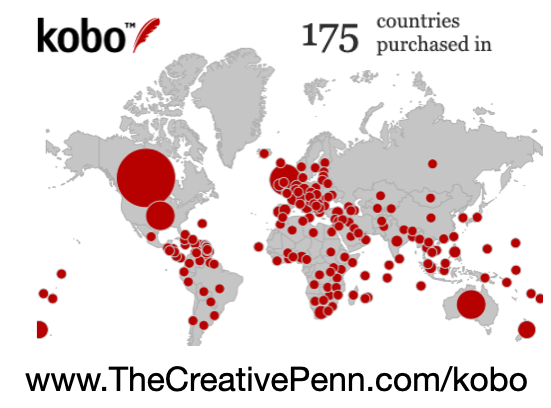 My international book sales through kobo, 175 countries My international book sales through kobo, 175 countries
But once I set the book editions up at Bookvault, and I had the weight and dimensions sorted, I started looking at the variability of shipping costs.
It is crazy how much shipping costs vary, and I discovered I couldn’t just assume ‘it would all wash out’ and I’d end up making a profit overall. I had to be a lot more careful with the calculations.
So I focused on my biggest markets — the US, UK, European Union (which is multiple countries, but one shipping region), Canada, Australia, New Zealand, and South Africa. I added a note on the campaign to say I would add any other country for print shipping if people contacted me. As it turned out, no one asked for other countries, so this was the best way to go in the end.
You can try to prepare for everything and then something unexpected happens
A big spanner in the works for my campaign was the Russian hack, which took down the UK Royal Mail just before my launch.
This put all printed material/book shipping into flux and specifically hit the international side. Other shipping firms ramped up to take up the slack, but it made planning for the launch difficult as prices were shifting, even for posting in the UK.
Once again, I’m grateful for Bookvault’s adaptability as I could check different addresses and shipping prices even as things changed, and about 95% of my shipping ended up being within an acceptable range of what I charged.
Do your research. Weigh and measure your items so you can get exact quotes for each and check out what kind of packaging you need if you are doing your own shipping.
You have to add the shipping costs per reward and per country, so it’s a lot of manual setup to get right. But this is critical, so check and double-check.
I triple and quadruple-checked, slept on it, and checked again. Every time I checked, I found I had typed in something that didn't quite match (as you also have to re-type on the Add-Ons), and I didn't stop checking until the day before the launch.
Some creators in the USA only do print for the USA because of this reason, but as a Brit, I want to stand up for the international community of readers. If you're planning a campaign, please check your primary markets and add shipping options for them. Yes, it's a challenge, and you need to make sure you don't end up out of pocket, but we international readers are important too!
Set aside more time than you think you need
The campaign ended up being far more significant than I expected in terms of workload and time to complete. Everyone told me that, but it was still a surprise!
I’ve been working on it almost full-time for three and a half months, and that doesn’t include the actual writing of the book.
The Pilgrimage manuscript was finished and edited by early December 2022, and I worked with my cover designer and book designer Jane at JD Smith Design to get the print files done quickly so I could get proof copies in early January.
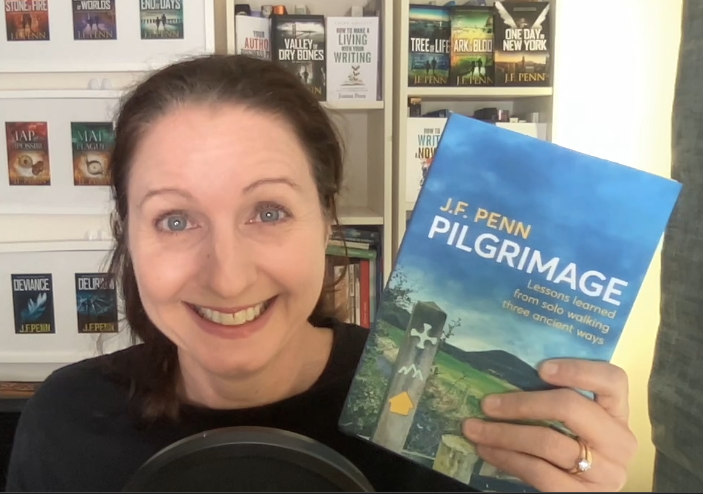 Jo Frances Penn with Pilgrimage Jo Frances Penn with Pilgrimage
It took time to prepare the multiple editions for the rewards
I usually produce an ebook, a paperback, and a large print edition, and I narrate my non-fiction audiobook.
But for this Kickstarter, I also wanted to do a special hardback with color photos inside, and extra details like silver foil and a flyleaf cover. I wanted to create a special print product I could be proud of.
I’m proud of all my books, but the usual paperback POD books are more about the content than the beauty of the product. For Pilgrimage, a book of my heart, I wanted a special edition.
I worked with Jane on the design, going through my photos from the various pilgrimages to find those that resonated with the content, for example, the cadaver tomb at Canterbury and my Compostela from the Camino.
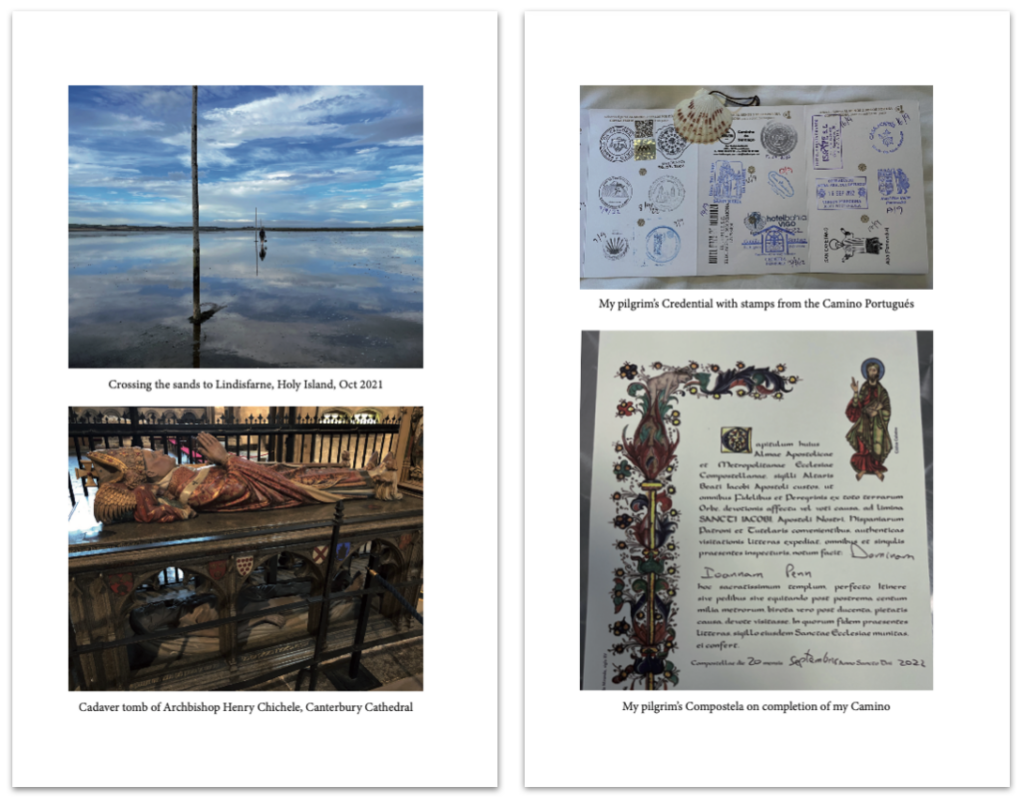 Extra photo pages in pilgrimage, including lindisfarne crossing, canterbury cadaver tomb, and my Credential and compostela from the camino de santiago Extra photo pages in pilgrimage, including lindisfarne crossing, canterbury cadaver tomb, and my Credential and compostela from the camino de santiago
Once we finished, I had a proof copy rushed from Bookvault to make the final updates before getting the weight and shipping costs for the campaign. Between us, we turned around everything as fast as possible.
I love love love the hardback.
It has a silken finish cover and feels lovely and weighty. The picture came out well as the paper is of higher quality than usual to allow for color printing, and overall, I am incredibly proud of the finished product. I even sent a copy to my mother-in-law, which I have never done before! (And yes, she thinks it is good!)
I definitely should have allowed more time, as I spent most of the Christmas and New Year period working on the book, recording and editing the audiobook, and preparing for the campaign.
I also didn’t have time to prepare, record, edit, and produce the Writing Setting and Sense of Place course until after the campaign, and it was really hard to find the energy to do this afterward.
It took time to build the Kickstarter campaign page, create the video and incorporate feedback
Most authors don’t write sales pages anymore. Sure, we write a sales description for the book page on the retailers, but we don’t often do a whole page for multiple editions.
On Kickstarter, you are basically writing a sales page for your campaign, which they call a Story.
Some of your existing audience might click through and back the campaign without reading it, but most backers will check out the details to find answers to any questions they have.
It is a very long page — and you also need a video, which is best to record at the last stage when everything else is done.
You can still see my Kickstarter campaign page for Pilgrimage here, so I won’t go through everything in detail.
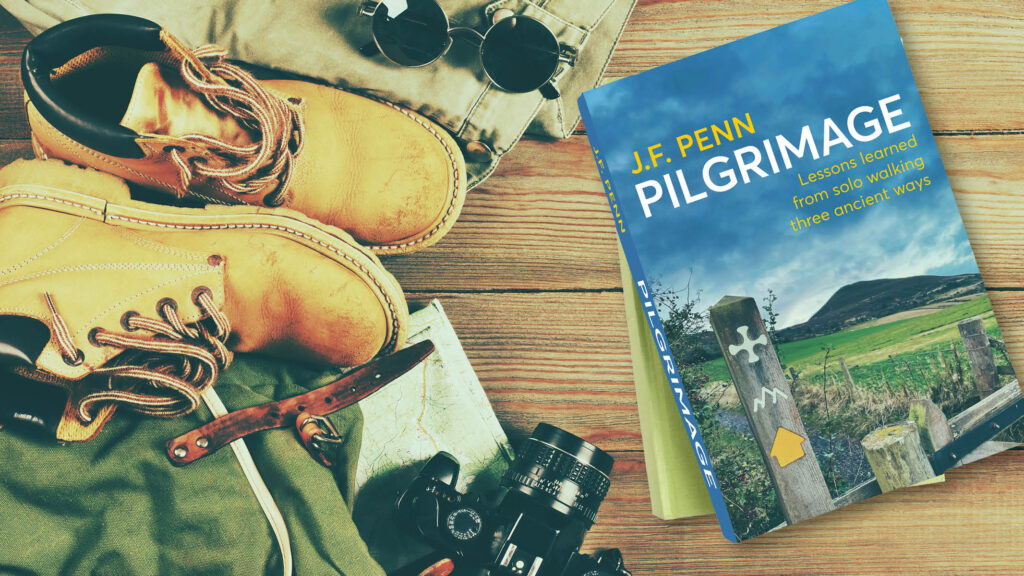 My Kickstarter banner for pilgrimage My Kickstarter banner for pilgrimage
The key aspects were who the campaign was aimed at, why this campaign was important to me and the book, what products were available and pictures of everything so the page was visual, sample chapters and sample audio, specifications including weight, pages, listening time, table of contents, about me the author, stretch goals, add-ons, and any questions, risks and challenges.
Then the reward levels which all have to be set up carefully for each pledge level with shipping cost per country, and specific details about what is included in each level.
I felt like the page had too much information, but since I didn’t really get many Backer questions, I guess it did what it was supposed to do!
I rewrote and edited that page so many times, adding and changing the order of things, responding to feedback, and switching things around.
Then in the last week, I prepared and recorded the video.
I watched Russell Nohelty’s videos for several of his campaigns and modeled mine on his. He also gave me some tips to improve it. I’ve been making videos for years so I didn’t have to up-skill on the technical side, but it still took a whole day to make a video that was under 3 minutes!
It took time to prepare the marketing for the campaign
I’m pretty low-key for most launches these days. I publish the book, send a few emails to my list, announce it on the podcast, do a little social media, update my websites, and then move on to the next book.
This was probably my biggest effort in terms of launch since my first novel, back in 2011.
I only had a two-week campaign, so I needed to make the most of that window. I’ll detail the marketing I did in the next section, but it took a lot of time to prepare the various things, and then execute them, as well as keep the energy up for promotion during the campaign.
Two weeks was definitely the longest I would want to do, as I was really over it by the end!
It took more time to create and deliver the extra Stretch rewards I promised
Since I had pretty low expectations of funding, I set my first Stretch goal at £10,000 for ‘lessons learned from writing a travel memoir.’
When I promised it, I thought it might be a few pages of tips, but I am incapable of delivering something incomplete and it turned into a short book on the topic which I delivered in ebook and audio format (recorded by me).
I will turn it into a book at some point, so the content will get re-used, but that definitely took more time than expected.
Then I set a stretch goal at £25,000 for a live zoom call for backers to ask me any questions, which we also achieved. That wasn’t such a big deal, and I really enjoyed doing it, so I would definitely do that again. It made me want to do more Q&A lives, but again, time is always an issue!
It took time to figure out the backer spreadsheet and check all the fulfillment details
Once you have finished your campaign, you send out surveys for mailing addresses and to fulfill rewards.
But I also needed to turn the backer report into a printing order for Bookvault, and that was nerve-wracking indeed! The spreadsheets were different formats and thankfully, my husband Jonathan helped me with the transformation from Kickstarter to Bookvault and then we spot-checked orders to make sure people would get the right books based on their orders.
I was petrified that some people might get the wrong book, and I’d have to resend the right one, which would end up with me out of pocket for double printing and shipping. But thankfully, all the checking worked and I haven't heard from anyone who got the wrong book.
It took time to follow up with backer payment and address issues
Most backers were easy to deal with. They received the updates and Kickstarter emails; they filled in their surveys and didn’t have any issues.
But there were problems with about 5% of backers, most of which were not their fault. There were failed payments when banks thought Kickstarter might be fraud, there were missed emails because of issues with deliverability, so backers didn’t receive the rewards, or they didn’t fill in the survey and return their address.
I had to follow up with every one of these, some of them multiple times, and slowly reduced my list of outstanding backers. I still have one person who I can’t reach, even though I have tried contacting them via email, social media, and their website. [Karyn B, if you're out there, please contact me!]
So here’s a tip. If you back a Kickstarter campaign, please log onto Kickstarter a few weeks after the campaign and check for updates. It’s possible that you are not receiving emails from Kickstarter and the creator may need details from you in order to fulfill your pledge.
If you backed my campaign, you should have everything now, so please contact me
| 


.png)
 More
More
 Religion & Spirituality
 Education
 Arts and Design
 Health
 Fashion & Beauty
 Government & Organizations
 Kids & family
 Music
Music News & Politics
 Science & Medicine
 Society & Culture
 Sports & Recreation
 TV & Film
 Technology
 Philosophy
 Storytelling
 Horror and Paranomal
 True Crime
 Leisure
 Travel
 Fiction
 Crypto
 Marketing
 History
 Comedy
 Arts
Arts Games & Hobbies
 Business
 Motivation