|
Description:
|
|
Welcome, Craig J Bishop!
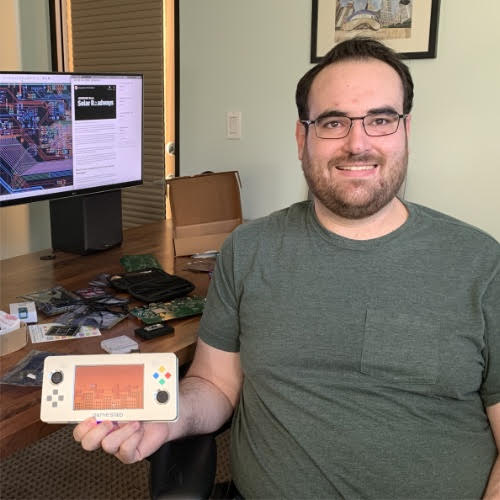
- Craig designed and built the Gameslab, which is a custom gaming platform built with a Xilinx Zynq part (XC7Z035).
- Bought reballed chips on PCBs. They were actually a $1200 chip he got for $80.
- Episode with Ryan Cousins
- There is apparently a kit for counterfeiting Xilinx chips
- National lab has a pdf on how to detect counterfeits
- Digilent Zybo
- Craig built the board on the JLC 6 layer process at 210×100 for each board. $150 for 5 PCBs.
- DDR3 chip was .8mm pitch
- Using stack up to calculate impedance/prop delay
- Used an excel sheet to track delay and skew for nets, since KiCad can’t track delays between layers
- FPGA on chip delays are also stated in the datasheet and need to be accounted for.
- Running Rust on STM32L0, on kernel modules in A9, applications / games
- Sense resistors with instrumentation amps going to the ADC to measure each rail’s current draw.
- BQ24250 chip for charging with configurable registers
- Zynq doesn’t necessarily need the bitstream programmed first. Instead the A9s boot first and can load the bitstream.
- Every game brings its own hardware
- Can put the Gameboy hardware into the fabric!
- Craig doesn’t like verilog, so he uses a higher level language called SpinalHDL. It is a fork of Chisel, which is based on Scala.
- Each of the above languages are strongly typed. Loosely typed means you can convert between data types, like in C.
- “Verilog is becoming the assembly language of FPGAs”
- ZipCPU
- AXI bus
- Most designs need to reimplement different hardware blocks. But there are libraries in Chisel, which can implement things easier.
- Vex Risc V
- Created a frame buffer for the LCD and some 2d graphics acceleration on the Gameslab.
- Learned to program to make PC games. This was part of the idea behind the Gamesphere project as well.
- PIC18F452 in a 40 pin DIP
- Used AT91R4000 for the game sphere
- Andrei LaMothe wrote the book “The Black Art of video game console design”
- Cypress dual port SRAM
- Craig’s first “big boy job” was working for a a neighbor up the street starting a semiconductor packaging company (Tim Olson)
- Deca Technologies was opening a Wafer Level Chip Scale packaging fab in the Philippines.
- After iphone came out, there was a lot of demand for low profile complex chips.
- Raspberry Pi photon problem
- Added a “squishy” layer to the silicon, and then exposing certain parts of the silicon to the interconnect.
- The graphics problem was that they wanted to make the chip bigger but the silicon smaller
- EWLB from Infineon looks like a plastic wafer.
- Can put two chips next to each other
- There was a paper about the subject (has the image Chris and Craig were discussing during recording).
- Sometimes the parts are placed 30 microns to the left, which is not good for the substrate they are placed upon.
- Can get really expensive PnP machines but they go slow.
- The microscope would spit out X, Y and rotation, but it scales with chip complexity, such as when there are two chips.
- Needed to do traces between them
- Craig’s job was to take the output and do some autorouting between them.
- Feature sizes were 1 micron
- Package design looks like PCB design
- Cadence sells System in Package designer but is really Allegro with different plugins.
- Can people do their own SIP?
- Craig thinks that design will move towards more SIP
- Split die architecture
- Split it into a few pieces: This will help improve yield and flexibility, as well as modularity.
- Chris asked about Chiplets, a topic that is championed by Dr Subu (sp?)
- Chiplets are going to do interconnect in silicon, not plastic
- Example is BLE and micro
- Adaptive alignment
- Craig gave a talk at KiCon about how Autorouters work and how they have been improving.
- Not your grandpa’s autorouter
- Freerouting is nice and available but it’s not the latest
- TopoR
- Moving towards interactive design (P&R), but Craig thinks it should go the other way.
- Generative design would be better
- Dave Vandenbout’s SKiDL talk
- Craig was briefly interviewed by Piotr and Alvaro at KiCon
- Find Craig on his personal site where he is documenting his projects (craigjb.com) and also find him as @craig_jbishop on Twitter.
- Check out the Phoenix 3H (hardware happy hour) if you’re in the area!
|



.png)
 More
More
 Religion & Spirituality
 Education
 Arts and Design
 Health
 Fashion & Beauty
 Government & Organizations
 Kids & family
 Music
Music News & Politics
 Science & Medicine
 Society & Culture
 Sports & Recreation
 TV & Film
 Technology
 Philosophy
 Storytelling
 Horror and Paranomal
 True Crime
 Leisure
 Travel
 Fiction
 Crypto
 Marketing
 History
 Comedy
 Arts
Arts Games & Hobbies
 Business
 Motivation