|
High school is an important time in the life of any teen: hormones are raging, social cliques are forming and the pressure is on to develop a college résumé. Teens gain more independence as they get older, but adults also expect more from teens without providing as much of the nurturing and guidance of their earlier years. Starting high school is a big transition and, it turns out, the ninth is grade a pivotal moment for teens’ potential success or failure in high school.
When students enter ninth grade at a traditional high school, they experience “ninth grade shock.” Kids experience a “dramatic drop” in their academic performance once they transition to high school, according to research conducted by Nikolas Pharris-Ciurej while at the University of Washington.
The differences are understandable in this period of change — in addition to adjusting to a bigger school environment, students are faced with more rigorous coursework that carry greater consequences. Many students get back on track and recover, but researchers have found that students who fail courses in the ninth grade have a harder time recovering and making up those credits; catching up to their peers becomes more difficult and these students face a greater risk of dropping out of high school.
At Hillsdale High School in San Mateo, California, educators are combatting “ninth grade shock” by developing the kind of community kids don’t want to miss. To create this environment, the public school applies strategies that are centered around relationship-building and meaningful work. Students enter the school belonging to a “house,” which is comprised of about 110 students, to help carve out smaller learning communities on this campus of about 1,400 kids. Students learn four core subjects (math, social science, English Language Arts and science) together within their house, and those subjects are taught by the same four teachers for both ninth and tenth grade. Students also stay in the same advisory for both years.
These four core subject teachers meet several times a week to discuss each student’s academic progress and personal dilemmas. Through sharing what they know about each student within their house, this team of teachers can see multiple sides of a student, not just what that child’s performance is in one subject.
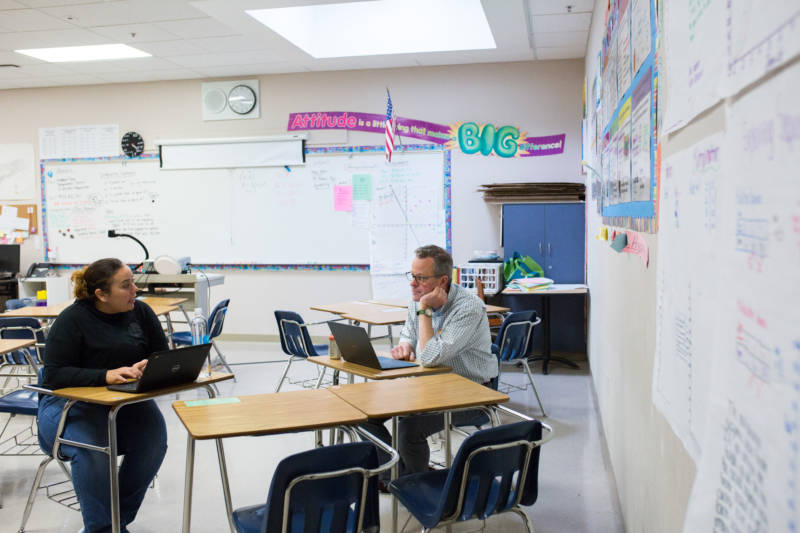 Teachers Danielle Robledo and Mike McCall have their weekly house meeting to discuss what’s going on in the lives of their students in order to identify areas of need. (KQED/Samantha Shanahan) Teachers Danielle Robledo and Mike McCall have their weekly house meeting to discuss what’s going on in the lives of their students in order to identify areas of need. (KQED/Samantha Shanahan)“Since we’re sharing kids, nothing really gets through the cracks,” said House Marrakesh social sciences teacher Danielle Robledo last spring. “We celebrate together we grieve together. We are a team with this one group of kids for two years and so you get to know people.”
But for all the support systems Hillsdale has in place, kids still have challenges that can get in the way of learning. Hear how student Jeffery Aragon overcame some of the failures he experienced in the ninth grade to find success as a high school junior.
Listen on Apple Podcasts, Google Play, NPR One or wherever you get your podcasts.
|



.png)
 More
More
 Religion & Spirituality
 Education
 Arts and Design
 Health
 Fashion & Beauty
 Government & Organizations
 Kids & family
 Music
Music News & Politics
 Science & Medicine
 Society & Culture
 Sports & Recreation
 TV & Film
 Technology
 Philosophy
 Storytelling
 Horror and Paranomal
 True Crime
 Leisure
 Travel
 Fiction
 Crypto
 Marketing
 History
 Comedy
 Arts
Arts Games & Hobbies
 Business
 Motivation