|

In this podcast episode Angie recaps the Red Rock Canyon Marathon in Las Vegas, Nevada, where she decided to see how fast she can walk a marathon. It got interesting!
Plus you will hear how to improve your walking speed and use it effectively in marathon training.
Race Recap: The Red Rock Canyon Marathon
The Red Rock Canyon Marathon in Las Vegas, Nevada, is put on by Calico Racing. The 12th year of the race was held on Feb 23, 2019.
Pre Race:
The race director was great about sending out pre-race emails and there was good information on the website. Joyce, the race director, said that putting on the race this year was very challenging because the government shutdown made it uncertain whether they would have to find a different location to hold the event. Then two days before the marathon the Las Vegas area had a snowstorm and the course had to be rerouted due to bad road conditions.
Packet pick up was located at Silver Sevens Hotel on Friday evening and they did offer last minute bib pickup on race morning at the start line. Since there wasn’t adequate parking available at the start area they required that runners either be dropped off or ride one of the buses from two locations in Vegas. I purchased a bus ticket to ride from the host hotel since I wasn’t planning on renting a car in the area and it departed at 4:45 am on Saturday morning for an approximate 40 minute bus ride. I sat with a lady from WA who is also working on her 50 states and has done over 100 marathons.
Race Morning:
The Red Rock Canyon National Conservation Area has more than 179,000 acres and is absolutely beautiful with red sandstone formations, sheer 1,800-ft. cliffs and several mountains, including Mount Wilson, Rainbow Mountain and Indecision Peak.
The park, which sees more than a million visitors each year, is federally designated as a Backcountry Scenic Byway, the 13 mile paved scenic drive traverses some of the Mojave Desert’s most stunning scenery with sandstone formations, desert vegetation, and wildlife.
It was dark and around 20 degrees when we arrived at the start and it slowly started getting light as we waited for the race to begin. It was lovely to see the sun rise over the mountains but I was very unsure about my race strategy due to the cold. Fortunately there were some indoor bathrooms to stay warm in addition to the portable toilets offered by the race. By the time the race started at 6:15 am my toes and fingers were numb. The half marathon started at 7am and the 5k after that.
Course:
The course was modified because of the snow. It consisted of 4 laps of 5.77 miles and one shorter lap. Each lap started by the visitor’s center and had approximately 3 miles of uphill climbing and 2.77 miles downhill per lap. Some places had a 10% grade and total elevation gain for the marathon was around 3,000 feet. The marathon had a 7 hour cut off and the half marathon a 6:15 cut off.
The course was paved throughout the entire race and a section of the road was coned off for runners so that car traffic could continue through the park. This meant that there was often two way traffic of runners in the coned off area but it seemed like people navigated it well. Although doing repeated laps isn’t the most fun it was actually nice to see the same people again and again and spectators and runners who’d already finished cheered you on when you passed the start/finish line multiple times. Another redeeming factor was the beautiful blue skies, sunshine, seeing the snow on the ground, the mountains, and the overall stunning scenery. The fresh air was very invigorating and it did warm up to the mid-40’s by noon.
Aid Stations:
We passed by the same aid stations multiple times and they were staffed by friendly and encouraging volunteers. They offered water, sports drink, and gels at each one. The race also had EMS standing by at the starting area and there were a couple locations with portable toilets. There was a bag drop at the starting line and because of the looped course those were available (many runners added and shed layers as the temperatures changed). I used Generation UCAN snack bars for fuel (1-30 minutes before the marathon and then ½ a bar every 5 miles). My energy levels were solid throughout and my stomach felt good.
Finish:
The male winner was Aaron Gall and he finished with a time of 3:23:35. The female winner was Tatyana Steis and she finished in 3:35:58. The average finish time for the marathon was 5:11:32 and there were a total of 95 marathon finishers, 288 half marathoners and 170 who did the 5k.
They had a nice food table at the finish line with ramen noodles, applesauce, yogurt, pudding, granola bars, chips, water, and sports drink. As I made loops by the finish line earlier in the day I semi panicked because I didn’t see any food (and I’m always hungry after a marathon). The race gave out a nice big medal and a tasteful technical shirt.
My Experience/Strategy:
Like I mentioned earlier I felt very nervous and conflicted about my plan to walk the entire marathon. Part of that hesitation was wondering if I’d be warm enough and the other part was probably a bit of pride not wanting to look like a dork. So I decided to start off walking and see how it went. It actually took quite a bit of concentration to walk the whole way, especially on the downhills. I decided to adhere to the rules of race walking where you have to have one foot in contact with the ground at all times and the front/leading leg straight on impact. Race walking requires a bit more hip and arm action to keep power and momentum. A lot of people out on the race course made comments on how fast I was walking, and of course I felt compelled to explain my walking experiment. I managed to speed walk the entire time, felt strong and often passed people on the up hills (and then they’d usually pass me on the downhills). By the end of the marathon my legs felt a bit stiff from the straighter form required for walking and the tops of my ankles and feet were sore but overall fairly good.
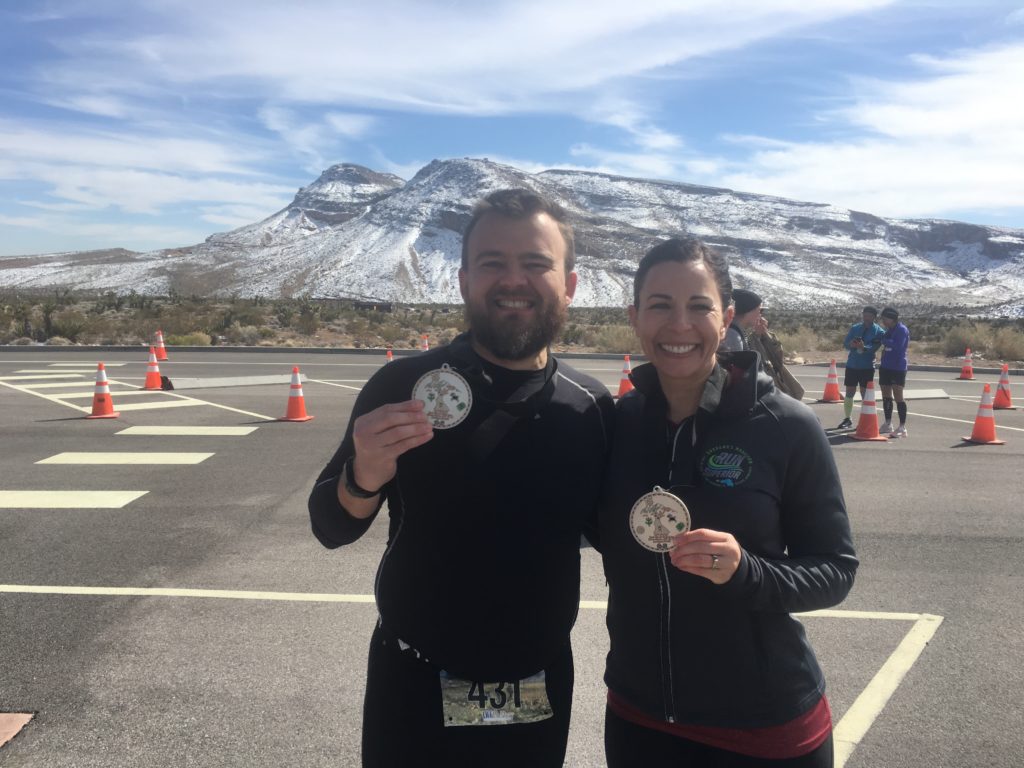 photo credit: Mark Goddard I met up with a former coaching client of mine named Mark Goddard from CA before the race and also saw him out on the course and after the race. Another MTA listener Teri was running the half marathon and I saw her out on a couple of the loops. Another fun surprise was when MTA fan Bobby from NY said hi to me out on the course. He was in the area and spectated a bit of the race. I also met some other cool runners at the event: Theresa, Grant, and Kyle who finished his first marathon (as part of training for an Ironman). We hung out and talked post race while we were waiting for the return bus. There was a couple out on the course and the ladies shirt said, “it’s my birthday and I’ll run if I want to.”
I got a lot of remarks about my walking speed and I’m sure people were laughing behind my back about me walking down hills. My finish time 5:31:21 for an average pace of 12:40 which was faster than I predicted due to the hilly course. My fastest mile was 11:38 and slowest mile was 13:58 (probably the one with the bathroom stop). My overall place was 57/95. This was my 44th state and 56th marathon.
It’s so important to remember that running and walking pace is all relative. A marathon is always a huge accomplishment, no matter how much time it takes you to finish or the percentage of running or walking you do.
I got this email a couple days after the marathon:
“Congratulations to everyone who came out to tackle the hardest and coldest Red Rock Canyon Marathon in our 12 year history. I SO appreciate all of your cooperation with the forced last minute changes to the course.” Joyce (race director)
How to become a faster walker
We’ve never really talked specifically about walking as part of marathon training. We often refer in passing to doing run/walk intervals and in many of the marathons I’ve done there has been some walking, sometimes planned but often unplanned. I’m sure many of us have had the disheartening experience of a marathon gone wrong where were ended up doing extended periods of walking.
A couple such times stand out in my mind. The first one was my 3rd marathon, the Little Rock Marathon, which I did back in 2011, five months after having our third child. My endurance and core strength was certainly not up to par yet and the hilly course didn’t help matters. I managed to run for the first half and then ended up walking the entire second half. It felt like the longest slog ever.
Another marathon that stands out was my 32nd at the Lincoln Marathon which was unseasonably hot for May. Toward the later miles of the race I began walking more and more and it started feeling like a death march. There have been many other marathons where I planned to walk certain intervals, like through aid stations or up hills, and this didn’t have the same demoralizing effect. Sometimes I would look forward to seeing a hill because I’d given myself permission to walk.
I also think that doing specific run/walk intervals are a very smart race strategy for many people. You might see individuals during a race that have a timer go off as a signal for them to start their next interval. I’ve often had run/walkers pass me during marathons or we would leap frog each other during the event. When I did the Air Force Marathon in OH I remember Jeff Galloway (probably the biggest promoter of the run/walk/run method) blaze by me on the course. Let me tell you, his walking intervals were not a stroll in the park.
Other ways that walking can be used in your training is during your warm ups and cool downs. Walking for 5-10 minutes as a warm up and cool down is a very effective way to get your body safely ready to run and then to return it to homeostasis. Some runners walk between speed intervals at the track. And it’s entirely normal to walk tough hills, especially if you’re trying to keep your heart rate in a certain zone. My rule for hills is if I can walk the hill faster than I can run it I default to walking. Another way that walking can be used is if you’re dealing with a niggle, injury, or illness. It’s a great way to still get some healthy activity in without setting your body back. Occasionally there will be run days when I just feel super worn down and know that running will only exacerbate that feeling. I often switch my running mileage over to walking and usually feel much better the next day.
The health benefits of walking are indisputable and it’s something that accessible to nearly every person. Walking is often the gateway into running for many people. I was recently doing continuing education to renew my nursing license and did a course educating healthcare professionals on exercise. Check out these stats on the amount of Americans who don’t get the minimum recommended amount of physical activity. First off, here’s what is considered the minimum amount of exercise:
“People are classified as meeting aerobic exercise recommendations if they report engaging in moderate-intensity activity (like walking) at least 150 minutes per week, vigorous-intensity activity at least 75 minutes per week, or an equivalent combination of the two. Ideally, aerobic activities should be spread throughout the week and performed in at least 10 minute sessions. The muscle-strengthening recommendation consists of two days per week of moderate- or high-intensity exercise involving all major muscle groups.” (5)
We all know that obesity is an epidemic in the United States. Estimates show that nearly 70% of the adult U.S. population 20 years of age and older are either overweight (33.3%) or obese (36.4%). One of the contributing factors in the obesity epidemic is the fact that few people engage in leisure-time physical activity. According to data published by the Centers for Disease Control and Prevention (CDC), approximately one-half of U.S. adults do not perform the minimum amount of exercise needed to prevent diseases such as diabetes and high blood pressure. One in four adults do not perform any exercise at all. About 80% of adults do not perform the minimum amount of aerobic exercise combined with the minimum amount of muscle strengthening exercise recommended in the Physical Activity Guidelines for Americans. Taken individually, the aerobic activity guideline was met by 49.7% of adults nationwide, and the muscle-strengthening guideline was met by 24.9%. Numerous reasons for failure to exercise exist, including lack of interest, competing demands for limited leisure time, fear of injury or pain, no access to facilities, and lack of knowledge of proper technique.
Often when people say that they “can’t” run (which of course is debatable) I encourage them to start a habit of walking or another activity that they enjoy. It’s all about finding a healthy activity that you will stick with. I always find it inspiring that there are many older people in our neighborhood who are out walking every day, rain or shine.
At the other end of the spectrum from walking for exercise there’s the sport of race walking. Race walking is a sport practiced from youth track and field all the way up to the Olympic level. It’s something that most people don’t know or think about. I think the first time I thought much about it was when I did my USATF coaching class and there was a woman in the group who had competed in race walking for the Phillipines. She was able to walk a 7:30 mile. That certainly puts my 11:30-12:30 pace into perspective. Many of the world class race walkers do sub-6:00 minute miles.
Some of the benefits of race walking are that it produces less impact on the body and requires solid endurance even though is a technically demanding sport. According to the USATF website: “Race walking differs from running in that it requires the competitor to maintain contact with the ground at all times and requires the leading leg to be straightened as the foot makes contact with the ground. It must remain straightened until the leg passes under the body. Judges evaluate the technique of race walkers and report fouls which may lead to disqualification. All judging is done by the eye of the judge and no outside technology is used in making judging decisions.” (2)
Race walking dates back to about 400 years ago in England and it didn’t take long to become a very popular sport around the world. By the 19th century, race walking was just as popular as horse racing and spectators often bet on the race outcomes, especially since racers would suffer through races that would last for several days. The typical races at that time would consist of racers trying to walk 100 miles in less than 24 hours. Other races would last more than 40 days, where the racers would try to walk one mile each hour. It did not take long afterward for race walking to become a part of the Olympics (1).
It’s seriously impressive when you look at the paces that these top level race walkers can do (often sub-6:00 min/mile). Check out some of these American race walking records (2):
- Female: 5k= 21:51 (7:02), 10k= 44:09 (7:06), 20k= 1:30:49 (7:18), 40k= 3:27:10 (8:20)
- Men: 5k= 19:09 (6:09), 10k= 39:22 (6:20), 20k= 1:22:02 (6:36), 40k= 3:02:18 (7:20)
Technique:
Race walking requires more of a hip swing than running. But similar to running you want to avoid over-striding which will produce a braking motion. Proper use of the arms is one key to mastering the hip motion because synchronizing arm and hip motion maximizes efficiency and speed.
Posture- Your body should be straight up and down throughout the entire stride, unlike with running where you want a forward lean starting from the ankles. In race walking bending reduces the ability to extend the hip and accelerate the stride.
Arms- Each arm should travel from a couple of inches behind the hip to just above the chest line. The primary power for arm movement is done by driving the shoulder on the backwards swing of your arm. But you don’t want to generate power by wildly pumping your arm backward or thrusting it forward. Use the shoulder as a fulcrum so that the arms swing like a pendulum.
Hips- The hips are the body’s primary source of forward motion. When the hips are rotated forward, the swinging leg is pulled off the ground. As you repeatedly pivot the hips forward, they act as the body’s motor, propelling it forward one step at a time and increasing the stride length behind the body.
Swing Leg- To remain efficient, race walkers must pay careful attention to how their legs swing forward after push-off. Race walkers swing the legs forward with the knee as low to the ground as possible. While some upward motion is necessary to break contact with the ground, it should be minimized. For the greatest efficiency of motion when the rear foot lifts up, it rises only an inch or two off the ground.
If you’re having a hard time visualizing these concepts we’ll include some links with the show notes or you can go over to Youtube and look at a video of a race walker in action. Even if you’re not planning on giving up running and turning into a race walker there are good reasons to improve your walking efficiency. Many runners use a run/walk method to pace their marathons and having good speed and efficiency during the walking intervals will help to rest your running muscles and give you a better overall pace. During ultramarathons, particularly on trails, there is a good amount of walking/hiking that goes on. Some ultramarathoners learn speed walking techniques to help improve their ultra times by getting the most out of their walking sections. Plus, becoming a faster walker will give you a more purposeful look as you walk to work or while out doing errands.
Sources:
www.athleticscholarships.net/athletics-race-walking.htm
www.usatf.org/statistics/records/view.asp?division=american&location=road&age=open&sport=RW
racewalk.com/howTo/basicTechnique.php
ultrarunning.com/featured/how-to-increase-your-walking-efficiency/
What Healthcare Professionals Should Know about Exercise. CEU
The post Race Recap: Angie Tries to Race Walk a Marathon appeared first on Marathon Training Academy. |



.png)
 More
More
 Religion & Spirituality
 Education
 Arts and Design
 Health
 Fashion & Beauty
 Government & Organizations
 Kids & family
 Music
Music News & Politics
 Science & Medicine
 Society & Culture
 Sports & Recreation
 TV & Film
 Technology
 Philosophy
 Storytelling
 Horror and Paranomal
 True Crime
 Leisure
 Travel
 Fiction
 Crypto
 Marketing
 History
 Comedy
 Arts
Arts Games & Hobbies
 Business
 Motivation