|
Just after 10 a.m. Monday morning off the coast of Oregon the temperature dropped, shadows sharpened and the morning eerily turned to night. The sky filled with stars and planets. An unusual sunset glowed from the horizon in every direction.
The total solar eclipse awed onlookers as it swept across America. People within a narrow 70-mile wide band witnessed totality, while the entire country was treated to a partial eclipse.
Clear skies in Oregon set into motion a nationwide viewing event that had millions of Americans erupting into cheers or falling into stunned silence as the moon slipped in front of the sun. Social media sites erupted with photos, videos and audio.
Traffic crept along as people parked along highways and overflowed campgrounds and festivals. The Oregon Department of Transportation estimated 1 million visitors descended on the state.

If eclipse mania stoked any newfound fans they won’t have to wait too long for the next one. A total solar eclipse will travel from Texas to Maine on April 8, 2024.
3 p.m. If you were stuck inside or blocked by clouds today don’t fret. You can watch NOVA’s Eclipse Over America, tonight at 9 p.m. on KQED 9 and streaming online.
NOVA investigates the storied history of solar eclipse science and joins both seasoned and citizen-scientists alike as they don their eclipse glasses and tune their telescopes for the eclipse over America.
2:35 p.m. The first people to see this morning’s eclipse…
NASA astronaut Michael Barratt had his camera ready on board Alaska Airlines Flight 9671 this morning . The aircraft was destined out over the Pacific Ocean for the first glimpse of the total solar eclipse. Along with 100 other passengers, he pointed his camera out a round window as the moon slid in front of the sun. He had crafted a filter using a Chex cereal box.
KQED’s Lindsey Hoshaw was on the same flight with journalists, scientists, eclipse chasers and contest winners who cheered and even swore aloud when the sky darkened.
Totality, Hoshaw said, was magical from mid-air.
“It felt like something out of a movie,” she said. “It was really inspiring to be around people who were so excited, who traveled all the way across the country to see something for two minutes.”
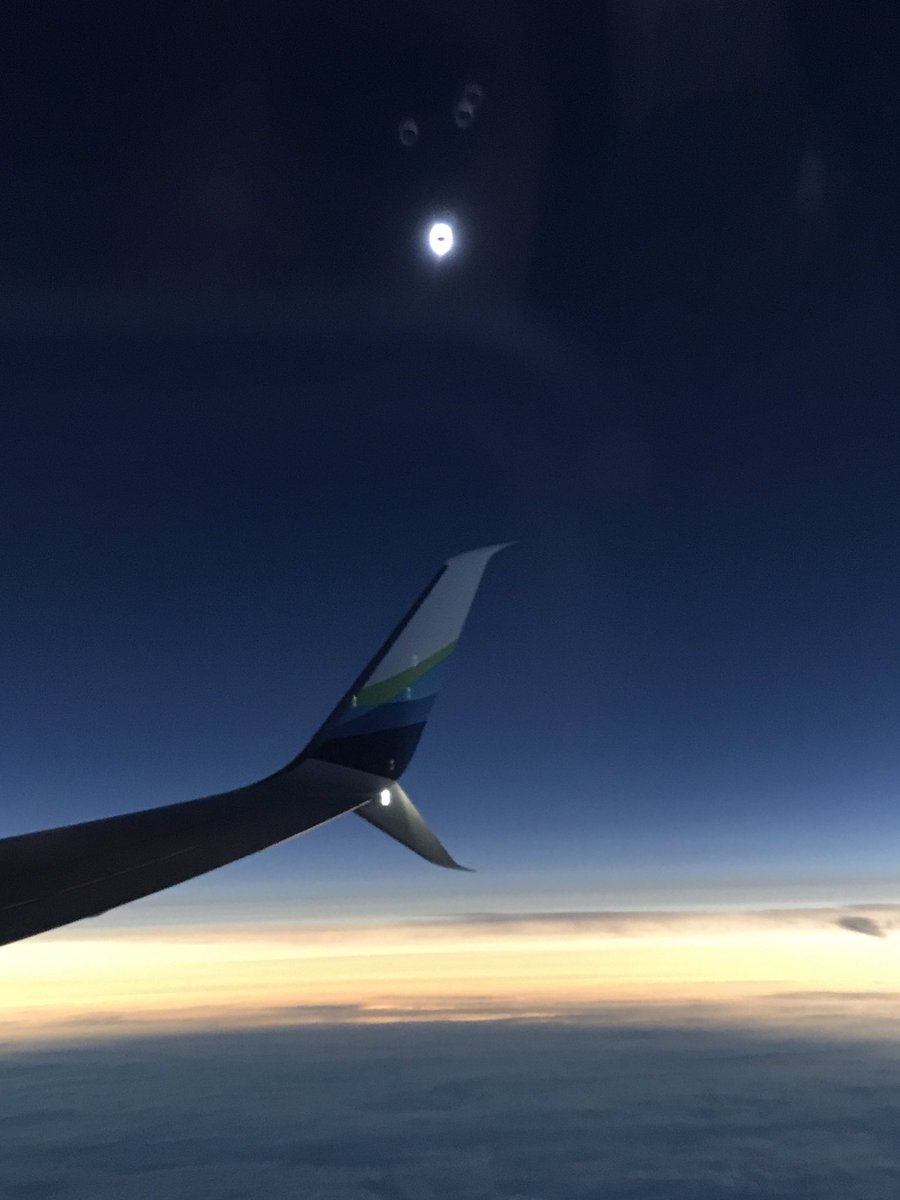 Alaska Airlines Flight 9671 flew out over the Pacific Ocean to intercept the path of the total solar eclipse. (Lindsey Hoshaw) Alaska Airlines Flight 9671 flew out over the Pacific Ocean to intercept the path of the total solar eclipse. (Lindsey Hoshaw) 1:15 p.m. ‘The sky turned inside out’
Those who have chased eclipses around the world often speak of the transformative experience of totality. But KQED’s Danielle Venton says that researchers at the Lost River Field Station in Mackay, Idaho found today’s solar eclipse particularly special.
“Maybe because the sun was high in the sky and the air was pretty clear up there,” Venton said. “The corona was strongly visible.”
There were three “filaments” of solar wind visible to the scientists, who will be combing through the data they collected for months to come.
“Just with the naked eye we were able to see what looked like some coronal streamers, these long streaks of solar material coming away from the solar disk,” said Joseph Hutton, a researcher from Wales. “And maybe a few prominences, which showed up bright pink against the disk of the moon.”
Even hours after what she called an astounding experience, Venton was exhilarated.
“What was interesting was how the light changed,” she said. “It kind of felt more like moonlight. Shadows were especially vivid. There was this general feeling of euphoria, this wave of ‘Oh my god’s’ and gasps and cheering.”
She says that when totality blanketed the Lost River Field Station, the sky turned dark where it was once blue, while the horizon glowed.
“It felt like the sky turned inside out,” she says.
12:42 p.m. KQED’s Lindsey Hoshaw captured the total solar eclipse from midair off the coast of Oregon on Alaska Airlines Flight 9671.
And then there’s this crew on Mt. Tamalpais:
"So glad I went to see the eclipse on Mt. Tamalpais," says KQED designer Christina  Your browser does not support the audio element.
| 


.png)
 More
More
 Religion & Spirituality
 Education
 Arts and Design
 Health
 Fashion & Beauty
 Government & Organizations
 Kids & family
 Music
Music News & Politics
 Science & Medicine
 Society & Culture
 Sports & Recreation
 TV & Film
 Technology
 Philosophy
 Storytelling
 Horror and Paranomal
 True Crime
 Leisure
 Travel
 Fiction
 Crypto
 Marketing
 History
 Comedy
 Arts
Arts Games & Hobbies
 Business
 Motivation