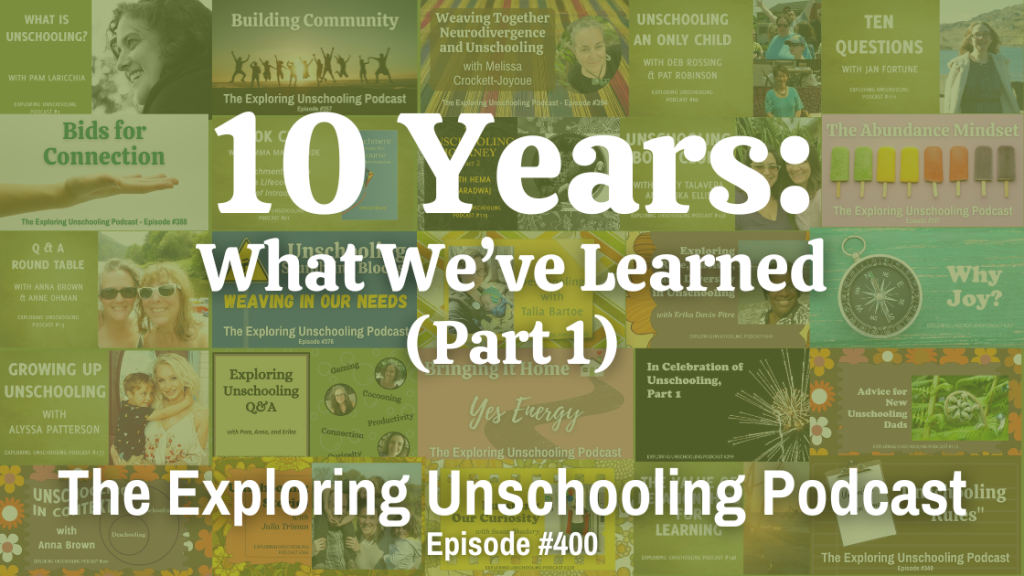
The Exploring Unschooling Podcast began at the beginning of 2016 when Pam released episode EU001: What is Unschooling?
10 Years! And 400 Episodes! To celebrate these huge milestones, we are looking back and reflecting this month.
In Part 1 of our celebration, Pam, Anna, and Erika explore the question of what we’ve learned on our unschooling journeys in the past 10 years. It was a very fun question to explore and we really enjoyed digging into all of our answers.
We talked about how living consensually is really about where we choose to direct our energy, how there’s no such thing as a perfect unschooler (or a perfect parent!), and how independence is not a good measure of unschooling or parenting success. These were all huge paradigm shifts for us over time that have proven to be so valuable.
We thank you so much for being a part of our Exploring Unschooling community and hope you find our conversation helpful on your unschooling journey and in your relationships!
THINGS WE MENTION IN THIS EPISODE
We invite you to join us in The Living Joyfully Network, a wonderful online community for parents to connect and engage in candid discussions about living and learning through the lens of unschooling. Come and be part of the conversation!
Sign up to our mailing list on Substack to receive our email newsletters as well as new articles about learning, parenting, and so much more!
Watch the video of our conversation on YouTube.
Follow @pamlaricchia on Instagram and Facebook.
Check out our website, livingjoyfully.ca for more information about navigating relationships and exploring unschooling.
So much of what we talk about on this podcast and in the Living Joyfully Network isn’t actually about unschooling. It’s about life. On The Living Joyfully Podcast, Anna Brown and Pam Laricchia talk about life, relationships, and parenting. You can check out the archive here, or find it in your your favorite podcast player.
EPISODE TRANSCRIPT
PAM: Hello, everyone! I’m Pam Laricchia from Living Joyfully and I am joined by my co-hosts Anna Brown and Erika Ellis.
Hello and welcome, everyone, to episode 400 of the Exploring Unschooling podcast. This year also marks 10 years since I started the podcast. The first episode went out January 10th, 2016 and it all just feels a little surreal yet meaningful for me. And not so much in that celebratory, look how long we’ve been doing this, yay! That is very cool. But in the more reflective sense that 10 years really is a good chunk of time, right? Enough time for thoughts and ideas to grow and change, to strengthen and wither.
And so, in the last month or so, I’ve become quite curious about exploring this more deeply. When I eventually shared my thoughts about it with Anna and Erika, hello internal processor, they were so very supportive and happy to dive into this reflection alongside me, for which I am forever grateful. You guys are amazing teammates, thank you so very much.
And I just wanted to share, Anna first appeared on the podcast in episode 4, the very first roundtable episode that we had, and Erika began listening in the early days, first appearing on the podcast in 2019 to talk about unschooling book clubs. And then in October 2022, they both officially became podcast co-hosts.
So, coming back to now, rather than doing a retrospective or greatest hits episode, as I was trying to think what to do for 400, we decided to use this anniversary, 10 years and 400 episodes, as a chance to pause and just ask ourselves a few simple, but at least what feel to me, meaningful questions.
What have we learned over the past decade?
What has changed?
And what still matters?
So, over the next three episodes, the three of us are going to explore those questions together. Now if you’ve been listening to the podcast for a while, you know that we don’t share our thoughts as experts with answers, but just as thoughtful and curious people who’ve lived this lifestyle with our families for many, many years and have participated in conversations in this sphere for a long time.
The podcast continues because we enjoy sharing our experiences, the ideas that resonate with us, and the patterns that we’ve noticed. And if you’re new here, welcome! We now have a rich archive of 400 episodes for you to explore.
The content is timeless and evergreen with a wide variety of formats from interviews with unschooling parents, to Q&A’s answering listener questions, to me sharing my published articles and conference talks that I’ve written, to ongoing series exploring things like unschooling stumbling blocks and the so-called “unschooling rules” that can trip people up as they embark on this amazing journey.
So, in this first 10-year anniversary episode we are starting our reflection with the question, what have we learned? Would you like to get us started Anna?
ANNA: I would! But oh my gosh, I’m glad we’re going to be talking and reflecting for the whole month, because it’s really hard to pick one or two things that I’ve learned, because I have learned so much about myself, about relationships, about the world. I think learning is one of the things that actually draws me to this way of life, because I feel like we’re always learning and I love that.
But what I’m going to talk about today is how living consensually in this lifestyle is really about where we choose to put our energy. The reality of it is, relationships and parenting involves work. It doesn’t have to be hard work, but recognizing that it can take energy to live with other people, to share your life with them, helps me think about how I want to spend my energy.
And as Mary Oliver asks us in The Summer Day, “Tell me what it is you plan to do with your one wild and precious life?”
So, for me as I reflect back, I never wanted to be a teacher and really it’s why homeschooling was not even on my radar. I’m too interested in learning for myself to try to impart age-appropriate information to someone else. But when our oldest made it clear that school was not going to be a good fit, I had to rethink some of these ideas.
Luckily, early on, I read John Holt and learned about unschooling and it was such a cool fit, because I love facilitating and supporting people that I love exploring the world and seeing what interests them. And I think a cool part of unschooling is that parents are also pursuing their interests and exploring. It’s about creating this environment where everyone is learning and growing and exploring together and that was exciting. That was a place I wanted to spend my energy.
Another aspect was how I want to be in relationship. Consent and not using coercion as a means to control behavior, well really not even trying to control behavior at all, was important to me. Recognizing that any behavior is just a communication of a need and it’s the needs we want to address. So, with that understanding, it changes the way we relate to each other. In healthy adult relationships we don’t coerce and punish or reward our way to the outcome we want, so why treat children differently? Why not start out with collaboration and connection? Children are incredible problem solvers and quite good at communicating their needs. I think we all know that. Why not learn those skills of navigating conflict and supporting each other from the beginning?
Recently there was a thread on the network where someone was grappling with some fears and they were wanting to reach for some control, and in part of my response I reflected, who do I want to be? How do I want to spend my time? And knowing that being an enforcer to unhappy people is not it. And I think that speaks to this energy lens I’m talking about.
Would I rather spend my energy working towards solving problems big and small than to deal with the fallout of people that don’t feel heard, don’t feel understood, feel like they’re being forced or coerced along someone else’s path? That’s an easy choice for me. Even if the culture is saying it’s for their own good, it’s that energy. What do I want to sit in? What do I want my days to look like? It just isn’t how I want to spend my time or my energy. It isn’t the person that I want to be in the world.
I want to focus on connection, understanding, problem-solving, and finding ways to live together joyfully. So, now you can see why Pam and I were drawn together some 20 plus years ago, because that living joyfully lens is a guiding light for me. I feel like it is this beautiful lens to look through to see these different aspects of our life and relationship and how that all weaves together.
I plan to continue spending my one wild precious life learning, growing, loving with abandon, prioritizing connections, and supporting others on their own unique journey. And so, yeah that’s my reflection for this one.
ERIKA: I love that so much. And actually, until you came up with this idea, I hadn’t really thought of how consent is about where we put our energy, living consensually. It’s just an interesting angle to think about living consensually. And it reminds me of something that I’ve thought about in the past. Sometimes it feels easier to reach for control, but then the way it actually turns out is like it’s not easier. It’s just being fast on the front side of what’s happening and then having to spend all this time with people who are upset.
And so, that is definitely something that I’ve learned through the podcast and through all of our discussions that we can choose that energy that we want to have and we can choose how we’re going to spend our time. And is it going to be that clamping down and trying to make everyone follow these steps? Or is it going to be this more connected, being true to ourselves, and allowing other people to be true to themselves as well, which really is what living consensually means to me?
PAM: Yeah, I love that energy focus and it was a huge a-ha moment for me back then and just so valuable for me moving forward, life-changing in the way that I looked at it. Because sometimes, the control, like you said Erika, makes it go faster up front for the most part, right. So often, we don’t really count the blowback later. We don’t relate it because sometimes it doesn’t even happen in the moment. It’s just a relationship thing that gets harder and harder and harder moving forward so at first we don’t even consider it as part of it. We just say well it’s just so much work to talk to everybody, to see what they need and see what we can figure out. That’s a lot of work because we’re only looking at the upfront piece of it and not really recognizing that back in blowback. But then you but once you start to recognize that and then you start to see oh like that’s why the relationships feel hard. That’s why our relationships feels hard.
It helps us realize that so much of it is our choices in the first place that have set this up. It’s not that our kids are grumpy, or our kids don’t listen, all those stories that more conventionally we hear in those parenting circles but we feel like it’s so out of our control. It’s our kids, they’re the ones that are grumpy, they are the problem. How do I fix my kid when in actuality, when you’re looking at that bigger picture and recognizing I have to use my energy somewhere or the relationships are completely disconnected and then parenting is just like a horrible hard thing that you have to do. You have to get through, it’s way too much of our life to do that for me.
I mean people approach it differently, but for me, what we’ve been learning and for us that’s been my experience as well that it just set a tone and an atmosphere and just felt so much better for me to put that energy there because that was connecting. We learned more about each other, and we actually enjoyed whatever choice that we made more because we didn’t have a person or two that we pulled along because they have to come and they just sit and sulk in the corner. We could enjoy so much more of our days. It didn’t feel like as much of a struggle even though it took more energy or effort up front but when I realized that I was learning things, I could enjoy that piece more and I certainly enjoy that piece more than trying to console somebody who’s really upset after we get back and break down.
ERIKA: It just sounds exhausting. Okay, I want to move on to what I’ve learned. I’m so excited about this anniversary. I think 400 episodes is a really big deal and 10 years of this podcast existing as this bolster and a resource and a comfort for so many thousands of families. It’s just really inspiring to think about and gives me goosebumps. I’m just so grateful for all that I’ve learned on this journey and really I have the podcast to thank for many of those aha moments I’ve had along the way.
When I was thinking about my own answer to what we’ve learned, what bubbled up for me was that there’s no such thing as a perfect unschooler. I can just think back to myself as a young mom or even just a young adult before I had children and I don’t think I could have wrapped my head around the idea that I can’t be perfect. What does that even mean? I think my many, many years in school gave me a pretty good idea that there are right answers and wrong answers. There are the correct paths that are worthy and good and then a lot of other paths that are disappointing and sad.
I just thought it was possible to do all the things correctly and then I could be perfect and I would be safe and so I internalized those ideas into parenting. I just was trying so hard to figure out how I could do it perfectly, how can I get an A-plus in parenting, how can I get an A-plus in unschooling. It’s so stressful thinking about that idea now, but it makes sense that that was my lens, at first. It wasn’t really even at a conscious level. I was just like a fish who doesn’t know what water is. I was just like part of this competitive culture that encouraged me to not make mistakes, to be the best but I think there is a part of me that’s really rebellious as well and so there was this part that knew that this pursuit of perfection isn’t the real story of life as a human.
Then my kids, they’re different from me. They aren’t people pleasers and they’re so clear about what works for them and I love them so much. I just can’t see them as wrong. How are they wrong? They’re awesome. So, in order to reconcile the truth of that I had to let go of the idea of the perfect parent/perfect child, the idea that mistakes should be avoided or that there’s any kind of a right answer to life. I know that in hard moments I sometimes still wish for that simplicity of getting the good grade, knowing what the right answer is but real life just doesn’t work like that.
It’s really too bad that I had so much training in that system that’s actually not that helpful when I got out into the real world and if I’m honest that external and internal pressure to be perfect or to be the best doesn’t really serve me at all. It adds so much unneeded stress. It’s safe to be different. It’s safe to make choices that don’t play out the way that we thought they would. There are just so many paths to take through life and there’s not a perfect approach.
What an amazing journey that realization has been for me. It’s not easy to release all of that baggage and all those messages of the years of conditioning but every time I can remind myself that the idea of perfection is just an illusion, our lives are made up of choices and our choices then ripple out from there, things just feel more expansive more relaxed and the possibilities open up.
I just thought maybe to get your minds buzzing with all the possibilities, I’ll throw out a few areas to consider. There’s not a perfect bedtime or a wake time. There’s no perfect diet or body. There’s no perfect age to learn any particular thing. No perfect way to be a friend or to contribute to your family or to communicate. There’s no perfect way to dress or to express your emotions or to move your body. Allowing ourselves to be unique and imperfect is so freeing and once I got there, then I could leave space for my kids and myself to just be who we are right now. This has been one of the biggest mental shifts for me in my lifetime so far I would say and it’s really thanks to conversations like these that I’ve really been able to process it.
PAM: I love that we’re all hitting on the ones that were big for us because yes this was another big one, just the idea of perfect. I’ve got to do it right. We have that whole “unschooling rules” series on the podcast because of the idea of, ‘just give me the rules of unschooling so I can be a good unschooler’ exists. That’s a fun series because that is really what it’s rooted in. Because at first, of course, I want to be really good at this. I want to be really good as a parent, and if you choose unschooling, I want to be a really good homeschooler, unschooler, whatever, whatever it is.
We are just so used to having that tick box. Then give me my list and I will do it and to reconcile that with the everydayness of life and for me it was so important, I would not have been able to wrap my head around it before I had kids. I wouldn’t have really had a reason to because conventional life and work because often work is the same but seeing my kids when they were younger and the choices they made, it was so different.
A big one for me was them not getting worked up or upset about mistakes. They were just like, ‘oh, that didn’t work the way I thought’ and then they would just try something else. Whereas, I’d be like, ‘oh my gosh I hope nobody saw that. I’m going to go over here and pretend I didn’t know it happened.’ Those pieces that I learned growing up just because being judged and graded was hard. That’s why I was always so driven to do the right thing, to find out what the right answer was and to do the right thing.
So yes, pulling back these layers around this was paradigm shifting for me. Mistakes don’t have to be a bad thing. I do learn a lot. Maybe I was missing some information. Maybe I just need more practice with that skill. I’m learning so much each time and I actually learn more when I can get messier. Often I would just keep trying to input, input, input until I find the right perfect answer before I actually ever take any action. I think it’s so interesting.
ANNA: I think we all have very different personalities and so there’s different aspects of this but I really agree with what you said Pam. If we didn’t have kids I don’t know that I would have gotten this in the same way because for me it was a system to crack. I knew how to perform in school to get what I needed to get. The A’s, the thing, the whatever. And like you said, it transferred to jobs and different things but I really do feel like it was so blown open by having kids.
They just had this natural piece about them of just, we make mistakes. They figure things out. They’re learning. When they’re learning how to walk and talk and do from the very beginning, it’s this really natural human process of learning. There was just something about the way my brain works and being fascinated by it which I think we all have in common. We like to tease out these nuances. It’s like, oh there’s a different way, this isn’t it. That’s a system. Humans actually are okay to learn and be messy and figure out these things and so I love that piece.
Then I love what you said Erika, at the end, when you were giving us the list of the different things because what that really brought out for me was that reminder that unschooling or coming to this way of life is this little door we walk through and then there’s this huge world on the other side. There are all the different things that it applies to. So, those mistakes and not being perfect and being messy, it just applies to everything and then suddenly it is this gigantic paradigm shift of everything that I thought was one way has lots of options and is so different than that and so yeah I just loved all of those pieces so much.
PAM: Okay, ready for this one? One of the most life-changing things I think that I have learned over the past ten years is that my child’s independence isn’t a meaningful measure of either my child as a person or me as a parent. And to take that a step further I’ve come to think that not only is it not a meaningful measure, holding it as a goal on our parenting journey can be actively harmful.
I have been thinking about this a while before mentioning it to you guys. I was thinking more the other day, I was curious and I cracked open my first book “Free to Learn: five ideas for a joyful unschooling life”, which I published back in 2012. I skimmed the table of contents and sure enough in the last chapter, idea five, living together, which is kind of this whole consensual piece we were talking about, but the title of the last section jumped out at me. “Moving on out”, so I quickly flipped to that page and there it was in black and white what I had written about preparing my kids for eventually moving out on their own as an important goal I see for myself as a parent. But the goal is not that my children move out as soon as possible, it is to have supported and helped them gain the knowledge and skills that will help make the transition to living on their own as trouble-free as possible.
How many of us started our parenting journey having absorbed that implicit goal of raising independent adults with the ultimate achievement of that goal being our children moving out. I mean, I certainly did so we began unschooling in 2002 and it’s interesting to see that 10 years into my unschooling journey when I wrote that book my perspective had shifted away from looking at that goal through the lens of the conventional agenda of moving out at 18. Like once you’re an adult, you move out and I shifted towards supporting them on their own timetable. So, I didn’t have that timetable anymore but still the assumption of quote unquote “moving out” was still implicit in my words.
So, in the last 10 years I learned one that moving out is not synonymous with independence and two that using the goal of fostering my child’s independence as context for my everyday parenting choices was actually getting in the way of not only my relationships with them but also in them developing their own self-awareness and hearing their own inner voice, understanding themselves better.
So, basically the choices I was making with an eye on that idea of fostering their independence we’re missing so much of the relevant context about them as a person and what was happening in the moment because I was kind of fixated on that future independence. I came to realize that what meant more to me was the idea of interdependence, of our lives weaving together and supporting each other as needed, no matter our ages or where any one of us happens to call home at the moment.
That paradigm shift had and of course continues to have a profound impact on my relationships with my kids and you can see this revelation unfold for me over the last 10 years of the podcast from episode 96 when Anna first introduced me to that phrase ‘independence agenda’ to episode 365 where the three of us just discussed it directly in more depth. To me it was just such a valuable shift that I learned that continues to have such an impact and that I just feel more and more deeply every year. I’ve had conversations with my kids about what does it prove when you move out? How does that prove that you’re independent? Versus the interdependence of living together that has just brought us so much more joy but also so much more knowing of each other, knowing of ourselves. Instead of all that external framework of trying to prove yourself, knowing yourself it’s just so much more meaningful I think moving forward. So, that was a big one for me.
ANNA: It’s such a big one and you know I do get excited because I just wanted to name it and we have named it over the years, this independence agenda because it is so strong in our culture. It starts with babies being moved to their own room. So, it is so interesting to just bring awareness to it so that you can watch for it because again when I think about who I want to be in the world and what’s important to me, it is that interdependence that you’re talking about. It’s that connection, that’s what makes being a human rich to me. Learning about myself, learning about others. So, this artificial agenda that’s handed to us. And it’s so culturally specific. There are many cultures where that isn’t the goal at all and so that’s always interesting too think of this as a have to, we have to make them independent, we have to be moving towards this and yet other cultures don’t even consider that.
I think it’s really interesting. And when we talk about how different we all are, which we’ll be talking about over the month too, it’s recognizing that when our kids are making that choice from inside of them, listening to that inner voice that it’s so different because they may very well have a drive to go off and explore the world or do different things and they may come back and they may not. They may be able to live their whole complete life altogether because again it doesn’t have to look one way. I think that’s the beauty of this life is just like getting rid of what isn’t serving me. No, what do we want to do, as the people here involved in this home and I don’t know that just opens up a lot of possibilities that I think are really beautiful. I do think this was a really big one so yeah I really appreciate you sharing that.
ERIKA: I love that part about how you can see it unfold over the course of the podcast. I just think that’s so fun and amazing that you have records of yourself saying, “This is what I believe now,” and then how that has changed over the years.
But I think, again, it’s like that fish in the water thing where you didn’t even know it was an assumption that you were carrying. It’s just a fact of our culture that you don’t even realize that there are other possibilities. And so, I feel like when that happens, when it’s something that’s so part of us that we don’t even realize we have that thought. We really only confront it either with help from someone who has realized it or when we bump up against problems in our own family. Like, they’re not moving out. Something’s wrong. And then it’s like, oh wait. Is something wrong? And then we can go through that process of questioning, is this really something that is mandatory?
And I thought of that cultural piece, too, because, right, it really is also so specific to what culture you’re in, what messages you’ve learned through your whole life. And I think once we’ve become adults in this culture, we’ve been exposed to that message so many times it just feels like, well this is literally what everyone does. But if we start thinking about it, it’s not what everyone does. Everyone has their own context.
And kind of like my perfection one, too, there’s not a perfect time to move out. There’s not a perfect age to feel like you’re a grown-up. It’s just these weird cultural things that, once you start seeing it, once you start questioning it, it just all kind of falls apart. And it’s like, okay, really anything is possible. We can just look at, who is this person? What do they want? What is their context? What feels like the next step to them?
And then it really to me is like, when you talk about the web of learning, you don’t want to be throwing them to the other side of their web of learning when they haven’t gotten there themselves. And so, developing independence in various areas of their life, it’s going to look so different for every person. And I just love that I’m not even to that age yet. And I already have been thinking about this. I just feel really grateful for that.
PAM: I love the piece of not throwing them across the web of learning, their understanding of the world. And watching them unfold on their own path and on their own timetable is just so beautiful. Because when you take that moment, it really is them and all about them.
And as they’re figuring things out, that’s beautiful. And I think we’ll probably be talking about this a lot more, but I loved Anna, you mentioned, and this is such a great example, that unschooling is a window to like the world, like to all these pieces.
When you start, because now you’re actually living together, right? You’re actually in relationship, rather than more often moving just from thing to thing to thing, right? So all these questions start to bubble up. Once you look at a little bit bigger picture than just all the things start to come into focus. It was such a great point, Erika, that it wasn’t even something that we had consciously made a choice about, or that we even knew was an assumption that we were carrying.
It was just like this fundamental fact of life, it felt like. But you’re right too, about it being cultural. For my husband, who’s Italian, that wasn’t a big thing. Moving out at any particular age wasn’t a thing at all.
So, all those little pieces, we start building our own web, our own wisdom and context around an idea. It’s just so beautiful.
Anyway, thank you both so much. Thank you for sharing your reflections about what you’ve learned on this amazing journey, and we will be talking about lots more as the rest of the month unfolds. And thank you to everyone listening, whether you’re listening in your podcast feed or watching on YouTube, we appreciate you joining us. So in our next episode, we’ll be diving into the question of what has changed for us.
And we invite you to join us in the Living Joyfully Network. As we mentioned in the last episode, we are now offering a free month trial, so you can come check it out and just see if it’s a good fit for you. And if you enjoy our podcast conversations, that’s probably a good sign that it just might be.
So to learn more and join us, just follow the link in the show notes or go to our website, livingjoyfully.ca. And we wish everyone a lovely day. Thanks so much to you both. Bye.
|



.png)
 More
More
 Religion & Spirituality
 Education
 Arts and Design
 Health
 Fashion & Beauty
 Government & Organizations
 Kids & family
 Music
Music News & Politics
 Science & Medicine
 Society & Culture
 Sports & Recreation
 TV & Film
 Technology
 Philosophy
 Storytelling
 Horror and Paranomal
 True Crime
 Leisure
 Travel
 Fiction
 Crypto
 Marketing
 History
 Comedy
 Arts
Arts Games & Hobbies
 Business
 Motivation