|
Description:
|
|
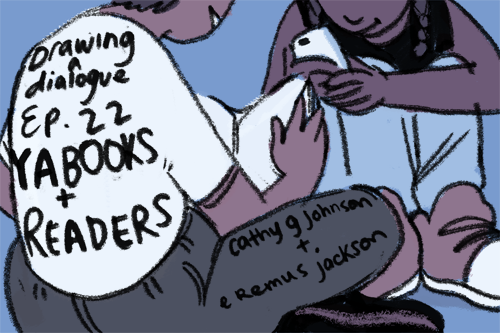
 Artwork by e jackson.
Drawing a Dialogue is a podcast discussing comics in historical + educational contexts by Cathy G. Johnson + e remus jackson. Episode 22: Cathy + e talk about Young Adult (YA) books + readers! e starts out by sharing the history of the YA genre, how books began to be marketed to an adolescent audience, + who is actually reading them. Cathy then talks about young adults in classrooms, including reading habits, new technologies + how comics can be used to teach a broader understanding of literacy. Contact: drawingadialogue@gmail.com, Twitter Subscribe: iTunes, or any podcast app you may use!
 Episode Links: From Romance to Realism, Michael Cart, 1996, HarperCollins “Institutionalizing The Outsiders: YA Literature, Social Class, and the American Faith in Education,” Eric L. Tribunella, 2007 - Link Go Ask Alice Wikipedia page - Wiki Critical Foundations in Young Adult Literature, Antero Garcia, 2013 - Link “Middle Grade Storytelling Goes Graphic,” Brigid Alverson, 2018 - Publishers Weekly Twenge, J. M., Martin, G. N., & Spitzberg, B. H. (2018, August 16). Trends in U.S. Adolescents’ Media Use, 1976–2016: The Rise of Digital Media, the Decline of TV, and the (Near) Demise of Print. Psychology of Popular Media Culture - Link Nippold, M. A., Duthie, J. K., & Larsen, J. (2005). Literacy as a Leisure Activity: Free-Time Preferences of Older Children and Young Adolescents. Language, Speech & Hearing Services in Schools, 36(2), 93–102. Cockroft, C., & Atkinson, C. (2017). “I Just Find It Boring”: Findings from an Affective Adolescent Reading Intervention. Support for Learning, 32(1), 41–59. Kids + Family Reading Report 2019 - Scholastic Scoring with reading: to engage adolescent African American males in reading, books must reflect their lives, say author Walter Dean Myers, educator Alfred Tatum. (2007). Reading Today, (2), 40. Park, J. Y. (2012). Re-Imaging Reader-Response in Middle and Secondary Schools: Early Adolescent Girls’ Critical and Communal Reader Responses to the Young Adult Novel “Speak.” Children’s Literature in Education, 43(3), 191–212. Ivey, G. (2014). The Social Side of Engaged Reading for Young Adolescents. Reading Teacher, 68(3), 165–171. Kendall, A. (2008). Playing and resisting: rethinking young people’s reading cultures. Literacy, 42(3), 123–130. Alvermann, D. E., Hagood, M. C., Heron-Hruby, A., Hughes, P., Williams, K. B., & Yoon, J.-C. (2007). Telling Themselves Who They Are: What One Out-of-School Time Study Revealed about Underachieving Readers. Reading Psychology, 28(1), 31–50. Carter, J. B. (2011). Graphic Novels, Web Comics, and Creator Blogs: Examining Product and Process. Theory Into Practice, 50(3), 190–197. Teaching multimodal literacy through reading and writing graphic novels, MP Cook, JSJ Kirchoff, Language and Literacy 19 (4), 76-95, 2017 Moni, K. B., & Jobling, A. (2001). Reading-related Literacy Learning of Young Adults with Down Syndrome: findings from a three year teaching and research program. International Journal of Disability, Development & Education, 48(4), 377–394. Rogers, M. F., & Myles, B. S. (2001). Using Social Stories and Comic Strip Conversations To Interpret Social Situations for an Adolescent with Asperger Syndrome. Intervention in School and Clinic, 36(5), 310–13. Kilickaya, F., & Krajka, J. (2012). Can the Use of Web-Based Comic Strip Creation Tool Facilitate EFL Learners’ Grammar and Sentence Writing? British Journal of Educational Technology, 43(6), 161–165.
Letters to the Editor Theme song by Downtown Boys Permalink |



.png)
 More
More
 Religion & Spirituality
 Education
 Arts and Design
 Health
 Fashion & Beauty
 Government & Organizations
 Kids & family
 Music
Music News & Politics
 Science & Medicine
 Society & Culture
 Sports & Recreation
 TV & Film
 Technology
 Philosophy
 Storytelling
 Horror and Paranomal
 True Crime
 Leisure
 Travel
 Fiction
 Crypto
 Marketing
 History
 Comedy
 Arts
Arts Games & Hobbies
 Business
 Motivation