|
Description:
|
|
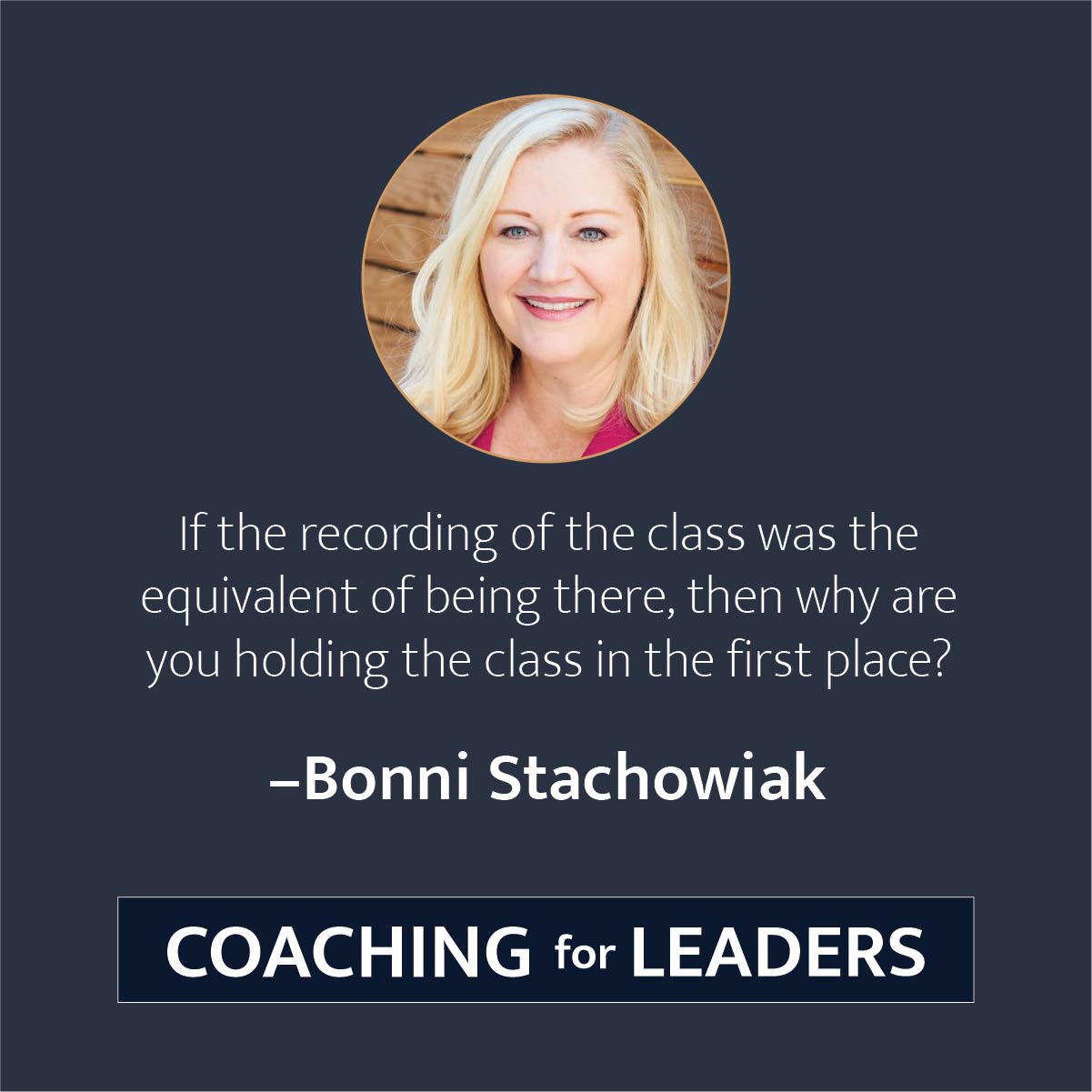 This week, we dedicate the entire show to community questions about training. This week, we dedicate the entire show to community questions about training.
Guest: Bonni Stachowiak (@bonni208)
Question from Jordan
I am a young manager (mid-20 s). My job requires training large amounts of staff on software and technology. Many of the staff are twice my age, and tend to ignore me when giving trainings. I m, not sure if this is because of my age, or because I have only been with the organization for 5 years, and many of them have been here for 20+. Or perhaps it is because of the subject matter of the trainings? Do you have any suggestions on how to get through to them?
2nd Question from Jordan
Do you have any suggestions on conferences one can go to, to expand skills on leadership and coaching?
- Bonni says a conference is a place to build a network, generate new ideas, and learn about new products
- Dale Carnegie Training provides a great resource for changing behavior, which is a great way to get better and leadership and coaching
Question from Kris
I am a manager in a large company and managing a global transformation programme. I am at a cross roads and my development plan includes getting more training on the following: (a) Leadership of global teams (physical and virtual) and (b) Strategic planning and organizational development (how does one define and develop a global organization, roles, numbers of people, strategy, governance, teams, processes, etc) to
implement a global transformation programme. Do you have recommendations on books, education or coaches for my further development?
Question from Suzie
Audio comment
Question from Andres
In a world of free online courses and MOOCS (Massive Open Online Course); what type of course would you be willing to pay for? What type of content/delivery would definitely be worth spending your (not your employer s) money on?
Question from Elmer
How do you make training accessible to the newest employee while bringing something to the table for the most experienced manager? I usually try to leave the conversation open for the subject matter experts in the room to share their knowledge (within reason and on topic) so there is a feeling of collaboration and not speaking down to them in those situations. Creating a course that is comprehensive is difficult.
- Dave suggests segmenting the training, if possible.
- How can you get the subject matter experts engaged in a leadership capacity in the classroom?
- Use a problem-based or case study approach. This engages the more knowledgable people in the room.
2nd Question from Elmer
One of our bosses/stake holders wants us to make our classes archiveable or semi-future proofed so we do not have to constantly go back and re-teach the classes one on one. What are some of the best ways to do that?
What experience and wisdom can you lend to any of our answers above?
Feedback
Thank you to Frank Preston, Jason Forney, Jordan Davis, Christopher Walloch, Jennifer Ikuenobe, Lisa Ner, Amy Mishra, Mark Adkison, Jerry Currier, Joseph Vrataric, Garry Grimwood, Natasha Merrick, Grant Gieseler, Marcela Hernandez, Laura Cristiano, Brian Mosher, Justin Stearns, Sylvia Naidoo, Joanne Farina, Shannon Boatwright, and Qi Meng.
The post 135: How To Get The Most Out Of Training appeared first on Coaching for Leaders. |



.png)
 More
More
 Religion & Spirituality
 Education
 Arts and Design
 Health
 Fashion & Beauty
 Government & Organizations
 Kids & family
 Music
Music News & Politics
 Science & Medicine
 Society & Culture
 Sports & Recreation
 TV & Film
 Technology
 Philosophy
 Storytelling
 Horror and Paranomal
 True Crime
 Leisure
 Travel
 Fiction
 Crypto
 Marketing
 History
 Comedy
 Arts
Arts Games & Hobbies
 Business
 Motivation