|
Description:
|
|
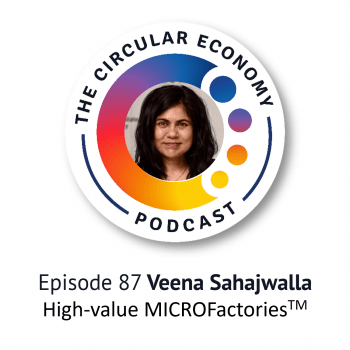
Professor Veena Sahajwalla, founder of UNSW SMaRT Centre, is an internationally recognised materials scientist, engineer, and inventor who is revolutionising recycling science.
In 2018, Veena launched the world’s first e-waste MICROfactorieTM and in 2019 she launched her plastics and Green Ceramics MICROfactoriesTM, another breakthrough for recycling technology.
Veena unpacks the concepts of micro-factories and micro-recycling, and we hear why it’s important to get clear on the constituent materials in waste flows – for example, not just textiles, but what the textile is made from.
Veena explains the importance of thinking beyond the manufacture of the recycled material, so you are designing solutions that are properly suitable for high-value end-products. Veena also describes how the projects are collaborating with industry partners, helping open up opportunities for important local jobs, skills and resilient income streams.
Podcast host Catherine Weetman is a circular economy business advisor, workshop facilitator, speaker and writer. Her award-winning book: A Circular Economy Handbook: How to Build a More Resilient, Competitive and Sustainable Business includes lots of practical examples and tips on getting started. Catherine founded Rethink Global in 2013, to help businesses use circular, sustainable approaches to build a better business (and a better world).
Stay in touch for free insights and updates…
Read on for a summary of the podcast and links to the people, organisations and other resources we mention.
You can subscribe to the podcast series on iTunes, Google Podcasts, PlayerFM, Spotify, TuneIn, or search for “circular economy” in your favourite podcast app. Stay in touch to get free insights and updates, direct to your inbox…
Don’t forget, you can use our interactive, searchable podcast index to find episodes by sector, by region or by circular strategy. Plus, there is now a regular Circular Economy Podcast newsletter, so you get the latest episode show notes, links and transcript delivered to your inbox on Sunday morning, each fortnight. The newsletter includes a link to the episode page on our website, with an audio player. You can subscribe by clicking this link to update your preferences.
Links we mention in the episode:
- A Circular Economy Handbook: How to Build a More Resilient, Competitive and Sustainable Business – buy from any good bookseller, or direct from the publisher Kogan Page, which ships worldwide (free shipping to UK and US) and you can use discount code CIRCL20 to get 20% off. It’s available in paperback, ebook and Kindle. If you buy it from online sources, make sure you choose the new edition with an orange cover!
- Sign up to get the podcast player and shownotes for each new episode emailed to your inbox
- SMaRT Centre website: Welcome to SMaRT@UNSW | SMaRT@UNSW
- LinkedIn: https://www.linkedin.com/in/veena-sahajwalla-3a79b420/
- Twitter: VeenaSahajwalla
About Veena Sahajwalla
Professor Veena Sahajwalla is an internationally recognised materials scientist, engineer, and inventor revolutionising recycling science. She is renowned for pioneering the high temperature transformation of waste in the production of a new generation of ‘green materials’ at the UNSW Sustainable Materials Research and Technology (SMaRT) Centre, where she is Founding Director.
Professor Veena is the inventor of polymer injection technology, known as green steel, an eco-friendly process for using recycled tyres in steel production. In 2018, Veena launched the world’s first e-waste MICROfactorieTM and in 2019 she launched her plastics and Green Ceramics MICROfactoriesTM, a recycling technology breakthrough.
Veena is the director of the ARC Industrial Transformation Research Hub for ‘microrecycling’, a leading national research centre that works in collaboration with industry to ensure new recycling science is translated into real world environmental and economic benefits. Professor Veena has also been appointed hub leader of the national NESP Sustainable Communities and Waste Hub. In 2021, Professor Veena featured in the ABC’s Australian Story and named the 2022 NSW Australian of the Year.
Interview Transcript
Provided by AI – add ~40 secs for the finished episode
Catherine Weetman 02:01
Veena, thanks so much for taking the time to join us on the circular economy podcast, so that we can talk about the work you and your colleagues are doing on the micro factories and micro recycling concepts. And I’m really interested to know more about that. So could we start by asking if you could unpack that a bit for us? What are micro factories?
Veena Sahajwalla 02:22
Yeah, thanks, thanks for having me, Catherine. And micro factories are really all about showing that production in a decentralised way of all kinds of value added products that we need in our lives can be done in a local and regional setting where the predominant feedstock and the material is a waste resource. And micro factories are ultimately about creating value from waste. So that no matter what we have, whether it’s coming from our homes or offices, we’re not kind of detaching ourselves from the notion that well, it’s somebody else’s problem. But rather taking that responsibility so that we can indeed start to say, what does it take to build that local ecosystem? And if we have to build that local ecosystem? You know, what are the benefits of doing that? It’s pretty obvious when you stop and think about it, that micro factories actually, as we have shown in setting these up and regional communities in Australia, is that we can create local jobs. And to me that’s so important, it gets people excited about the fact that waste is not a burden on our environment. Waste is really just another material that is a resource that is waiting to be harnessed. So we can imagine that the full circularity of different kinds of materials and their transformation. And not always seeing that there’s always going to be the like for like conversion, which is what we tend to think recycling is all about luck, rather to think that if we can’t convert the same product into that like for like conversion, that’s okay. What we are really saying is that the micro level that micro recycling, is getting right down at that final level of detail. And saying, Now, I should see a product not just as a piece of textile waste, or or glass waste, but rather to see those as important materials. And what would that transformation look like if we were able to apply those concepts of micro recycling where the transformation is such that that fabric that went into into the production doesn’t come out as a fabric. In fact, waste textiles and glass get converted into our green ceramic products. So to get this we’ve got a nice soft fabric, and of course, hard glass, and of course, our micro factories and how we manufacture in our micro factories. But at the micro recycling transformation level, which is what we’re really talking about here is really to reform those materials. And by reforming it, we’re actually showing that it is possible to actually produce a whole new product, which is the most important thing is of high quality. And yes, those green ceramics are what we then using for various building applications. And that’s really what micro factories is all about. It’s about showcasing that ultimately, it’s really about those economies of purpose. And economies of purpose can be brought to life, you know, we really stop and think, What is the purpose in a given community or in a given regional town, if we want to have that ability to bring more manufacturing into those regions, bring local jobs, do our own recycling and reforming, we need to be able to actually encourage and support those local local actions. And circular economy in action is the way we will deliver impact. And that’s really what microfactory is all about.
Catherine Weetman 06:00
I think there are so many fascinating aspects to that. So just to bring it to life a bit if we could talk about that green ceramics example. Just so people get a clearer picture in their mind. So we’re using textiles and glass, found locally. So are the other textiles? Do they need to be any specific textiles? Or can you use typical textile waste, which is, you know, a mixture of natural fibres and synthetics and so on?
Veena Sahajwalla 06:36
So Catherine, I always, yeah, so I always talk about the fact that, you know, when when we talk about raw material and feedstock, you know, we have to also remember that in any manufacturing operation, that control of that input feedstock is important. And so part of what we have developed in terms of micro recycling solutions, is exactly that, that we need to understand what these different kinds of fibres are, what are the different input materials coming from, of course, textiles. And then the other part, of course, is glass. And we’re creating a highly integrated product between two materials that wouldn’t normally come together. So part of this is very much about also saying that, you know, when designing these solutions, whether fundamentals of materials science has to deliver, ultimately into a high quality product. So part of what we do with our micro recycling science is that behaviour of those materials at the micro level, and that then allows us to put them on under micro factory settings, and creating these kinds of green ceramics that then allow us to create, you know, robust, and solid products were, of course, these materials, but coming together, they actually, interestingly, give us all that high performance that we are after. So if you want to put into floor tiles, you know, what is the expected standard in terms of performance? And that’s the important question there. That, you know, we need to be able to always look at it, not from just the point of view of input, but really go back and say, What does manufacturing do to these materials, and ultimately, the product that you make? Is it fit for purpose? But because it’s no point, somebody making a feedstock, and saying, Oh, look, I’ve made these pellets to get it out there. And I’m going to hope that there is a market for it. And what we are saying is that you can’t just be in the world of recycling remanufacturing without having an appreciation for the finished product that you want to make.
Catherine Weetman 08:36
I think you’re really what I think you raise a really a really interesting point. And that was something that Colin church, from the Institute of minerals, metals, and mining, think I’ve got that right – IOM3,in the UK. He raised that and said that often with modern supply chains, those involved at the beginning, in the material development and so on, have no visibility of the kind of end uses for their product. So they’re not able to optimise the design of it. So think this whole system perspective and thinking, what product could we create that’s needed locally? That’s high value and obviously meets any performance specifications. And I guess ideally, is in some way better than the existing alternative whether it’s because that’s, you know, better from a sustainability point of view or even just just the fact that it’s it’s local, or whatever, but But you know, how can it compete, but just to come back to make sure I’m really fascinated to understand more about the process, I guess for the feedstock. So are you have I understood that you take whatever batch of textiles you get at that time, and then look to see what the particular chemical properties of that batch are once it goes through the recycling process, and use that to then determine the specification of this week’s end product. Is that how it works?
Veena Sahajwalla 10:17
Well, I mean, we do have both aspects, you know, when you think about textiles, though, the way it performs is one, it’s actually, you know, seen as a material that undergoes, of course that transformation in in, of course, the way those molecules work in that system. So there’s
Catherine Weetman 10:36
that. So we’ve got the fibres, and to make sure I understand it. So we’re, you’re not trying to get something down to a granular level are you working with, with the fibres themselves? Yeah, that’s right, that makes more so
Veena Sahajwalla 10:50
you might, you might have these kinds of fibres, materials I’m holding, holding this up, you can see that it’s about the fibres. And of course, it’s also about, you know, ultimately, the kinds of colours that come into these kinds of products come from this textile. So there is both that engineering side of it, in the way these materials work at a micro level, is how that fibre gets integrated into the whole structure, and how it all gets bonded together. Absolutely. So that’s, that’s one side of it. But then the other side of it is, you know, the aesthetics part of it. Because, of course, the love in the kinds of things we were producing is, you know, how do we create these products that represent, you know, the local colours. And of course, we produce, for example, different kinds of green ceramic tiles, all of these made from, you know, perhaps textiles that people might have from their old uniforms, for instance. And so if there is there is that emotional connectivity as well. But you’re absolutely right down at the, at the fundamental level of fibres, and each of the other sort of, you know, materials that are there in a hybrid blend. That high end, of course, without getting into those details, now performs is multifunctional. And so that’s really why what we are really trying to do is see different kinds of textiles, not just as something that puts in the colour, I mean, that’s the obvious, you know, outcome, you can see that it looks looks pretty amazing. But on the other hand, there’s also other other transformations at the micro level that these textiles undergo. And this is why of course, the way we produce it. Of course, it’s a patented process that allows us to really fine tune, which is what our research of micro recycling has shown us. And that then allows us to fine tune that input in the right blended form, to be able to have that blend, then be able to be manufactured in the form of Britain ceramic tile. So yes, there is there is a lot of fundamental science that then allows us to incorporate and create those various hybrids, which are again, fit for purpose.
Catherine Weetman 13:05
Yeah, and I guess there’s no end of interesting stories you can create, you know, for using sort of small batches of input products, you know, end of end of use textiles, and so on the uniforms example that you that you gave, it reminds me of Elvis and Kresse, who make very high quality bags, belts, wallets, and so on, out of end of life fire hose, which is, you know, laminated a really complicated product. But of course, you know that that end of life products have saved hundreds, if not 1000s of lives, and can go on for years and years and years as a belt or wallet. So how do you decide? What kind of waste materials to use? Are you? Are you led by the science of what could we transform this into? Or are you led by the, you know, what’s very problematic in the local area?
Veena Sahajwalla 14:02
I mean, it’s got to be always on both ends of that spectrum. You know, on one hand, the science is exciting. And we will be looking at scientific solutions for things like E waste for batteries. So we’re developing our micro factories, and that micro recycling science for some of the more complex waste products like our batteries, but on the other hand, of course, we know that when it comes to community needs, you know, batteries are going to be an important question moving forward, people are concerned about broadly how to recycle energy storage devices, you know, whether whether we’re talking about the little handheld systems or the larger, you know, batteries like solar batteries. I mean, in all these cases, we recognise that these material resources are indeed limited resources on the planet. So we’ve really had a lot of energy that has gone into making them in the first place. So why would you not go after the kinds of metals that they contain. But really, you know, go after it in a way that you can create clean and green processes. So that businesses that are really looking to, ultimately how recycling of batteries, for example, or erase more generally can occur. also recognise that it’s not just here’s one big solution. And that’s all it is. But recognise that there are multiple pathways to be able to get a particular element, or you know, an oxide. So if you want to get to zinc oxide, you can source that zinc, for example, from selling the batteries. And so then to be able to say, okay, aha, so if I had that zinc oxide, now I’ve got a rather expensive material that I can source from waste. And in all of these cases, again, going back to that point about, you know, what kind of quality material and product do I make? And is that going to be good enough to meet the requirements for the user who’s going to take that, and put that into into their application? So I think, to me, whether we’re talking about green ceramics, or indeed a lot of our concrete metals, know, these cases, they have to have that quality, you know, component in that thinking, you know, whether it’s around the chemistry or whether it is around the end product properties, how waste resources come together, and how they are, you know, transformed in that collective. Like we were talking about, you know, whether these are making of our green ceramics, or what do we make with old batteries in terms of, you know, metals. In all of those cases, we’ve got materials that are mixed up. And of course, it is near impossible to unpack that because these are rather complex materials. It’s not just physically crushing up glass, or shredding out plastics and saying, Okay, well, here it is shredded, or crushed glass or whatever. Now, we’re talking about even more complex materials, like all the all the mass that is present inside of batteries, and of course, that E waste. So we’ve certainly got to deal with the fact that there may well be some metallics, they may well be some plastics, and the structures of more and more complex product is the reason why of course we talk about micro recycling, you know, how do you on a circuit board start to think about producing both copper alloys and tin alloys? Because both copper and tin are present, and they’re both important. But how do you go about making that without necessarily using a smelter? Because of course, you can throw everything in a smelter. And you can say, look, I mean, you know, the big grand big smelter will look out for it. But what if we are talking about decentralised solutions, that the advantage of what we talk about in terms of some of the techniques that we have developed, those fundamental techniques allow us to isolate these different metals, so you can bring about that isolation, and ultimately, your one single input, you know, let’s say this, a circuit board can be isolated into these different metallic alloys like copper based or tin based alloys. And that’s important, because they’re not gonna be somebody who is processing e waste, but I know I can create these different kinds of alloys for various markets. And of co |



.png)
 More
More
 Religion & Spirituality
 Education
 Arts and Design
 Health
 Fashion & Beauty
 Government & Organizations
 Kids & family
 Music
Music News & Politics
 Science & Medicine
 Society & Culture
 Sports & Recreation
 TV & Film
 Technology
 Philosophy
 Storytelling
 Horror and Paranomal
 True Crime
 Leisure
 Travel
 Fiction
 Crypto
 Marketing
 History
 Comedy
 Arts
Arts Games & Hobbies
 Business
 Motivation