|
Description:
|
|
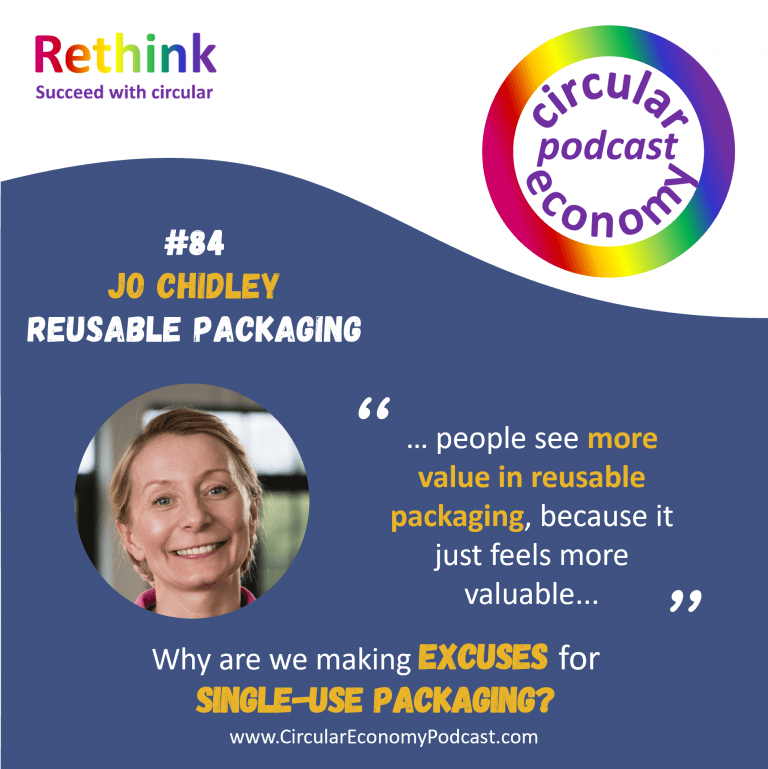
Catherine Weetman is in conversation with Jo Chidley, a circular economy expert, chemist, herbal botanist, and co-founder of TWO successful circular economy businesses, Beauty Kitchen (which is on a mission to create the most effective, natural and sustainable beauty products in the world) and the business we’re focusing on today, ReRe. ReRe is a buy anywhere, return anywhere, reuse anywhere alternative to single-use packaging, helping retailers, brands and consumers to switch to Reuse & Refills across a wide range of products from milk to moisturisers and pasta to protein.
Widely regarded as one of the pioneers of sustainable beauty since founding Beauty Kitchen back in 2014, Jo Chidley has been instrumental in developing the world’s first closed-loop solution for beauty packaging and has powered the service behind the ground-breaking Re programme & Refill Stations. Thanks to her leadership, Beauty Kitchen is recognised on the UK’s 50 Most Disruptive Companies list and has won numerous industry awards.
Jo is now championing a Reuse Revolution through ReRe – which is the new brand name for Return-Refill-Repeat. Jo talks us through the many barriers – or excuses – that are blocking progress towards reusable packaging, and highlights some of the benefits including customer engagement and carbon reduction. You’ll probably be shocked by the proportion of GHG emissions created by the packaging of everyday products.
Jo explains the transformational potential of reusable packaging, and explains how ReRe is changing the brief for packaging designers – beyond the usual questions: can you make it cheaper, can you make it lighter and so on.
Jo tells us about the importance of turning competitors into collaborators, and why the system – the infrastructure – is the most difficult part of scaling out reusable packaging. We talk about how to make it convenient, and attractive, for people to return the packaging for another cycle of use.
To explain an acronym Jo uses – DRS – that means Deposit Return Schemes, which are regulations that say retailers have to provide take-back options for certain products or packaging, with customers paying a deposit when they buy the original product, and getting that deposit back when they return the item. For example, Scotland is introducing a deposit return scheme, so when you buy a drink in a single-use container you will pay a 20p deposit, which you get back when you return your empty bottle or can. That scheme goes live in August 2023.
Early on, Jo mentions a figure for the plastic packaging produced by the FMCG (Fast Moving Consumer Goods) sector each year. I wanted to give you a link to that statistic, but in looking for it, I discovered several different numbers for plastic packaging production, all from reputable sources. The figures range from 141 million tonnes to 171 million tonnes a year, across all industries. I’ll include links to those reports in the shownotes.
Podcast host Catherine Weetman is a circular economy business advisor, workshop facilitator, speaker and writer. Her award-winning book: A Circular Economy Handbook: How to Build a More Resilient, Competitive and Sustainable Business includes lots of practical examples and tips on getting started. Catherine founded Rethink Global in 2013, to help businesses use circular, sustainable approaches to build a better business (and a better world).
Stay in touch for free insights and updates…
Read on for a summary of the podcast and links to the people, organisations and other resources we mention.
You can subscribe to the podcast series on iTunes, Google Podcasts, PlayerFM, Spotify, TuneIn, or search for “circular economy” in your favourite podcast app. Stay in touch to get free insights and updates, direct to your inbox…
Don’t forget, you can use our interactive, searchable podcast index to find episodes by sector, by region or by circular strategy. Plus, there is now a regular Circular Economy Podcast newsletter, so you get the latest episode show notes, links and transcript delivered to your inbox on Sunday morning, each fortnight. The newsletter includes a link to the episode page on our website, with an audio player. You can subscribe by clicking this link to update your preferences.
Links we mention in the episode:
- A Circular Economy Handbook: How to Build a More Resilient, Competitive and Sustainable Business – buy from any good bookseller, or direct from the publisher Kogan Page, which ships worldwide (free shipping to UK and US) and you can use discount code CIRCL20 to get 20% off. It’s available in paperback, ebook and Kindle. If you buy it from online sources, make sure you choose the new edition with an orange cover!
- Sign up to get the podcast player and shownotes for each new episode emailed to your inbox
- Beauty Kitchen website is beautykitchen.co.uk
- ReRe https://rereworld.com/
- Facebook is https://www.facebook.com/beautykitchen
- Instagram https://www.instagram.com/beautykitchen/
- Twitter https://twitter.com/beautykitchen
- You Tube is https://www.youtube.com/beautykitchen
- LinkedIn is https://www.linkedin.com/company/beauty-kitchen-ltd
- The World Economic Forum Future of Reusable Consumption report mentioned by Jo: https://www.weforum.org/reports/future-of-reusable-consumption-models
- Ellen MacArthur Foundation Global Plastics Commitment resources: https://ellenmacarthurfoundation.org/global-commitment/overview
- Greenpeace – A Crisis of Convenience: The corporations behind the plastics pollution pandemic (2018) https://www.greenpeace.org/international/publication/19007/a-crisis-of-convenience-the-corporations-behind-the-plastics-pollution-pandemic/
- Roland Geyer’s main research (I use his charts and reports in my book), with Jenna Jambeck and Kara Law: Production, use, and fate of all plastics ever made https://www.science.org/doi/10.1126/sciadv.1700782 This report says “We estimate that in 2015, 407 Mt of primary plastics (plastics manufactured from virgin materials) entered the use phase, whereas 302 Mt left it. […] Most of the packaging plastics leave use the same year they are produced, […]. For example, in 2015, 42% of primary nonfiber plastics produced (146 Mt) entered use as packaging […], whereas nonfiber plastic waste leaving use was 54% packaging (141 Mt)…” So 42% of 407 Mt is 171 Mt (for 2015). Again, that’s ALL packaging, not just FMCG.
- The World Bank publishes a presentation from Roland Geyer – p3 has plastic packaging WASTE at 46% of 343 m tonnes/year in 2018, so 158 m tonnes of plastic packaging waste https://thedocs.worldbank.org/en/doc/951211603384968172-0130022020/original/CESession3WorldBank21Oct2020RGeyer.pdf
- WRAP’s Plastic packaging web page says “The world produces 141 million tonnes of plastic packaging a year.” (again, no reference!) https://wrap.org.uk/taking-action/plastic-packaging
About Jo Chidley
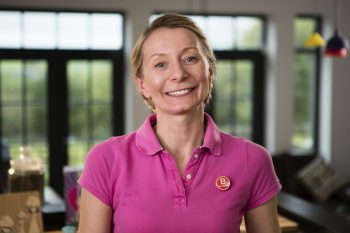 Jo Chidley is a circular economy expert, chemist, herbal botanist, and co-founder of Beauty Kitchen, the highest scoring B Corp in the UK beauty industry. Founded in 2014, Jo has set out to change the face of the beauty industry by creating the most effective, natural, and sustainable beauty products in the world. Jo Chidley is a circular economy expert, chemist, herbal botanist, and co-founder of Beauty Kitchen, the highest scoring B Corp in the UK beauty industry. Founded in 2014, Jo has set out to change the face of the beauty industry by creating the most effective, natural, and sustainable beauty products in the world.
Widely regarded as one of the pioneers of sustainable beauty, Jo is championing a Reuse Revolution through sustainable innovation by implementing Cradle to Cradle design into Beauty Kitchen’s circular approach. Among her achievements and award accolades, Jo has been instrumental in developing the world’s first closed-loop solution for beauty packaging and has powered the service behind the ground-breaking Re programme & Refill Stations. Thanks to her leadership, Beauty Kitchen is recognised on the UK’s 50 Most Disruptive Companies list and has won numerous industry awards, including ‘Who’s Who in Natural Beauty’.
Interview Transcript
Provided by AI
Catherine Weetman
Could we start by asking you to give us a quick overview of your first circular business the Beauty Kitchen?
Jo Chidley
Yeah, sure. If I just take a step back. So the FMCG industry creates over 161 million tonnes of plastic packaging every year. And sadly, as we know, most of this isn’t recycled. The global packaging industry is worth $1 trillion annually. 99%, the single use and less than 1% of the reusable packaging is smart and trackable. So when I we thought about Beauty Kitchen, so I am a chemist, but My professional background has been in human resources, working for some big brands, including Avon Cosmetics. And we wanted to disrupt the beauty industry. But when it comes to formulations, and natural, sustainable ingredients and formulations, although not all of the industry uses them, it’s something that is really well developed, where the opportunity leave for us was definitely within the packaging aspect of it, and the rest of the supply chain. So some of the things that that we have that lots of other businesses don’t is we are the highest scoring B Corp in Europe for personal care, and one of the highest scoring in the world. And that means that we can bring people planet and profit together. But alongside that, we’re also Cradle to Cradle certified and 90% of our product range. 10% isn’t certified yet, because it’s new products. But 90% of that product range is Cradle to Cradle certified. And that’s at silver or gold level. So it’s a very high level for Cradle to Cradle. Now, these two certifying bodies are not really known within the beauty industry. In fact, they’re not really known a lot outside of sustainability if I’m honest. But they were really important to be able to develop the culture of how we wanted to explore circular business models as a business, particularly within personal care, because it’s a huge industry that has a huge problem with single use packaging.
Catherine Weetman
And I think people are really getting interested on there people are realising that even though you might be able to recycle something lots of us know that that’s not really all that all that good a solution. And lots of us know that you things go off in a recycling bin, but then they end up being incinerated. So even though we’re kind of doing the right thing as as householders, and as citizens, we still feel a bit guilty about it, because we know it’s not really the solution. So I think there’s a whole growing awareness that we need to do things differently. And so can you say you kind of had the the betta kitchen with much more sustainable packaging. But what was the spur for starting to offer reusable packaging and what guided your choice of materials.
Jo Chidley
Maybe reusable packaging was always something that that was a foundation of Beauty Kitchen to start with. What we wanted to do was understand reusable packaging within personal care. So Beauty Kitchen is an indie beauty brand, we do skincare, Bath and Body. But we’ve had a little bit of fun and play around with with different packaging options. So and that includes packaging options with recycled content, or that can be recycled. One of the other elements that we did in the early days with Beauty Kitchen. And not a lot of people know this, but there’s hundreds of 1000s. In fact, millions probably billions of unused packaging sitting in warehouses waiting to go to either landfill or incineration. Because brands and retailers have have changed the packaging of a certain product. And it sits as ‘grey’ stock. Sometimes people buy that that stock and reuse it, but generally ends up going you know, where we don’t want it to go. And we introduced in the early days what was called pre cycled packaging. And that meant it was packaging that other brands and retailers didn’t want to use, but it was brand new. And as a as an an offshoot from Beauty kitchen, we thought well, we would at least like to use it once before it then goes into either the recycling system and it goes completely into the bin. So that was our starting journey of playing around with different models within the supply chain, and how to reduce waste, which ultimately is part of Cradle to Cradle principles and the circular economy at large. Whether its own brand that’s on a small scale, we could also then look at different materials. So we looked at glass, aluminium and stainless steel. And the reason why we wanted to not look at plastic was at the moment, we have a monoculture of plastic and it needs disrupting because a monoculture in any format anywhere in anything. It’s just not good diversity and celebrating diversity in any format is definitely better. So with Beauty Kitchen, we could do things on a startup scale. And what that what that did is it really got us to understand the problems within the supply chain, not just from a packaging perspective. But when you get to larger, more global businesses, how they actually have to manage their packaging. So if we look at some of the large personal care organisations, 50% of their GHG emissions comes from packaging, nuts, just huge. And that was where we realised what we had developed with Beauty Kitchen is something that could then be offered out to the FMCG industry, starting with personal care, because personal care is a relatively straightforward way for consumers to be nudged into reusable packaging. The other aspect to that as well is that we had the credibility within the industry. And we’d also gone through the pain points of the supply chain details with regards to moving to a reusable packaging system. Because it’s not just about reusable packaging. To be fair, that’s actually the kind of easy part. The difficult part is the infrastructure that sits around a reuse provider. And it was for us, we had to take the time to turn competitors into collaborators. And I guess one of the I like to come back to that competitors to collaborators, because I think that’s that’s really important. But I guess just to unpack that, you know, the the complexities of the supply chain, there’s also the cost isn’t there, if you kind of think about returning your own empty packaging to the supplier. Unless you’ve got a really convenient drop off point, then it means posting it back. And there’s a cost to that and potentially damage in transit because is the consumer going to you know, have they got a box to put it in. And that applies to everything that might come back to you know, not not just packaging, but things that might go back for repair. If the consumers chucked away the original packaging, then, you know, it could get damaged in transit and something that only needed a minor repair is now is now trashed. So there are all those challenges. Oh All of which add cost and complexity to the scenario. And you can imagine it, it’s kind of one of the things that puts lots of companies off going down that route. So, okay, so then you got the idea for what for how you are going to do this. So So what happened next? Well, what we needed to do was get a list of all of the barriers to why people are why businesses wouldn’t change from single use packaging to reusable packaging. And I’m being polite by saying it’s barriers, because really, it’s excuses. Because, you know, a barrier is something that you can overcome. And that’s why we’ve used that. So things like reusable packaging is expensive, both from a cost perspective and a carbon perspective. single use plastic LCA sure lower carbon emissions than single use glass, aluminium and steel. Packaging shape is part of a brand’s identity; you know, how do you get consumers to return empties? How do you get the empties back from stores? How do you wash it? How do you ensure the product quality refilling in store is messy and costly, it was the – and that list is not exhaustive. There’s a very very long list of putting up excuses of why reuse shouldn’t or couldn’t work, or why a brand wouldn’t want a retailer wouldn’t want to engage. And it’s but what has happened, that is definitely supported our solutions to all of those issues and all of those barriers, is market conditions. So – and you kind of touched on that earlier – so consumers, they want less plastic, consumers are willing to pay more not a huge amount of more, but they see more value in reusable packaging, because it just feels more valuable. And that’s one of the that’s been one of the key consumer behaviour ‘nudge’ points for us is when you look at plastic, as a material, as a consumer, you do not see any value in it generally. And that’s, you know, being the problem with plastic bags, plastic packaging, anything, it’s not really seen as something that you think is a value to you. And also alongside the fact that you maybe don’t want plastic anymore, it doesn’t then set with your values. And then the other things, you know, Net Zero targets, plastic pack reduction targets, your brands and retailers want to do the right thing, plastic taxes, almost here EPR is coming carbon taxes lately, you know, DRS systems are going to be launching. So there’s there’s a huge part of market conditions around making things more circular, that have obviously have helped in terms of the backdrop to the barriers that we’ve had to find solutions for. So that that has really helped. And to be able to get more brands and retailers in each in collaborating with each other. Because at the end of the day, this is not around one brand, creating a reuse system just for their brand, because that’s never going to work. Because let’s face it, you’re seeing about my shelf with all the different, you know, potions and lotions that are sitting behind here. Think about it. When you look at an online store, whether that’s a supermarket store, your bricks and mortar store or a specialist store, the plethora of different brands, if every single one of them created their own reuse system, they would never get to scale. And as we know, when it comes to the circular economy, that’s been the challenge, how do you get things to scale. So what we’ve done is we’ve come in to see here is a solution for packaging, because we know that your consumers are looking to buy your particular shampoo, or body wash or moisturiser, the packaging element of it is not really that of interest to them. But if we can place a value on that piece of packaging, and they become part of the system, then they are more likely to return it. And that’s we’re it’s about bringing brands retailers and consumers who want to participate in the circular economy, they just don’t have a way of accessing that. And packaging is a great way in a great a big opportunity to solve some big problems. And the fact that we have got know some |



.png)
 More
More
 Religion & Spirituality
 Education
 Arts and Design
 Health
 Fashion & Beauty
 Government & Organizations
 Kids & family
 Music
Music News & Politics
 Science & Medicine
 Society & Culture
 Sports & Recreation
 TV & Film
 Technology
 Philosophy
 Storytelling
 Horror and Paranomal
 True Crime
 Leisure
 Travel
 Fiction
 Crypto
 Marketing
 History
 Comedy
 Arts
Arts Games & Hobbies
 Business
 Motivation