|
Description:
|
|
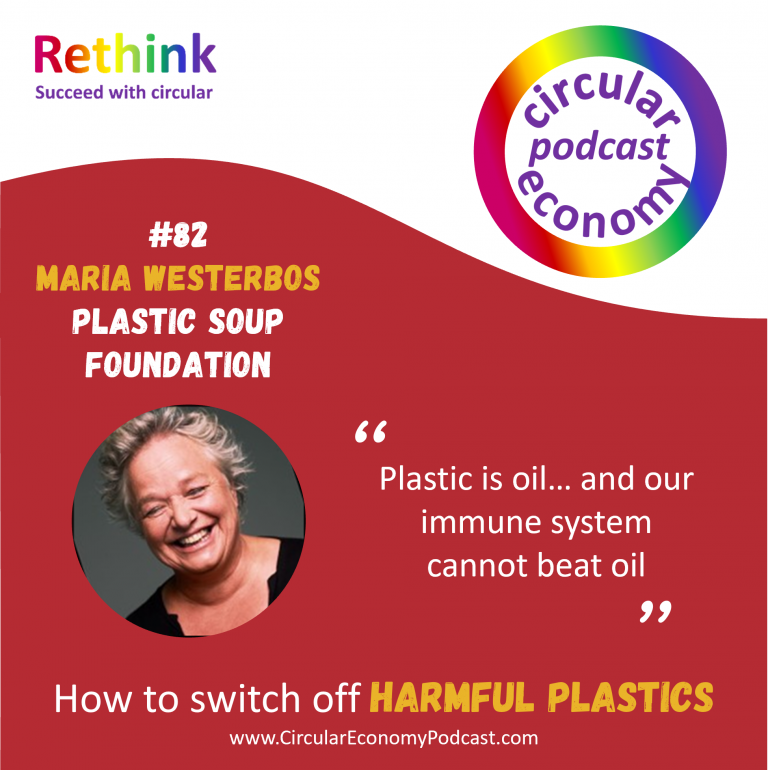
We know plastic waste is a massive problem – but do we know how plastic is affecting our health? Catherine Weetman talks to Maria Westerbos about the groundbreaking work of the Plastic Soup Foundation.
Many of us are becoming increasingly aware of the amount of plastic in our lives – whether it is clothing and household textiles made from synthetic fibres like polyester, acrylic, lycra and so on, or the anti-crease finishes, flame retardants and other additives in those fibres. And of course, there’s plastic packaging, the outer cases of phones and laptops, and much, much more. Plastic has many useful properties: it can be moulded into complex shapes, it’s light weight, flexible, durable and so on.
But now, we’re realizing there are downsides to all this – what happens when plastic is discarded, and ends up causing pollution and harm to other living species – and also, how plastic, and the chemicals it contains, is affecting our health. We know plastic particles and microfibres are now found all around the world, and are contaminating our water and food – but what about our contact with plastics in our daily lives… they are in lots of personal care products, we wear them next to our skin, we eat food that’s been wrapped in plastic.
Maria Westerbos explains why we need to understand much more about the impact of plastics on our health, and how some of the organisations that exist to protect our health are – shamefully – looking the other way.
Maria is an expert in mass communication, and she’s used her background as a science journalist, her 25 years experience working in TV and her intuition to inspire social change.
In 2011 she set up Plastic Soup Foundation. With its first campaign, Beat the Microbead, the Foundation has succeeded in changing both the perceptions and use of microplastics by international businesses, local and national governments, consumers and NGOs.
We hear how Maria found the sweet-spot to engage people with making changes to their daily lives, including the Beat the Microbead app to help you check what’s behind the product label.
Podcast host Catherine Weetman is a circular economy business advisor, workshop facilitator, speaker and writer. Her award-winning book: A Circular Economy Handbook: How to Build a More Resilient, Competitive and Sustainable Business includes lots of practical examples and tips on getting started. Catherine founded Rethink Global in 2013, to help businesses use circular, sustainable approaches to build a better business (and a better world).
Stay in touch for free insights and updates…
Read on for a summary of the podcast and links to the people, organisations and other resources we mention.
You can subscribe to the podcast series on iTunes, Google Podcasts, PlayerFM, Spotify, TuneIn, or search for “circular economy” in your favourite podcast app. Stay in touch to get free insights and updates, direct to your inbox…
Don’t forget, you can use our interactive, searchable podcast index to find episodes by sector, by region or by circular strategy. Plus, there is now a regular Circular Economy Podcast newsletter, so you get the latest episode show notes, links and transcript delivered to your inbox on Sunday morning, each fortnight. The newsletter includes a link to the episode page on our website, with an audio player. You can subscribe by clicking this link to update your preferences.
Links we mention in the episode:
- A Circular Economy Handbook: How to Build a More Resilient, Competitive and Sustainable Business – buy from any good bookseller, or direct from the publisher Kogan Page, which ships worldwide (free shipping to UK and US) and you can use discount code CIRCL20 to get 20% off. It’s available in paperback, ebook and Kindle. If you buy it from online sources, make sure you choose the new edition with an orange cover!
- Sign up to get the podcast player and shownotes for each new episode emailed to your inbox
- Plastic Soup Foundation and its campaigns have been featured extensively in top-tier titles including The Times, The Independent, The Daily Telegraph, Bild, The Daily Express, The Daily Mail, and Fast Company.
- Website: https://www.plasticsoupfoundation.org/en/
- And the Plastic Health Coalition https://www.plastichealthcoalition.org/
- Instagram: https://www.instagram.com/plasticsoupfoundation/
- Facebook: https://www.facebook.com/plasticsoupfoundationnl/
- Twitter: https://twitter.com/plasticsoupfoun
- LinkedIn: https://www.linkedin.com/company/plastic-soup-foundation/
- The report Maria mentioned, showing that almost 9 out of 10 products from major cosmetic brands contain microplastics: https://www.plasticsoupfoundation.org/en/2022/04/almost-9-in-10-products-from-major-cosmetics-brands-contain-microplastics/
- Professor Dr. Raymond Pieters’ paper https://www.plasticsoupfoundation.org/en/2021/11/plastic-particles-can-affect-our-immune-system/
- UNSSC Circular Economy 6-week online course – starts again in August 2022 https://www.unssc.org/courses/circular-economy-and-2030-agenda
About Maria Westerbos

Maria Westerbos is an expert in mass communication. She combines a taste for inspiring social change projects with strategic insight and near-flawless intuition covering a wide range of target groups.
Maria started as a science journalist but gradually became involved in the world of television. She worked for more than 25 years (primarily freelance) for broadcasting companies and production companies, initially as editor/researcher, but then as producer, production coordinator, editor-in-chief, executive producer, business-unit manager, delegated producer and creative producer.
In 2011 she set up Plastic Soup Foundation. With its first campaign, Beat the Microbead, the Foundation established change in the use of microplastics by international businesses, local and national governments, consumers and NGOs.
Maria is a flamboyant woman with a zest for life who is able to motivate groups with inspiring stories about taking a positive approach to complex problems for permanent change.
Plastic Soup Foundation
Founded in February 2011, Plastic Soup Foundation is an environmental non-profit organisation campaigning to end plastic pollution. With a passionate team, Plastic Soup Foundation gives everything to challenge the impact of plastic pollution in the environment, the oceans, and crucially, in the human body.
Based in Amsterdam, Plastic Soup Foundation has an international reach. They are the founders and organisers of the Plastic Health Summit, an annual global conference which brings together the world’s most eminent scientists to assess the latest research on how plastic affects the human body, as well as bringing forward solutions to negate its impact on our health and the planet.
Plastic Soup Foundation’s other campaigns to curb the impact of plastic waste include the Ocean Clean Wash, a campaign to reduce synthetic fibre pollution by 80 percent in the coming years, as well as launching the Plastic Health Channel in 2021 – an online channel which brings together experts and academics to discuss new research on how plastic enters and affects the body.
Plastic Soup Foundation also coordinates World Cleanup Day – the biggest worldwide cleanup action of the year – on behalf of the Netherlands.
Interview Transcript
Provided by AI – add ~3:45 mins for the finished episode
Catherine Weetman 00:00
So, Maria, welcome to the Circular Economy Podcast.
Maria Westerbos 00:04
Hi, nice to be here.
Catherine Weetman 00:06
And perhaps we could start by asking you to tell us what the Plastic Soup Foundation is, and what it aims to do.
Maria Westerbos 00:14
The Plastic Soup Foundation is an NGO, and I did fund the organisation 11 years ago. And what we try to do is stop plastic pollution at the source. So we do not clean up beaches or the ocean, what we do is trying to stop leakage to the environment of plastic.
Catherine Weetman 00:38
So what kinds of things does that involve?
Maria Westerbos 00:42
Well, cosmetics, for example, we started 10 years ago, we started Beat the Microbead. And that was about the little beads that are in personal care products. And in the it took us 10 years, but now there are no beats anymore in Europe. In cosmetics, we we did achieve that it’s out of there, that it tasted very happy with that.
Catherine Weetman 01:11
Yeah, that’s a fantastic achievement. And so how did you go about building that campaign? You know, how did you get started and build momentum?
Maria Westerbos 01:22
Well, we started we started with, with seeing two people that they were that the ‘plastic soup’ was not a far away issue, not far from their bed, but that it’s in, in the bathroom. So that taking a shower would mean that you would add plastic to the ocean, to the environment, to waterways. And telling people that was quite a shock. And at first we reached out, especially to women, highly educated 2014, nine, that was the age group, they were very sensible for the for the message. And they started asking retailers to stop selling plastic weed beats, cosmetics with beats in it.
Catherine Weetman 02:13
Hmm. And so that’s really interesting, the connection between what you’re doing in your everyday life, and then this, this problem of the plastic soup. And just before we go further, for those who haven’t heard of the, you know, the plastic soup problem, could you tell us a little bit about what that is.
Maria Westerbos 02:31
And plastic soup is I when I for the first time heard of the plastic soup, it was as if I was struck by lightning hits, it’s about the plastic and never breaks down really it breaks down with a very, very, very small pieces, and nano plastics and even smaller where you cannot see it anymore. And and during my lifetime, when I was a kid, I had him step, which was made of wood, I had a little bike, which was made of iron and steel. And hardly anything of it was plastic. And when somebody told me, I’m a journalist, I am asked to do some research about the problems for our time and reach problems. We did not or we’re very hard to solve. And when he told me about plastic soup, as I told I was struck by lightning, I thought so plastic never goes away under my watch. I did not notice that all that plastic ended up in waterways and in the ocean. And so there is a lot of plastic in the ocean now because it went to their. And by the way it’s also in the air.
Catherine Weetman 03:52
Yeah, yeah, we’re finding out it’s, it’s everywhere, isn’t it embedded in in permafrost as it’s sunk down over the over the years and the decades. And so let’s talk about some of those issues. So as well as being in the ocean, and lots of us will have seen the documentaries. Looking at how you know it ends up inside fishers it ends up even making areas where fish can’t, you know, bigger fish can’t even swim through because it’s attached to fishing lines and all that kind of stuff, making it impenetrable. So we’ve seen the sort of health problems that it’s causing for creatures in the ocean. But there are lots of other issues starting to come to light about what happens when these plastics break down. Which ones do you think people need to know about and what do they need to know?
Maria Westerbos 04:50
What happens with the fish or what happens with a bird like the Midways and the albatross was living there? What’s happening with them? is happening with us, we are not different from any other species. And we think we are, but we’re not. So we have plastic in our blood, we have plastic in our lungs, and you need to know that that has an effect. And not only because plastic is inert, so our immune system starts attacking that plastic does not respond. And then our immune system gets stressed. And the cells explode. They’re just like little bombs.
Catherine Weetman 05:35
Wow.
Maria Westerbos 05:36
And that causes inflammation, and probably it causes diseases like cancer. And I, yeah, I can I can tell you terrible diseases, and I can predict those. But let’s not do that, because you get very sad of that. And next to that there are chemicals in all those plastics and those chemicals. We already know, for 30 years, I think at least, that those chemicals are very bad for our health. But industry or governments, both are not taking any measures against that. And that means we’re talking about infertility, talking about autism, Parkinson’s, dementia, are they are they let me not go on, because, again, it will make you very sad. And we should stop adding so much chemicals in plastic, next to the fact that we should not produce so much plastic.
Catherine Weetman 06:49
Yeah, I think those are, those are two really interesting issues, we’ve been hearing a lot about five microfibers. And we might come back to that and kind of nanoparticles. But the immune system issue, again, it you know, when you first hear about it, it seems counter counter intuitive, doesn’t it, you kind of imagine that if something’s more or less inert, then your immune system would sort of leave it alone, if it’s not causing a bigger harm. But to then find out that actually, that’s not what happens and your immune system is sort of going into overdrive. And the fact that it can’t do anything about this imposter substance and chemical and you know, solid that’s in your system, then causes even more issues with your immune system is very interesting. And you know, the chemicals, it’s kind of, I’ve just been helping to try and remove some asbestos from my parents house, so we can have some work done. And, you know, I’ve been through it before for my own houses. And it’s, you know, it’s something where, even when we knew in the 1980s, that asbestos was a problem. Even when that was out in the open, it was still legal to use it. And it was being sold off cheap. So ended up in all sorts of, of extra places. And it’s this, this, you know, this discovery, as we find often with pharmaceuticals, and so on that after 10 years, when the long term effects can be split studied, that’s when we decide that actually this is harmful. And now we need to get it out of the system. But some things like plastics, particularly, there’s just so much profit involved. That the, the funding of the resistance, just like with fossil fuels, the funding is is really powerful, isn’t it and it and it drowns out, tries to drown out voices like yours and plastic soup and lots of the other campaigners.
Maria Westerbos 08:58
At the same time, if you make if you compare it with asbestos, plastic is an oil. So it’s oil, and then it’s a little bit more than oil, we added chemicals to it. So imagine you have oil in your blood. Of course, immune system cannot beat oil, even we cannot look at the birth, which is a call to an oil spill. And then imagine that you have to take your blood and your lungs and in your veins probably. So there’s oil in your veins.. So you know, it’s something that call it by the name. And then it’s even worse
Catherine Weetman 09:40
than asbestos. Yeah. Oh, absolutely. Absolutely. It’s worse.
Maria Westerbos 09:43
It’s then the story comes about the profit.
Catherine Weetman 09:46
Yeah, exactly. Exactly. That I mean, my comparison was that even when the world started to realise that asbestos and lead and other things, there’s still this kind of resistance to it. And, you know, just ridding ourselves of it and waking up to, to the dangers. And so, let’s come back to what about the microfibers? And you mentioned nanoplastics. Earlier on, are there any specific issues that you want to highlight with those? And I would say that about 20 years ago, we started making our clothes garments from more and more from plastic. Right now. It’s 69% 69% polyester. And then I’m amongst that nylon and acrylic. Before 2030, that will be 80%. And the most shocking fact i i think is that in Holland, where we have less than 18 million people, we throw away 1 billion garments, pieces of garment, a year, 1 billion a year, wow, we are 80 million people. And that’s because you can wash Primark, Primark, clothes, clothes, you can watch them five times, and then it’s to new clothes of the Emperor. And other brands have the same issue. It’s made of such a bad quality. That and the yarn is so short, and so weak, that it breaks down, almost looking at it. And that’s an exaggeration, of course. So because of that, our garment is spreading, or entering the air, and then we breathe it in. And now we already know, we feel it’s found by scientists in living long sea living people. And in that people, and we know these very smart, very little plastic parts can get in between cells. So those garments, probably if they can enter in our blood waste, and damaging death, whatever they do. I predict that it’s not more than two years before we can say that inhaling your own garments, makes you sick. We do know nylon has that effect. People who work in Ireland factories have problems with their lungs, there’s it could be that we all suffer from it. But two years from now, we will be sure or not. Well, I think yes. Wow, well, that’s, that’s a new, new bit of information for me that, you know, there’s research emerging to say that workers in nylon factories who are in inhaling the fumes and the and the particles and so on are becoming sick. So yeah, another an |



.png)
 More
More
 Religion & Spirituality
 Education
 Arts and Design
 Health
 Fashion & Beauty
 Government & Organizations
 Kids & family
 Music
Music News & Politics
 Science & Medicine
 Society & Culture
 Sports & Recreation
 TV & Film
 Technology
 Philosophy
 Storytelling
 Horror and Paranomal
 True Crime
 Leisure
 Travel
 Fiction
 Crypto
 Marketing
 History
 Comedy
 Arts
Arts Games & Hobbies
 Business
 Motivation