|
Description:
|
|
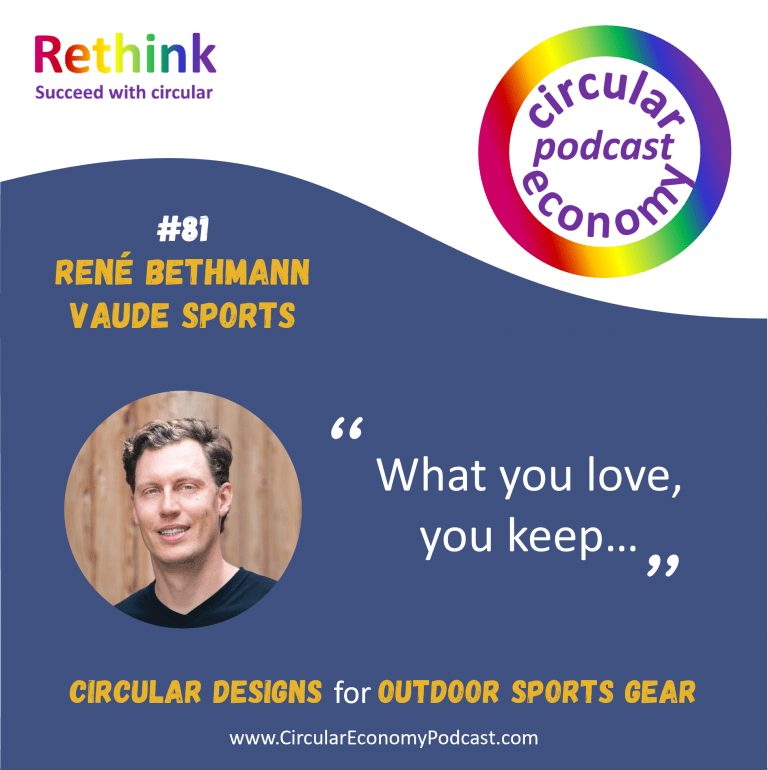
How do we navigate the tensions of having brilliant products that help us enjoy outdoor activies, yet which are difficult to repair and recycle? René Bethmann specializes in textile and apparel technology, and is leading new approaches to the design of more circular products and materials at Vaude Sports.
René focuses on emotional durability, repairability and renewable or recyclable materials. Plus, if we focus on defossilization, not decarbonization, we can unlock new ways of thinking about textiles, coatings and other materials.
Podcast host Catherine Weetman is a circular economy business advisor, workshop facilitator, speaker and writer. Her award-winning book: A Circular Economy Handbook: How to Build a More Resilient, Competitive and Sustainable Business includes lots of practical examples and tips on getting started. Catherine founded Rethink Global in 2013, to help businesses use circular, sustainable approaches to build a better business (and a better world).
Stay in touch for free insights and updates…
Read on for a summary of the podcast and links to the people, organisations and other resources we mention.
You can subscribe to the podcast series on iTunes, Google Podcasts, PlayerFM, Spotify, TuneIn, or search for “circular economy” in your favourite podcast app. Stay in touch to get free insights and updates, direct to your inbox…
Don’t forget, you can use our interactive, searchable podcast index to find episodes by sector, by region or by circular strategy. Plus, there is now a regular Circular Economy Podcast newsletter, so you get the latest episode show notes, links and transcript delivered to your inbox on Sunday morning, each fortnight. The newsletter includes a link to the episode page on our website, with an audio player. You can subscribe by clicking this link to update your preferences.
Links we mention in the episode:
About René Bethmann
 René Bethmann graduated in Textile and Apparel Technology and has worked for several leading brands across Europe in the field of product and material management (in Ticino, the Italian part of Switzerland, Norway and finally back to Germany). René Bethmann graduated in Textile and Apparel Technology and has worked for several leading brands across Europe in the field of product and material management (in Ticino, the Italian part of Switzerland, Norway and finally back to Germany).
Currently he’s working at VAUDE as Senior Innovation Manager, managing innovation processes and related projects about material and joining technologies with strong focus on biopolymers and recycling strategies.
Furthermore, since 2020 he is a consultant of the VAUDE Academy for Sustainable Management. He is a proven global speaker in the topics of bioeconomy, circular economy, and innovative material technologies with over 15 years’ experience in the sports industry.
He lives together with his wife and 2 daughters on Lindau Island, Lake Constance.
Interview Transcript
Provided by AI
Catherine Weetman
So, Rene, for people who haven’t heard of Vaude, please, could you tell us a bit about what it does? And how it started?
Rene Bethmann
Yes, so we are an outdoor and bike sports outfitter. We are located in the area of Lake Constance that’s in the south of Germany. We were founded in 1974. And we are 100% family owned, right now with a second generation. Yeah, they’re running the company. And yeah, so as the outer sports business differs through specific purpose driven products in a natural environment compared to fashion. So, as our products protects from nature elements, we do have a responsibility to protect the nature from us, particularly. So meaning we need to look on our environmental footprint. And that’s also what is within our DNA at Vaude, that we want to give the best products out but with a lowest environmental footprint. There are also trends, but no fast trends, such as in fashion.
Catherine Weetman
Yeah, and that’s, that’s a great way to think about the clothing that we need, isn’t it, that it? It protects us from from something whether that’s shoes, you know, the simplicity of shoes, protecting us from sharp things and you know, dirty things on the floor. But often fashion creates many more needs and desires. Around that which we kind of, you know, we lose sight of the essential function of, of clothing and outdoor gear, but that I really liked the idea of thinking about how the, what we buy, in terms of outdoor gear is protecting us from nature. But there has a dual responsibility to protect nature from us in terms of, you know, what happens to it at the end of life, and so on. So, I’m keen to understand more about your design thinking approach. Maybe you could tell us a little bit about your role at rowdy at Faraday and kind of how that’s feeding into the current sustainability challenges for outdoor clothing.
Rene Bethmann
Yeah, so I’m working as a senior innovation manager at very meaning do have not like a routine worker. So I’m working with everything, which is not really available yet on the market. So in our market in our in our direct supply chains, so I’m looking for new technologies, especially new materials, and we’re where we can shift a bit away from our fossil based materials towards to the renewable and recycled materials. So because due to the fact that that we have a protective factor in our products, we rely on synthetics, so meaning on fossil based materials in our industry, long time ago, when the synthetics were not really established, that were used. So we were using wool, we were using natural materials, but when you come into the protective factor and also to the comfort factor, then synthetics are offering a much higher, I would say a much higher. Yeah, the protection in this area and also in terms of comfort. So for us, it’s important that we need to shift away from those fossil based carbon targets to renewable carbon. So when we’re looking especially on the beginning of life of our products, so at Vaude with our brand material goals, we have set ourselves a goal to make 90% of our tech starts by 2024. Out from renewable and, or recycled materials. So meaning that those tech sites will have a renewable or recycled material content of over 50%. So of course, we are aiming for 100%. But due to a viability and technical barriers, it’s often not really possible to go to 100%. Also, sometimes due to economic reasons. And yeah, and also we are aiming to extend it on our component areas, such as hard plastics, and films. So
Catherine Weetman
So that’s quite an ambitious starting point anyway, isn’t it? because 2024 isn’t far off and say 90% of the material should be renewable or recycled, but just to come back to what you said you use the term from renewable carbon sources. Could you unpack that a bit for us? Is it kind of going beyond recycled materials to something else?
Rene Bethmann
Yes, exactly. So, we knowing that a bit from the renewable energy, so when we all know that we need to shift our energy sources from the fossil based one or from the nuclear power ones towards to the renewable energy sources. So there are different possibilities, there are different pillars, I would calling them like solar power, wind power, and also hydropower and some more. And as the same concept we also need for our materials. So let us say more or less all the materials we use in our industry, they are based on carbon. So meaning we need to get away from those fossil based carbon towards to the end, renewable carbon and renewable carbon, as also for the renewable energy can come from different sources that can come from biomass.
Rene Bethmann
So bio based and also waste, so bio waste, and origins, but it can also come off from recycled sources that will be probably also in the future, some major pillar, and what is coming up. It’s also the utilisation of carbon dioxide, so that we removing carbon dioxide from the atmosphere, or also from the exhaust pipes, and converting those into chemical products. So this is just an the starting phase right now. But in the next 10-15 years, this will also gain ground. So that’s why it’s not. So that for that for like things like in the renewable energy, there’s not just one single solution. There are many more solutions as several solutions to go away from the fossil base.
Catherine Weetman
Sources. Yeah, that’s interesting. And I think I think you’re right, that we’re seeing lots of development around New Generation materials, and thinking about the carbon dioxide capture and turning that into a material that reminds me of something I included in the book a couple of years ago, Dell were capturing air pollution in India, I think it was and turning that into ink that they were using on their packaging, labels, and delivery labels. And you know, that that seemed, I guess relatively simple. From a from my point of view, I’m sure it wasn’t simple at all, in terms of the development that went into it, but it shows the potential of of, you know, turning, turning something problematic into something that that can be used to replace a fossil based carbon. So but I guess the the key thing is not so much around what the materials contain, it’s, it’s what happens to them at the end of life. And how can we make sure that these materials stay in use for much much longer? So we’re, you know, we’re not allowing the doctrine of Fast, fast fashion if you like that, you know, We only need to keep things for a relatively short time and then replace them. So how do we encourage people to keep things for longer? By making them, you know, both durable and more functional? But how do we also deal with wear and tear?
Rene Bethmann
Yeah, that’s right. And so, let us start just on the challenge we have with end of life and our industry, and so in the entire textile industry. So the big problem is that we are missing collective waste streams here. And also we missing like an infrastructure, regional infrastructure, but also global infrastructure, because we have a global supply chain. So we’re sourcing from mainly from Far East, but also from Europe, from the US from more or less all areas in the world. So and just to get things back to it. It’s also a big challenge. Plus, textile product contains a lot of different materials, but also different kinds of chemicals, different kinds of finishes. So it’s very difficult yet to sort those different components out of the products. And also a feasible business models, they are so far also not really existing, because if a feasible business model would exist for this, to do the collection and the recycling, then more companies would do that. But so far, it’s not that feasible. So in the end, it’s really important, of course, for industry to have our own close loop and not relying on waste utilisation from other industries, such as, like, recycled flakes from the bottling industry. So we have a lot of discussions here in the industry, but also working here on several working groups several initiative to make it like a comprehensive approach. And as I mentioned, how can we just avoid that our stuff is ending up in the bin, you can see and, and important, of course, is that because I text our product is a basic commodity. So it’s an object of utility. So maintaining says needed a gentle care through responsible washing, for example, is important. And you also need to know that some components like a broken zipper, or even like a hole in the textile, there are a lot of signs of wear over time, but quite a few that can be repaired. So for example, just coming back to validate here, at our own Repair Centre, we can do a lot of sales, repairs for products. And last year, so 2021, we had a repair quote of 65% of the products that came in. So we are increasing also the rate here. So the quota of the products, which can be repaired in the end is also one of our aims.
Catherine Weetman
So this is this is people send their gear back to you because it’s damaged in some way.
Rene Bethmann
Not directly to us. So as we’re not selling our products directly to the end customer, we are selling it to the dealer. So the customer need to bring the stuff then to the dealer and the dealer sending it to us, okay, then goes from the logistics, that’s user and we avoiding also in the end, like too many packages to flying around.
Catherine Weetman
Sure. So of what of what the retailers and so on are sending back to you that they think is repairable. You’re managing to repair 65% of them. And then then what happens does it go back to the consumer who’s bought it brought it into the retail centre or what happens to those repaired products?
Rene Bethmann
Yeah, so the repair products, they’re joining them back to the customer. So they’re going directly to the customer.
Catherine Weetman
And did I read something about Vaude helping people do their own repairs through Ifixit?
Rene Bethmann
Yeah, that’s right. So a few years ago, we started a cooperation with IFixIt. It was known for doing repair guides and spare parts for for doing mobile phone repairs. So and we are providing year the user with repair manuals and also with spare parts, supplies so that the customer can do the repairs also by themselves. If something is broken for example, because This can happen. It’s a product, which is meant to be used in the end. And of course, it will not last forever. But you can prolong the use phase. And that’s one of the most important thing when it comes to you also to sustainability, that the products are durable. And one thing I also would like to add here is, we also developed our own repairability index, which allows us to rate the repairability of our products. And then we can also see where actually our sticking points where can we improve also, where we maybe need to design the zipper in a different way on a jacket, that it’s easier to been replaced?
Catherine Weetman
Yeah, that’s a great point. And, and I’m sure there are lots of simple things that you can do at the design stage to really help things be more repairable. And just just to come back on the I fix it, resources, because the scope of the products that the Ifixit community covers now is is growing and growing. And I found the Ifixit sort of outdoor gear section really helpful is it had a very good diagnostic to help you even decide which kind of zip you’d got. Because that that isn’t as obvious as you’d think. And, you know, I was amazed how many different types of zips that there were and, and why some of the zip replacement zip fasteners that I bought that fitted, okay, then then decided that, you know, they just wouldn’t go up and down the zip. And you know that they looked visually exactly the same, they were the right size and everything, but it turned out to not quite be the same type of zip. So that’s a great place to start before you before you embark on any repairs would be would be my advice. So, Renee, how are you How’s vow to helping people understand what’s happening behind the scenes with all your design work and the other sustainability and circular features of the products and processes?
Rene Bethmann
Yeah, so we are trying to be as as transparent as possible. We’re also setting the benchmark in the integration of different standards combined in our own equal design tool, equal design labour, we call it green shape. And yeah, our sustainability report, for example, is not just a PDF, document, what you can download, and then you can read through 100 pages. So it’s, it’s a, it’s an interactive website, where people can click through more or less all topics, which are related in terms of sustainability in our company, and also topics which are driving the industry. So, and once we are making our statements public, yes, to more or less every challenge we are facing, we are also having and the statement we also mentioning where we are working on and how we want to improve it. Of course it goes not everything at the same time. But over time, we are making yet improvements. And in addition, we also providing insights on congresses |



.png)
 More
More
 Religion & Spirituality
 Education
 Arts and Design
 Health
 Fashion & Beauty
 Government & Organizations
 Kids & family
 Music
Music News & Politics
 Science & Medicine
 Society & Culture
 Sports & Recreation
 TV & Film
 Technology
 Philosophy
 Storytelling
 Horror and Paranomal
 True Crime
 Leisure
 Travel
 Fiction
 Crypto
 Marketing
 History
 Comedy
 Arts
Arts Games & Hobbies
 Business
 Motivation