|
Description:
|
|
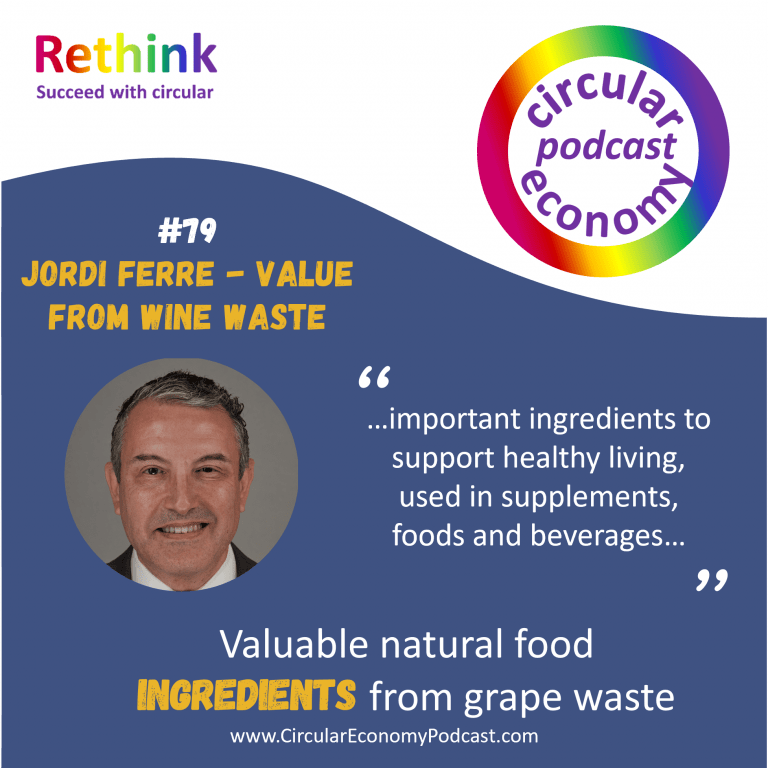
Jordi Ferre of Alvinesa talks to Catherine Weetman about creating valuable natural ingredients using waste from the wine industry.
You may be surprised to learn that, Instead of becoming waste for landfill, grape skins and other unused parts of grapes from the wine-making process can then go on to create important ingredients to support healthy living, which are used in supplements, foods and beverages.
Alvinesa Natural Ingredients based in Spain, is a “circular economy” leader of sustainable plant-based ingredients. New Chief Executive Jordi Ferre is leading the expansion of Alvinesa’s plant-based ingredients into the global food and nutrition markets.
Jordi is an accomplished C-suite business leader who brings a strong commercial and operations background in the food sector, covering B2C as well as value-added food ingredients and agritech.
Podcast host Catherine Weetman is a circular economy business advisor, workshop facilitator, speaker and writer. Her award-winning book: A Circular Economy Handbook: How to Build a More Resilient, Competitive and Sustainable Business includes lots of practical examples and tips on getting started. Catherine founded Rethink Global in 2013, to help businesses use circular, sustainable approaches to build a better business (and a better world).
Stay in touch for free insights and updates…
Read on for a summary of the podcast and links to the people, organisations and other resources we mention.
You can subscribe to the podcast series on iTunes, Google Podcasts, PlayerFM, Spotify, TuneIn, or search for “circular economy” in your favourite podcast app. Stay in touch to get free insights and updates, direct to your inbox…
Don’t forget, you can use our interactive, searchable podcast index to find episodes by sector, by region or by circular strategy. Plus, there is now a regular Circular Economy Podcast newsletter, so you get the latest episode show notes, links and transcript delivered to your inbox on Sunday morning, each fortnight. The newsletter includes a link to the episode page on our website, with an audio player. You can subscribe by clicking this link to update your preferences.
Links we mention in the episode:
About Jordi Ferre, Chief Executive Officer, Alvinesa Natural Ingredients
 Jordi Ferre is an accomplished C-suite business leader with a strong commercial and operations background in the food sector including B2C (business to consumer) as well as the value-added food ingredients and agritech sectors. He holds dual citizenship in the United States and Spain, having lived and worked in the U.S. for the past two decades. Jordi Ferre is an accomplished C-suite business leader with a strong commercial and operations background in the food sector including B2C (business to consumer) as well as the value-added food ingredients and agritech sectors. He holds dual citizenship in the United States and Spain, having lived and worked in the U.S. for the past two decades.
Mr. Ferre joined Alvinesa Natural Ingredients in September 2021. He was most recently CEO of AgroFresh Solutions, a Nasdaq-listed global leader of post-harvest solutions that extend the shelf life of fresh fruits and vegetables. Previously, he was Chief Operating Officer of PureCircle, the leading producer and innovator of great-tasting stevia ingredients. Prior positions include Vice President, Sales & Marketing SPLENDA® Sucralose at Tate & Lyle; as well as various B2C positions at Wise Foods, Chupa Chups and Warner Lambert.
Mr. Ferre holds a BBA-MBA degree from Esade Business School and completed the Program for Management Development (PMD) at IESE Business School, both located in Barcelona, Spain.
About Alvinesa Natural Ingredients
Alvinesa Natural Ingredients is a “circular economy” leader of sustainable plant-based ingredients. The company sells an extensive range of natural products made from wine grape pomace, including organic, for use in the food, beverage, nutrition, animal nutrition and wine-making industries. The portfolio includes a wide selection of polyphenols (micronutrients with antioxidant activity), colors (anthocyanins), polysaccharides, natural tartaric acid, grapeseed oil and alcohols.
Alvinesa controls a sustainable, traceable, and waste prevention supply chain. The company sources the highest quality, no- and low- pesticide grape pomace mainly from Spain’s abundant Castilla-La Mancha wine region. Alvinesa transforms 100% of the raw materials it sources into ingredients that are used to produce a range of mostly consumer products for global markets. In this way, Alvinesa preserves global food supplies by not destroying food to make ingredients. Applying thirty years of technical expertise, the company manufactures all products to unsurpassed quality standards at its low carbon footprint, state-of-the-art manufacturing facility. Instead of chemical solvents, only water is used for extraction, which preserves natural goodness. Alvinesa generates a high percentage of its energy requirements renewably onsite: 100% of steam energy (by producing its own biomass), and up to 30% of electricity (via solar power).
Alvinesa has a global presence, exporting to more than 15 countries. Visit Alvinesa.com to learn more.
Interview Transcript
Provided by AI
Catherine Weetman 00:01
What happens to grapes after the winemaking process? Hello, and welcome to the circular economy podcast, where we find out how circular approaches are better for people, planet, and prosperity. I’m Catherine Weetman, of Rethink Global. And I’ll be chatting to those people making the circular economy happen. rethinking how we design, make and use everything. We’ll talk to entrepreneurs and business owners, social enterprises and leading thinkers. You’ll find the shownotes links and transcripts at Circular Economy podcast.com where you can subscribe to updates and to our monthly edition of circular insights. Welcome back, it’s episode 79. Thanks so much to those of you who got in touch to say how much you’d enjoyed the last episode with Colin Church of IOM3. When we talked about a few of the big picture issues relating to materials of all kinds. We’d love to hear your feedback. And of course, we’re grateful for those of you who leave a positive review in your podcast app, or recommend us to your friends and colleagues. It really helps spread the word on the circular economy. onto today’s episode, you may be surprised to learn that instead of becoming wasteful landfill, grape skins and other unused parts of grapes from the winemaking process can then go on to create important ingredients to support healthy living, which are used in supplements, foods and beverages. Alvinesa natural ingredients based in Spain is a circular economy leader of sustainable plant based ingredients. New chief executive Jordi Ferre is leading the expansion of Alvinesa plant based ingredients into the global food and nutrition markets. Jordi is an accomplished C suite business leader who brings us a strong commercial and operations background in the food sector, covering business to consumer, as well as value added food ingredients and agri tech. Have a listen. And I’ll catch up with you afterwards with what I took away from our conversation. Jody, welcome to the circular economy podcast.
Jordi Ferre 02:26
Catherine, thank you very much for having me.
Catherine Weetman 02:29
Yeah, and maybe we could start by asking what Alvinesa does?
Jordi Ferre 02:34
So what Alvinesa does is take grape pomace from the wine producing process, basically what’s discarded from the wine producing process, and turn that into valuable ingredients for food for using food. And I think it’s important to understand that this is done in a very sustainable manner, first of the origin of taking a product that otherwise will be discarded, that will become a big environmental problem. You take that? So that’s the sustainability story. But then what do you do with that product is what’s more remarkable, because you actually create high value, food ingredients, and natural ingredients. So I think that’s the double thing that we do we take organic matter that otherwise will be discarded and turn it into value.
Catherine Weetman 03:31
So in the wine industry, generally then, what would happen what what kind of waste? Are we talking about? Is it just skins? Or is it batches of wine that hadn’t worked out what what kind of inputs?
Jordi Ferre 03:46
A little bit of both you had the first cycle of production during the time of harvest right away. In the winemaking process, basically, you take out the liquid, you take out the substance, and all that is dry matter or matter there is not obviously yes, dry matter is actually discarded because you don’t use that for the winemaking. So you first take that wine matter. That’s what they call grape pomace. And then that’s the first stream of raw material that we take. And then there’s a second stream, like you said, is that once the bodegas or the wine, wineries start producing the wine is cetera, there are some there are some dry matters that are left in the tanks of the wine that otherwise will be discarded. So we on a second round, we actually collect those. And we actually extract value from those. So really, it goes from the beginning of the season, through the whole winemaking process we don’t leave anything to waste.
Catherine Weetman 04:57
Yeah, that sounds interesting.
Jordi Ferre 04:58
And that second part that That matter is called lees for those that may know that there’s a lees that was left in that bottom of that tank where the wind is made.
Catherine Weetman 05:09
So the what’s left from the pressings, then when we’ve pressed the wind and got the liquid out, that’s the pomace. And then the sediment at the bottom of the fermenting tanks, which in some cases, you end up with a bit of in in your wine bottle, sometimes, though, not very often these days. Right? And the idea is to avoid drinking that because it’s a good way of getting headaches. So that sediment is called that called the lees.
Jordi Ferre 05:40
The lees. Yes, that’s a sediment that’s left. That’s very well put.
Catherine Weetman 05:45
So so how unusual is there? So you’re doing this in in Spain? For quite a few, but acres or wineries in your region? And does that happen? Do you? Do you know that that happens in other countries? Or is it something that’s still pretty unusual?
Jordi Ferre 06:05
So I will say this, I’m going to answer you in two ways. It’s very usual. But it’s very unusual. And I’m going to explain myself. The industry of extracting from grape pomace has existed for over 100 years. There are different companies that do that. Typically, the structure of those companies will be relatively small factories or distilleries like they call it. And the main goal of that was to, to extract the alcohol from the grape pomace. Typically, those will be close to the to the wineries it will be typically in a urban enclave. So it was a very small operations that were mainly geared to extract alcohol,
Catherine Weetman 07:05
and alcohol, for what purpose for industrial purposes, or today,
Jordi Ferre 07:08
the alcohol is used for both industrial. So it’s useful bio ethanol, which call industrial alcohol, but also there is obviously alcohol that’s used to do brandy to do port, and other speciality liquors. Right. So you got that. And that’s the traditional part of this industry. What’s unusual is the way we do it at all, Vanessa, because what Albinus is different from any other distillery around the world is our sheer size. So just to give you a little bit of an idea, we can process up to 300,000 metric tonnes of polymers in our plant here in the centre of Spain, I think the closest distillery in the world that you would have may do 100,000. So that’s a lot bigger. But most important, we do finish the ingredients in house. In other words, we do most of our ingredients here. So from A to Zed, we can produce those, typically the other distilleries that exist around the world, not only they would be smaller, but what they would do mainly is to extract the alcohol, and take a bunch of intermediate products that will be sold to other manufacturers that will transform it further. So what we do differences, the volume, and also the way that we valorize. And from a sustainable standpoint, you don’t have to move product around, we just do it in the same place. To your question, what’s Spain versus other countries, it’s obvious that the main wine regions in the world are in southern Europe, you got some in the southern hemisphere as well, Argentina, Chile, of course, you got California, and you got Australia, but the main wine regions are in Europe. And typically what’s interesting is in Spain in the centre of Spain, where we are located in Casa la Mancha, that’s the highest concentration of wineries in the world. So although maybe the wines here do not have the name of other origins, regions like Rio here in Spain or other places like this, from a sheer volume perspective, this is pomace is extremely abundant here. And that’s a very important thing to be close to raw material. So that’s what I say it’s usual, but it’s really unusual the way we do it.
Catherine Weetman 09:31
And the closeness that’s important, presumably not just from the perspective of the logistics cost, but also because the product is deteriorating. So the faster you get into the system, the better. So maybe you could give us some examples of the kinds of products that you’re producing from the promise and the lease. So I
Jordi Ferre 09:53
mentioned before about the alcohol, and I would say 50 It’s 50% Industrial Use 50% for for human use. And then you have an important product which is natural tartaric acid. And natural tartaric acid is typically used in wine and is used in pharma and other food applications. Okay. And so that’s an important product for the industry. Then you have another product that you extract from here from the seeds, you actually extract grapeseed oil, which is actually growing in acceptance and consumption around the world, especially markets in Asia and the United States is becoming a speciality oil for consumption that’s actually becoming very popular.
Catherine Weetman 10:47
Is that is that for cooking with or salads or as a salad things
Jordi Ferre 10:52
mainly salads cooking, that’s why it’s more precious specialities more to be tasted, seen rather than be cooked with? Because obviously there is I mean, your limitation in terms of volume was always going to be how much is the crop, right? Because you that’s the thing with circular economy, you, you take what what another stream gives you, you don’t really create a whole industry to create that. So that’s, that’s the catch. So it’s always more speciality. And then the other part is very interesting with natural colorings. Typically, it’s done with red grape. And, you know, you basically do colorings with brown to rich colours, that’s used widely in the colouring industry as a natural colour. So And finally, very important that I’m sorry, guys,
Catherine Weetman 11:42
I’m just going to ask Would that just be for food? Or could it be for fibres, fabrics and things like that?
Jordi Ferre 11:49
It will be mainly for food not for fabrics. Because that would be using fabrics will probably use non natural.
Catherine Weetman 11:56
Yeah, but there is towards more natural dyes. And so that, you know, there’s there’s quite a correct trend starting there. So I was, I was interested to know whether, but I’m guessing it’s a it’s quite a high cost.
Jordi Ferre 12:12
That’s the problem. It could be high cost not effective. And there is some limitations how much you have, but very popular, especially in for the use of foods, and beverages. And then finally, today, and I’m going to explain to you what I mean by today you have you have antioxidants. I mean, it’s widely known that wine has very good antioxidant or grape. And then wine obviously has very good antioxidant, anti oxidant properties. So what we do is we take out the polyphenols from the promise, and we sell those into the food, nutraceutical animal feed and cosmetic industries. And you know that that is a high value product that you actually take from pomace, which is one of the most with most wellness qualities that you can have and the consumption of polyphenols antioxidants has been growing, and it’s becoming more and more mainstream. So that’s an important one. Obviously, you have a whole stream of new innovation that could come in the future. Because I don’t think that we have yet extracted all the value you can from from promise, great promise, I think there’s much more that nature can give you and that’s what we looking at?
Catherine Weetman 13:35
Yeah, I’m sure you’re right there that we’re we’re gradually getting better at understanding the different elements in all sorts of biological ingredients and what we used to consider as waste. And I was interested to learn that Alvinesa is replacing some synthetic ingredients with these natural byproducts. So what kind of things would that include? I mean, it’s tartaric acid is that is that helping to replace a cheaper synthetic material,
Jordi Ferre 14:12
there is a there is a trend obviously, it’s always more natural ingredients and natural tartaric acid is potentially replacing what the stearic acid is considered synthetic. Typically synthetic stearic acid will be mostly manufactured in China. So the more efficient and the more we produce, the more we can replace that. And obviously, as you know, Catherine with the food trends today and consumption trends mean natural tartaric acid is becoming a very, very sought ingredient by some of the large food and beverage in |



.png)
 More
More
 Religion & Spirituality
 Education
 Arts and Design
 Health
 Fashion & Beauty
 Government & Organizations
 Kids & family
 Music
Music News & Politics
 Science & Medicine
 Society & Culture
 Sports & Recreation
 TV & Film
 Technology
 Philosophy
 Storytelling
 Horror and Paranomal
 True Crime
 Leisure
 Travel
 Fiction
 Crypto
 Marketing
 History
 Comedy
 Arts
Arts Games & Hobbies
 Business
 Motivation