SIOUX FALLS, S.D. Any changes made to the NCAA Division I basketball tournaments have little to do with the Summit League. It's the big boys and girls like the Southeastern Conference and Big Ten that are making the decisions in their own best interests. But the Summit League's commissioner has a message: Don't forget about us.
There were reports last week that college basketball is readying for bigger tournament fields, sooner rather than later. The changes might trickle down to the Summit League.
Josh Fenton is concerned that if March Madness is expanded from its current 68-team format to 72, 76 or even 80 teams that mid-major and low-major conferences like his Summit League will be relegated to so-called play-in games just to get into the real tournament.
"What I think is really important, and what I've stated from the Summit League standpoint, is the experience of playing in the NCAA tournament is special for all teams," the commissioner said Sunday afternoon at the Denny Sanford Premier Center between games at the conference tournament. "I respect that conferences are getting larger and they believe that they should have more access to the tournament. But we should be able to provide our student-athletes that make it to that point a meaningful experience. And is a meaningful experience just putting all of the AQ conferences into the First Four sites, or the play-in games? That concerns me a little bit."
Power leagues like the SEC and Big Ten, which have added schools in recent years, are worried worthy teams from their conferences will be left out of the NCAA field. A legitimate beef for the behemoths, but at what cost to smaller conferences?
Fenton was referring to Division I conferences like the Summit League that get one bid to the NCAAs, earned through winning the league tournament to gain the automatic qualifier (AQ). That's the carrot at the end of the stick for small Division I schools like North Dakota State, South Dakota State and others in the Summit getting to the tournament and getting a shot at upsetting a team from a bigger conference.
If the NCAA expands the tournament, Fenton's uneasiness is that the major conferences will insist smaller leagues fill the early-week spots in games just to get to the 64-team bracket. In the current 68-team field, eight teams are paired off into four of those games, played in Dayton, Ohio, that are called the First Four. The winners of those four games advance to make the 64-team bracket.
Or, in the parlance of some, the "real" tournament.
An expanded field would mean there'd be 12 or 16 teams playing games in Dayton or other locations. More teams would be shoved to the play-in games before advancing to the "real" tournament.
"My biggest thing is, and I think most people's, is preserving the special institution that is March Madness, both on the men's and women's side, and let's not get to the point of where we have two basketball tournaments," Fenton said.
NDSU's men's team knows about play-in games and the difference between those and the bracket of 64.
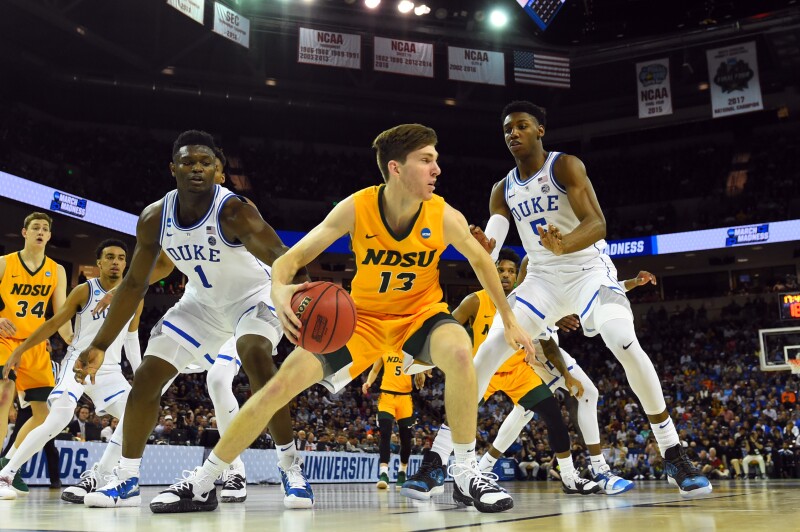 In 2019, the Bison beat Omaha in Sioux Falls for the Summit League championship. They received a 16 seed, the lowest possible, and beat fellow 16-seed North Carolina Central 78-74 in a First Four game in Dayton. That advanced NDSU to the bracket of 64, where they played No. 1 seed Duke in a game that was nationally televised as the featured prime-time event on CBS. Jim Nantz, Bill Raftery and Tracy Wolfson the network's top broadcast team called Zion Williamson's and Duke's 85-62 victory over the Bison.
Nielsen estimated 6.2 million TV viewers saw the NDSU-Duke game, by far the most eyeballs ever on a Bison sporting event.
The difference in atmosphere, television viewership and hype between NDSU's First Four game in Dayton and its contest against Duke were night and day. One felt like a play-in game, one felt like an NCAA tournament game.
That's where Fenton's fear sprouts. He doesn't want the Summit League champions automatically consigned to play-in games, to be pushed aside because the schools in his league are the have-nots of Division I.
"It speaks a little bit to the structure challenges we have within Division I," Fenton said. "If you looked at the diversity of institutions that we have in Division I, especially financially speaking. I don't need to tell you some Division I schools have $200-plus million athletic department budgets and some of our non-football members have $10 million budgets."
It's not difficult to see where the power lies.
Fenton believes the celebrations on the court at the Denny this week should lead to a shot at being Cinderella, not a second-rate game against another team from a small conference. ]]> |



.png)
 More
More
 Religion & Spirituality
 Education
 Arts and Design
 Health
 Fashion & Beauty
 Government & Organizations
 Kids & family
 Music
Music News & Politics
 Science & Medicine
 Society & Culture
 Sports & Recreation
 TV & Film
 Technology
 Philosophy
 Storytelling
 Horror and Paranomal
 True Crime
 Leisure
 Travel
 Fiction
 Crypto
 Marketing
 History
 Comedy
 Arts
Arts Games & Hobbies
 Business
 Motivation