FARGO Maybe when Katherine Lee Bates wrote “America the Beautiful” after a trip to Pikes Peak, things would have been different if she sat at Augusta National Golf Club on a perfect, sunny day. Maybe Amen Corner would be part of the lyrics.
The Holes 11, 12 and 13 are not often mentioned with the Grand Canyon, Mt. Rainier or Yellowstone Park as America’s geographical treasures but for golfers, they’re up there. Yet, when Tom Hoge plays his first round in the Masters on Thursday, he won’t be interested in being a tourist.
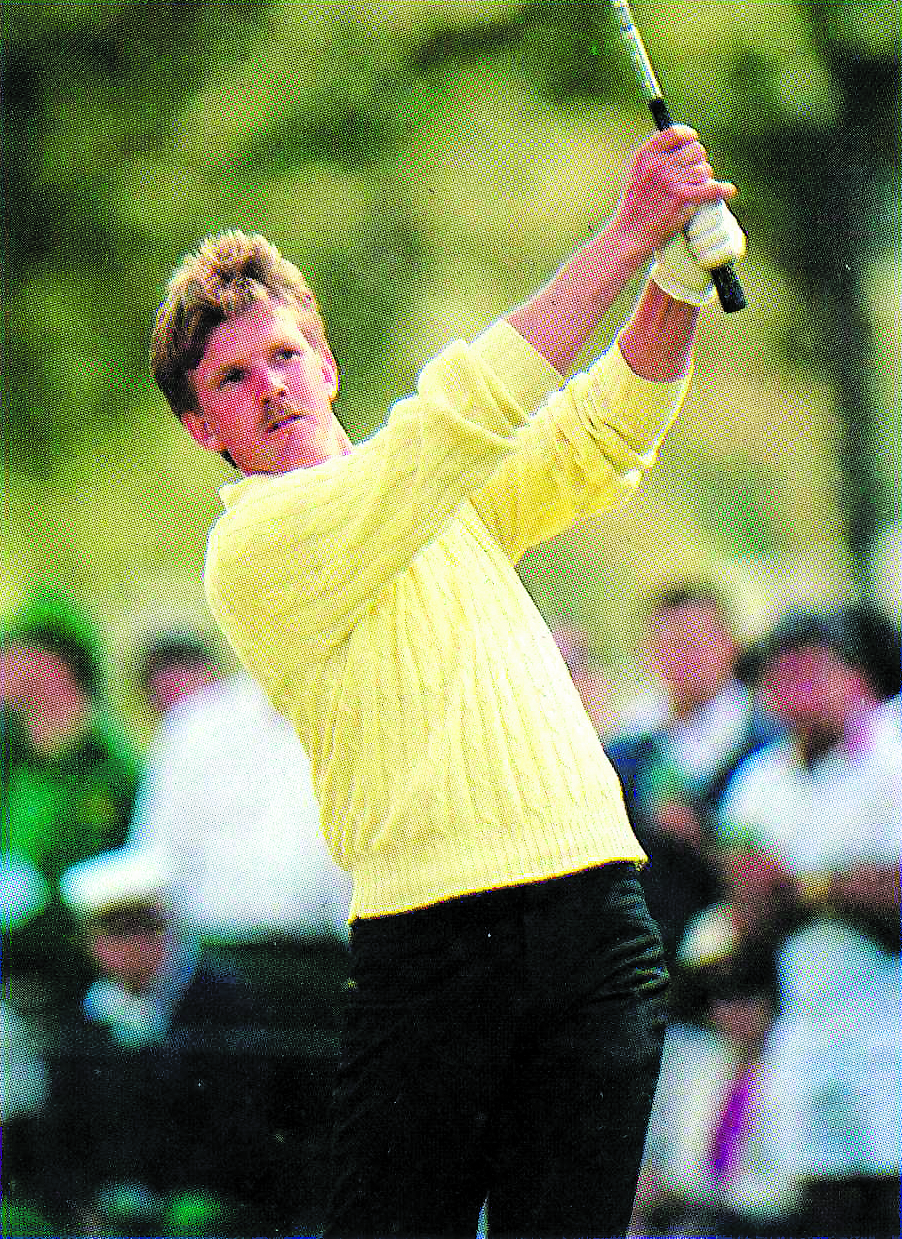
Neither was Mike Podolak, the only other North Dakotan to ever play the Masters. The graduate of Oakes (N.D.) High School and Oxbow resident made the field in 1986 by virtue of being on the 1985 U.S. Walker Cup team.
“Amen Corner is really the biggest part of the golf course,” Podolak said. “It’s the most interesting part of the golf course for sure.”
Hoge, a Fargo South graduate, qualified for the Masters after winning the Pebble Beach Pro-Am, his first victory on the PGA Tour. He arrived at Augusta on Monday and will do his usual practice and preparation Monday through Wednesday. Thursday tee times have yet to be released.
But to reach the weekend, there’s little doubt he’ll have to navigate his way through Amen Corner.
The two words were coined by "Sports Illustrated" writer Herbert Warren Wind in 1958, who has said it was inspired by the song “Shoutin’ in the Amen Corner.” With SI, Wind wrote, “At the farthest reach of the Augusta National Course down in the Amen Corner where Rae’s Creek intersects the 13th fairway near the tee, then parallels the front edge of the green on the short 12th and finally swirls alongside the 11th green.”
The allure for the spectator is how it’s laid out; fans are allowed only on one side of those three holes, leaving the natural beauty of Augusta uninterrupted on the backside of No. 11 and 12 greens and No. 13 fairway on the southernmost point of the course.
The ideal vantage point is just to the right of the 12th tee box, allowing a view of 11 green, the entire 12th hole and most of the tee shot on 13.
The three holes are not visible from 11 tee, but once a golfer reaches the top of the hill Amen Corner comes immediately into focus.
“I stopped dead in my tracks for five minutes,” said Charlie Hoge, Tom’s brother who played the course a few weeks ago. “It’s a culmination of what you watch on TV, then you realize you’re standing there. It just blew you away.”
For Podolak and Tom Hoge, it was, and is, more about the business of golf. No. 11 has been lengthened considerably since Podolak played it, one of the few on the course that is longer since the 1980s. The elevation hasn’t changed, especially from the 10th tee.
“My yardage book from 1986, which is pretty primitive, shows a 100-foot elevation drop from tee to green,” Podolak said. “That’s a big number.”
Tom Hoge said he plans on playing them “cautiously,” saying making pars on 11 and 12 puts a player in good shape. When Podolak played, No. 11 was around 450 yards. Now it’s 517.
“They took the tees back into the trees and added more length,” Podolak said. “If you make a 4 there, you’re running to the next tee feeling pretty good. It’s such a hard shot.”
No. 13 isn’t nearly as difficult. It’s a short 500-yard par-5 that because of the sharp dogleg left usually favors the right-handed hitters who play a draw. But Rae’s Creek is an ever present danger on that hole, too.
Hoge plays more of a power fade, but that won’t preclude him from reaching the green in two with a good tee shot. A huge right-to-left power draw can leave a player with a 5- or 6-iron into the green.
“The 13th is where you can make up ground,” Podolak said. “You can get it to the green and make a putt for eagle. There’s a lot of drama on that hole and it’s shaped the same way it was 40 years ago.”
The 12th over the years has also been a make-or-breaker. It’s short, at around 157 yards, but potentially vicious with Rae’s Creek directly in front and bunkers in the back. The green is more horizontal in nature, not leaving a lot of room to land the tee shot.
“I’ve seen so many rounds end up in disaster just because of that one hole,” Podolak said. “The wind swirls and you’re always trying to figure out what club to hit. A lot of balls end up in that back bunker.”
  ]]> ]]> |



.png)
 More
More
 Religion & Spirituality
 Education
 Arts and Design
 Health
 Fashion & Beauty
 Government & Organizations
 Kids & family
 Music
Music News & Politics
 Science & Medicine
 Society & Culture
 Sports & Recreation
 TV & Film
 Technology
 Philosophy
 Storytelling
 Horror and Paranomal
 True Crime
 Leisure
 Travel
 Fiction
 Crypto
 Marketing
 History
 Comedy
 Arts
Arts Games & Hobbies
 Business
 Motivation