|
Description:
|
|
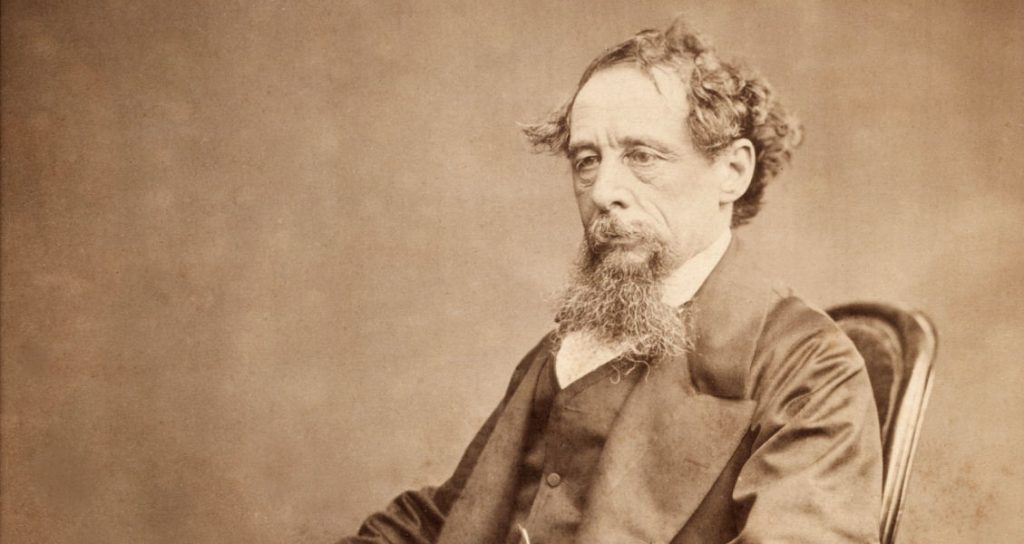 “I will honour Christmas in my heart, and try to keep it all the year” – Charles Dickens “I will honour Christmas in my heart, and try to keep it all the year” – Charles Dickens
Few writers of the 19th century are so
well-known and so beloved as Charles Dickens. He was a keen observer of society,
as well as being a writer of brilliant satire but most people know little about
Charles Dickens, outside of the fact that he wrote a couple of famous stories
that most people end up having read before they leave school.
Charles John Huffman Dickens was born on 7 February
1812 in Portsmouth, England. On the outside, it would appear that he and his seven
siblings enjoyed a fairly normal childhood. He enjoyed reading but also spent
lots of time outdoors. He had a unique ability to remember his childhood along
with the people and events of the time, and this would be a great advantage to
him when he started looking for inspiration for his writing.
His father, John Dickens was a pay clerk for
the Navy and so the first few years of Charles Dickens’ life were spent moving
around due to his father continuously being relocated, although things seemed
to settle for a few years when the family moved to Chatham in Kent when Charles
was five, during which time he received some private education. However, this
came to a crashing end in 1822 when the family was forced to move to London due
to increasing debts as it turned out that his father had been living beyond his
means.
Eventually, John Dickens was sent to debtors’ prison, effectively leaving the family without a source of income and so, as was the custom at the time, Charles’ mother, Elizabeth, and the youngest children joined their father at the prison. Charles, on the other hand, was forced to find lodgings, even though he was still only 12 years old, with a family friend called Elizabeth Roylance. He and his sisters would then visit their parents in prison on Sundays and the prison itself would feature directly as the backdrop to one of his stories, Little Dorrit.
To help support the family, pay off his
father’s creditors, as well as to attempt to maintain his own education,
Charles Dickens was forced to leave school, and he found work at the Warren
Blacking Warehouse along with other child labourers where he would often work
10 hours a day for only 6 shillings per week. Incidentally, one of the other
boys at the Warehouse was called Bob Fagin, and Dickens used his name for one
of the characters in Oliver Twist.
This went on for some months until Charles’s
grandmother died, leaving £450 to the family, which was enough to get John
Dickens released from debtors’ prison. However, Charles’ mother did not send
for him to rejoin the family, preferring that he continue to work at the
warehouse with the other child labourers, something which led Charles Dickens to
forever see women in a negative light.
Despite having such a hard life during his formative years, Charles Dickens continued to read and learn, and he also strove to perfect his own writing skills. Slowly, through finding work in journalism and also through occasionally getting his stories published in magazines, the first of which was A Dinner at Poplar Walk, which he submitted for publication in 1833, Dickens began to develop a reputation as a gifted writer. As it turned out, he wasn’t only popular with the general public as Oliver Twist and The Pickwick Papers are said to have been stories that captivated Queen Victoria, who would regularly stay up late into the night to read them and discuss them with others.
In 1835 Charles Dickens became engaged to
Catherine Thomson Hogarth, the daughter of George Hogarth, who was a writer for
the Morning Chronicle where Dickens was a journalist. The couple were married
on 2 April 1836 and went on to have ten children. This was a source of concern
for Dickens as so many children caused him financial strain and he blamed the size
of the family on his wife and the fact that she came from a large family
herself. He would eventually split their bed in half, erecting a bookcase
between them in the hope of ensuring no more children would be born.
In 1842 Charles Dickens and his wife made their
first visit to the United States, leaving their young family in the care of Catherine’s
sister, Georgina. They landed in Boston, Massachusetts and spent some time
there. Charles was appalled at the conditions suffered by slaves and was an
advocate for the abolition of slavery although there are some who say that his
criticisms didn’t go far enough. He would go on to travel to New York on a
regular basis, giving lectures and attempting to seek to establish copyright
laws to protect his intellectual property and the property of others
abroad. However, he had little success
and saw very little income from works of his that were copied and published in
America.
Dickens continued to turn out exceptional pieces
of literature and he was relatively prolific. Most of his best-known works were
actually serialised stories when they were first published before being
re-published as novels, including The Pickwick Papers, Oliver Twist, Nicholas
Nickleby, The Old Curiosity Shop, David Copperfield, Bleak House, A Tale of Two
Cities and Great Expectations among others. Of course, there were also one-off
stories, especially at Christmas time such as A Christmas Carol and The Haunted
Man.
Charles Dickens was also a strong Enlightenment-era
philanthropist and helped to establish organisations with the aim of bettering
the working conditions of the poor, seeking to make changes to labour laws to
help protect society’s most vulnerable, especially children.
In 1858, Charles Dickens and his wife
Catherine separated after Catherine found out that her husband was having an
affair with an actress called Ellen Ternan who was only 18 years old when the
45-year-old Dickens met her. In 1860, Ternan left the stage and Dickens
supported her until his death.
Charles Dickens had a close shave with death
in 1865 whilst returning home from Paris by train as he was involved, on 9 June,
in the Stapleford rail crash, which saw seven carriages plunge off a bridge
that was being repaired at the time. Dickens was travelling in the only
first-class carriage to remain on the tracks and helped to tend the injured and
dying and was always nervous when travelling by train following the incident.
During a series of readings that were billed as ‘farewell readings’ which took place between 1868 and 1869 Charles Dickens suffered a stroke and he collapsed four days later on 22 April 1869, resulting in the tour being cancelled. He decided to use the time to begin writing a new novel, called The Mystery of Edwin Drood and after recovering some strength he also gave 12 more readings running through the first quarter of 1870, but by this time Dickens was gravely ill. He made his final public appearance in the presence of the Prince and Princess of Wales on 2 May at a Royal Academy Banquet.
Charles Dickens died on 9 June 1870 at the age of 58 following another stroke, which he had suffered the day before. Despite a century and a half having elapsed since he died, Charles Dickens continues to be considered as one of history’s greatest writers, with works such as Oliver Twist and A Christmas Carol, among others being told and retold in print, film, radio, and television ever since. |



.png)
 More
More
 Religion & Spirituality
 Education
 Arts and Design
 Health
 Fashion & Beauty
 Government & Organizations
 Kids & family
 Music
Music News & Politics
 Science & Medicine
 Society & Culture
 Sports & Recreation
 TV & Film
 Technology
 Philosophy
 Storytelling
 Horror and Paranomal
 True Crime
 Leisure
 Travel
 Fiction
 Crypto
 Marketing
 History
 Comedy
 Arts
Arts Games & Hobbies
 Business
 Motivation