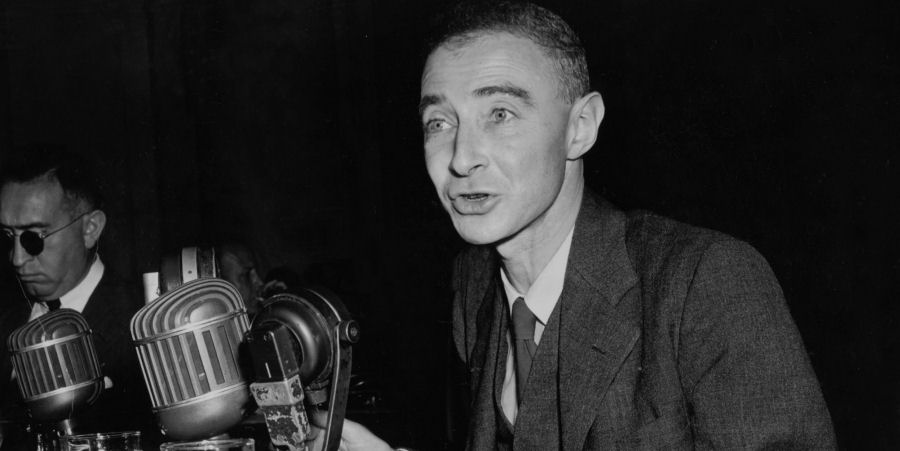
 “I am become death, the destroyer of worlds” – J Robert Oppenheimer. “I am become death, the destroyer of worlds” – J Robert Oppenheimer.There are many examples of people from history
who are immensely famous in their field but who are not necessarily that well
known otherwise. J Robert Oppenheimer is one of those figures. If you have an interest
in physics or the history of the Second World War, then you will likely have
heard of him, but otherwise, you may not. It is also true that the significance
of the contributions a person made during their lifetime may be diluted with
time and so although he may not be a household name today, there was a time
when J Robert Oppenheimer was one of the most famous scientific minds on the
planet and whose achievements shaped 20th-century physics and beyond.
Julius Robert Oppenheimer was born in New York
City on 22 April 1904. His parents were Jewish and had emigrated to the United
States from Germany in the late 1880s. Oppenheimer had an enduring love of learning
throughout his childhood. He had a voracious appetite for knowledge and advanced
so quickly through his classes that he finished his third and fourth grades in
the same year. He also skipped most of the 8th grade.
He was accepted by Harvard at the age of 18
and although his favourite study subject was chemistry, Harvard at the time
required its students to have a broader repertoire of knowledge which included
philosophy, mathematics, literature, and history. J Robert Oppenheimer was
nothing if not brilliant and by taking six courses a term he managed to catch
up very quickly in the fields where he was considered weaker. By his first year, he was accepted to
graduate standing in physics due to the extra personal study he had been doing.
This meant that he would not be required to take the entry-level classes in
physics and was able to take the advanced level ones instead, effectively
allowing him to skip ahead.
It was not long before he discovered his true passion, which was theoretical physics, gaining significant note and accolades along the way. He even assisted a Nobel prize-winning physicist during the 1930s. By 1936 he was a full professor at Berkeley although his theoretical research continued to keep him quite busy as well. During his time at Berkeley, the FBI under J Edgar Hoover started to take an interest in J Robert Oppenheimer as he was showing some communist tendencies. He had close friends and family who were either active in the communist party or who had previously been members, including his wife Kitty, his lover Jean Tatlock and his brother Frank.
His genius did not go overlooked though, and with
war escalating in Europe, the United States became concerned that it would
eventually be drawn fully into the conflict. Consequently, even before the
attack by the Japanese on Pearl Harbor in December 1941, the event which drew
the USA into an all-out war, President Franklin D Roosevelt had approved an
idea to harness the power of the atom and to as quickly as possible, develop
the atomic bomb. By the middle of 1942, J Robert Oppenheimer had been selected
to help lead the team that would eventually do so. Due to the security
clearance required to lead such a team, the FBI’s interest also grew and
Oppenheimer’s home was bugged as he was put under close surveillance.
Oppenheimer and others began considering
possible site locations for nuclear testing and Oppenheimer felt that an area
known as Los Alamos Ranch School outside of Santa Fe in New Mexico might fit
the bill. Oppenheimer had fallen in love with the southwestern United States
many years previously when an unexpected illness he had contracted whilst in
Europe compelled him to seek a different climate in order to recuperate. He
consequently spent some time in the southwest United States and developed a
love of horseback riding and for the American desert.
It took thousands of brilliant individuals
working tirelessly in order for the mathematics, radiological concepts, and
advanced theoretical probabilities to be understood sufficiently to finally
perfect atomic weapons technology. Three
years of continuous work on the project eventually culminated with a test at
the Trinity test site near Alamogordo, New Mexico on 16 July 1945, a test that
saw the world’s first-ever nuclear explosion.
As J Robert Oppenheimer witnessed the
devastating explosion, and his contribution to its creation, a verse from Hindu
scripture came to him; “I am become death, the destroyer of worlds.”
The weapon was an incredible scientific and
military success, but secrecy was key and the whole Manhattan Project was kept
secret until the USA was able to deliver two bombs to targets in Japan. The
first of these was Hiroshima on 6 August 1945 and then Nagasaki three days
later. After the bombings, J Robert Oppenheimer, in the eyes of many, was seen
as a scientific hero showing what was capable of being achieved with a
brilliant mind and American ingenuity and resources.
His greatness though did not stop the FBI which
passed some of its research to J Robert Oppenheimer’s enemies. This resulted in
him being hauled in front of the House Un-American Activities Committee in 1949
where Oppenheimer admitted that he had been associated with the Communist Party
during the 1930s. His opposition to the development of the hydrogen bomb added
fuel to the fire and on 21 December 1953, his security clearance was revoked by
the Atomic Energy Commission.
J Robert Oppenheimer had become a household name, at least in the physics and wider science community and was only marginally less famous than Albert Einstein. Having been stripped of his security clearance, he turned his energies back towards education. He had also become worried about the potential for scientific technologies and innovations to be used to hurt humanity rather than help it. Consequently, he partnered with notable scientists of the time including Albert Einstein and together they formed the World Academy of Arts and Science to help mediate and combat the misuse of scientific knowledge.
Around the same time, J Robert Oppenheimer gave
lectures at home and abroad, including Europe and notably in Japan about
science throughout history and the nature of the universe. In 1957 he was made
an Officer of the Legion of Honour by France and in 1963 he received the Enrico
Fermi Award from President John F Kennedy. He also received an award from
President Lyndon Johnson after Kennedy was assassinated which recognised Oppenheimer’s
contributions to both theoretical physics and the Los Alamos Laboratory which
had significantly shortened the war in the Pacific. Although this essentially
brought Oppenheimer back in from the cold, he still didn’t get his security
clearance back and indeed his connections to the communist party were brought
up again in the 1970s when his daughter Katherine, who was trying to get work
as a UN translator was refused the required security clearance.
Like so many of his generation, J Robert
Oppenheimer smoked a lot and in 1965 he was diagnosed with throat cancer. He had
surgery and underwent radiation treatment and chemotherapy but none of these were
successful. He ultimately lost his battle with the disease and it claimed his
life on 18 February 1967. He was 62 years old.
J Robert Oppenheimer is remembered as a
brilliant scientist and teacher and the father of modern theoretical physics,
at least as far as the USA is concerned, and whatever one’s views on the
development of weapons of mass destruction, his contribution to the emergence
of big science cannot be underestimated.
The post J Robert Oppenheimer appeared first on 5 Minute Biographies. |



.png)
 More
More
 Religion & Spirituality
 Education
 Arts and Design
 Health
 Fashion & Beauty
 Government & Organizations
 Kids & family
 Music
Music News & Politics
 Science & Medicine
 Society & Culture
 Sports & Recreation
 TV & Film
 Technology
 Philosophy
 Storytelling
 Horror and Paranomal
 True Crime
 Leisure
 Travel
 Fiction
 Crypto
 Marketing
 History
 Comedy
 Arts
Arts Games & Hobbies
 Business
 Motivation