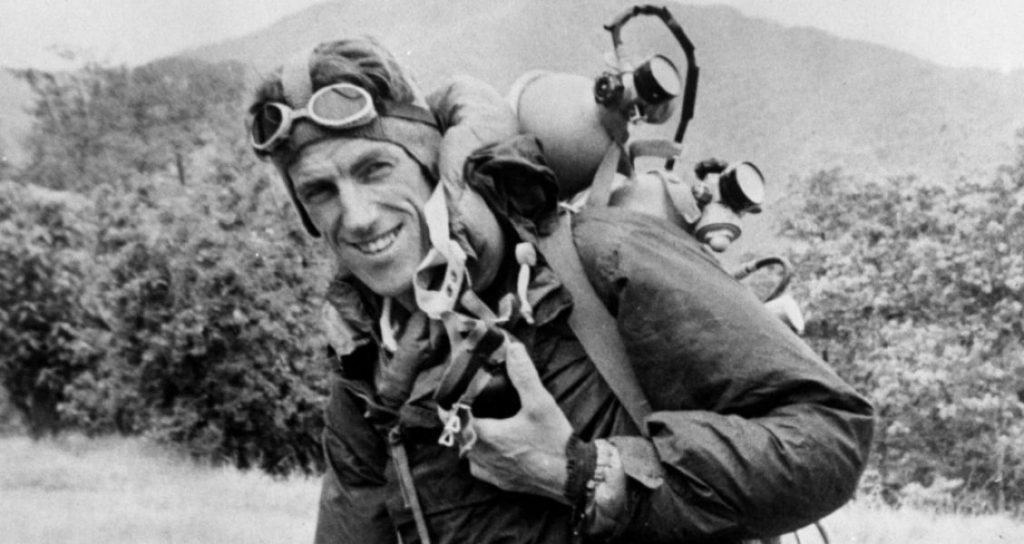
 “Human life is far more important than just getting to the top of a mountain” – Sir Edmund Hillary. “Human life is far more important than just getting to the top of a mountain” – Sir Edmund Hillary.Sir Edmund Hillary is probably one of the most
famous Kiwis of all time. It was his
adventurous spirit and his impressive philanthropy work in combination with his
hardy determination and exploratory gifts that made Sir Edmund Hillary one of
the greatest explorers of the 20th century.
Sir Edmund Hillary was born in Auckland, New
Zealand on 20 July 1919. His father had served in the 15th (North
Auckland) Regiment at Gallipoli during World War I and when he returned home,
he was allotted land south of Auckland, a benefit which was given by New Zealand’s
government to returning soldiers. Edmund was sent to a good grammar school as
was the wish of his mother, but he had to travel for 1-hour and 40-minutes by train
each way to do so.
Edmund’s time at grammar school was not
something he remembered with fondness as his school commute meant that he
couldn’t take part in after-school activities. He was quite short for his age
although he would eventually grow to be over six feet tall. He was also quite shy
but gained confidence after taking up boxing. However, it was not boxing that sparked
Edmund’s imagination; this would come in his later teenage years when he
discovered what would become one of his lifelong passions, a love of climbing
and all things mountaineering.
Despite his father having served in World War
I, the Hillary family were generally pacifists and Sir Edmund Hillary’s older
brother even spent time in jail during World War II as a conscientious
objector. Sir Edmund himself, on the other hand, desired to participate
believing it to be his patriotic duty.
His pacifist, and occasionally meddlesome, father utilised a loophole in
the law which allowed certain occupations to be exempt from service. One of
those occupations just so happened to be the family trade of beekeeping.
Despite this, and as the war entered its
fourth year, Sir Edmund Hillary eventually joined up in 1943, learning to
become a navigator. His military career was cut short though, and he never saw
combat, as a plane accident left him badly burned. He was hospitalised for
several weeks before eventually being discharged to recover at home.
After the war, Sir Edmund Hillary continued
his lifelong love of mountaineering and climbing, scaling a variety of peaks
both in Europe and New Zealand. However,
the chance of a lifetime came his way in 1951 when the British were presented
with a chance to attempt an ascent of Mount Everest. The Nepalese government
only permitted one or two expeditions per year and so the chances to make an
attempt on the summit of the highest mountain in the world were few and far
between with many different countries bidding for the opportunity every year.
New Zealand joined forces with the British team
led by John Hunt to form a joint expedition which in 1951 extensively explored
the mountain during the 1951 season in order to find a route that would lead to
the summit. This approach paid off when in 1953 Sir Edmund Hillary joined the group
that would try to make the formal ascent.
After several setbacks, including being
delayed by two days due to snow and wind, Sir Edmund Hillary and his Sherpa
friend Tenzing Norgay set out with the support of three others, reaching 27,900
feet on 28 May. With their support crew turning back and their oxygen supply running
low, Hillary and Norgay managed to squeeze through a crack between two rocks. A
few laboured steps later, the two of them stood at the top of the roof of the
world. After taking some photographs, the two descended back down to camp and
arrived as national and international heroes. Sir Edmund Hillary was the first
man to successfully climb to the summit of Mount Everest.
Although his climb would mark him as one of
the greatest explorers and mountaineers of the 20th century, it was his
interactions with the people of Nepal that would awaken one of his other
lifelong passions, a strong humanitarian drive to help see the living
conditions and prosperity of the Nepalese people improve.
He founded the Himalaya Trust in 1960 and remained
at its head until his death. Thanks to the work performed by the trust, a large
number of schools and hospitals have been constructed throughout rural and
remote areas of the Himalayas providing education and access to medical services
to many of the world’s most impoverished people.
In addition to his philanthropic work, Sir
Edmund Hillary’s explorer spirit continued to thrive and he went on to perform
other astonishing feats including reaching both the North and South poles becoming
the first person ever to reach both poles in addition to the summit Mount
Everest, a challenge that inspires the most rugged and enterprising explorers to
this day.
After returning from the Everest expedition plain old Edmund Hillary became Sir Edmund Hillary when he was made Knight Commander of the Order of the British Empire on 6 June 1953. He also received the Coronation Medal from Queen Elizabeth II, the Order of New Zealand, the Polar Medal, the Order of Gorkha Dakshina Bahu First Class from the kingdom of Nepal, the Commander’s Cross of the order of Merit of the Republic of Poland and various other honorary awards and accolades. On 22 April 1995, the rank of his knighthood was increased when he was appointed Knight Companion of the Most Noble Order of the Garter, which is the most senior order of knighthood that can be bestowed in the British honours system. Only 26 people at any time can be members of the order of the garter with two of these being the Sovereign and the Prince of Wales. The rest are all known as Companions.
Sir Edmund Hillary died on 11 January 2008 at the age of 88 following a heart attack in his home country of New Zealand where flags on public buildings were lowered to half-mast. Following a state funeral later that month, he was cremated with his ashes being scattered in Auckland’s Hauraki Gulf.
The post Sir Edmund Hillary appeared first on 5 Minute Biographies. |



.png)
 More
More
 Religion & Spirituality
 Education
 Arts and Design
 Health
 Fashion & Beauty
 Government & Organizations
 Kids & family
 Music
Music News & Politics
 Science & Medicine
 Society & Culture
 Sports & Recreation
 TV & Film
 Technology
 Philosophy
 Storytelling
 Horror and Paranomal
 True Crime
 Leisure
 Travel
 Fiction
 Crypto
 Marketing
 History
 Comedy
 Arts
Arts Games & Hobbies
 Business
 Motivation