|
Description:
|
|
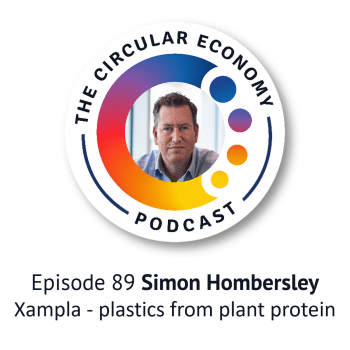
Simon Hombersley, CEO of Xampla, shares the story of how this Cambridge University spin-out has created the world’s first plant protein material for commercial use, pioneering the replacement of the most polluting plastics with natural alternatives.
Xampla’s ambition is to become the leader in natural polymers, and it’s been developing its natural polymer resin over the past 15 years. The polymer, which Xampla describes as a breakthrough material, performs just like synthetic polymers, but decomposes naturally and fully without harming the environment at the end of life.
Xampla is the first UK University spin-out to be awarded B Corp status and is working with multi-national companies, including Britvic, Gousto and Croda on new technologies.
Podcast host Catherine Weetman is a circular economy business advisor, workshop facilitator, speaker and writer. Her award-winning book: A Circular Economy Handbook: How to Build a More Resilient, Competitive and Sustainable Business includes lots of practical examples and tips on getting started. Catherine founded Rethink Global in 2013, to help businesses use circular, sustainable approaches to build a better business (and a better world).
Stay in touch for free insights and updates…
Read on for a summary of the podcast and links to the people, organisations and other resources we mention.
You can subscribe to the podcast series on iTunes, Google Podcasts, PlayerFM, Spotify, TuneIn, or search for “circular economy” in your favourite podcast app. Stay in touch to get free insights and updates, direct to your inbox…
Don’t forget, you can use our interactive, searchable podcast index to find episodes by sector, by region or by circular strategy. Plus, there is now a regular Circular Economy Podcast newsletter, so you get the latest episode show notes, links and transcript delivered to your inbox on Sunday morning, each fortnight. The newsletter includes a link to the episode page on our website, with an audio player. You can subscribe by clicking this link to update your preferences.
Links we mention in the episode:
About Simon Hombersley
Simon Hombersley is CEO of Xampla, a Cambridge University spin-out that has created the world’s first plant protein material for commercial use, pioneering the replacement of the most polluting plastics with natural alternatives. Xampla’s ambition is to become the leader in natural polymers.
A serial cleantech entrepreneur, Simon is also the Founder of Lontra, an engineering firm developing and commercialising energy-saving compressors. Simon previously founded TwentyNinety, Puntios Limited, and was CEO of Oxford Flow.
Simon has been published in:
World Economic Forum: There’s a single-use plastic you’ll throw away today without realising
The European: Let nature prosper by design
Business Green: A solution to plastic pollution? A plastic that doesn’t pollute
In November 2021, Simon represented Xampla at a COP26 Tech Nation event “Scaling Climate Tech”, where he set out Xampla’s ambition to replace single-use plastic.
About Xampla
Xampla is a spin-out from the University of Cambridge. Its natural polymer resin has been developed over the past 15 years. Its breakthrough material performs just like synthetic polymers, but decomposes naturally and fully without harming the environment at the end of life
Xampla is the first UK University spin-out to be awarded B Corp status and is working with multi-national companies, including Britvic, Gousto and Croda on new technologies.
Interview Transcript
Provided by AI – add 3:43 mins for the finished episode
Catherine Weetman 00:03
Simon, welcome to the circular economy podcast.
Simon Hombersley 00:06
Thank you very much, it’s good to be here.
Catherine Weetman 00:08
And we’re not too far apart today because you’re in, in or near Cambridge, I believe. Yes. Perhaps we could start by asking you to unpack the Xampla mission for us.
Simon Hombersley 00:21
We are a mission led business, we’re a B Corp actually where the UK is first university spin out to become a B Corp. And we have a very simple mission. That’s to reduce plastic pollution. And specifically within that we’re focused on the most polluting plastics. So these are single use plastics, and microplastics. These are the kinds of plastics that always leak into the environment, they can’t be captured typically within a systems approach within recycling, so forth. So that’s, that’s our focus the most polluting plastics. And that’s,
Catherine Weetman 00:53
that’s a really evocative phrase. And and I think, a few episodes ago, we heard from Maria Westerbos of the Plastic Soup Foundation, and she’s really exercised about micro plastics, particularly in cosmetics and things where we perhaps wouldn’t expect them not microbeads, but micro plastics. So
Simon Hombersley 01:13
Plastic Soup, doing a lot of really good work on the on the health impacts of plastics is an increasing development in those fields of the understanding of not just these plastics are bad for the planet and other creatures. They’re bad for us. They really are. And the evidence is now there for that.
Catherine Weetman 01:29
Yeah, I think it’s really interesting that the science is now starting to focus in on that. And I know, somebody wants told me years ago that in pharmaceuticals, drugs are generally withdrawn after about 10 years, because that’s, that’s when the research on the on the long term side effects becomes clear. So and I think just this week, somebody posted something about the dangers of reusing children’s toys. Because I guess, 10 or 15 years ago, in plastic toys, and so on, there were types of plastic or additives, BPA and all that kind of stuff that’s now been outlawed. So yes, lots lots of things to think about when we’re deciding to use plastics. So can you tell us a bit more about the kinds of products that Xampla has, and how it’s avoiding fossil fuel based chemicals?
Simon Hombersley 02:30
The kind of products that we’re working on as sort of launch products are two examples I’ll talk about one is a single use plastic packaging application, and the other is a micro plastic replacement, or Microcapsule. Actually, in that particular case, so. So we have developed? Well, let me start with the problem. So convenience, consumers love convenience. And brands love giving consumers what they want. So this is one of the reasons that we have so much single use plastic in our lives is because actually consumers want it and they value it. And it brings hygiene and portion control. And in some cases, you can argue that actually, these plastic packaging solutions are actually good for the planet in terms of reducing food waste, and so forth. So this is why brands use single use plastic and flexible films and sachets. But the problem is, those are the most polluting plastics, you can’t economically recycle flexible film. And furthermore, brands today are beginning to respond to consumer pressure, they’re beginning to understand that consumers, particularly younger consumers are making choices about what products they buy, based on the plastic content. And that’s a serious driver in all of this sector, which is really important. So for our launch product, what we’ve developed is a clickable, edible replacement for plastics, which we are using to wrap a stock cube. So the stock cube comes to the consumer, the consumer, instead of unwrapping it and throwing away either tin foil or a piece of plastic, they simply they can rinse it under the tap, they throw the whole thing including its wrapper into the pot, give it a stir, and they eat their own packaging. Now that’s a product we’ve launched with Gousto, the home recipe kit company here in the UK. And we’re now rolling that out. And that’s a really interesting example because it’s actually what we’re trying to do as a company is is excite and innovate and work with brands to give new formats and new exciting consumer experiences. And obviously, the result of that is if we rolled out all across gastos range alone, that will be about 17 tonnes of plastic replaced per year. So significant volumes of these materials can be replaced in an exciting and innovative way. And the other area that we’re working on is microplastics in particular, and this is much more an area where there’s regulatory drivers so a lot of consumers I’m not particularly aware of what plastics are in their formulations and personal care products and home care products. So we’re working on tiny micro capsules of our materials, which cause no harm at all to the planet in terms of pollution, but delivered the same. The cause no harm at all to the planet in terms of pollution, but deliver the same product viability in the same product that our brands want from us.
Catherine Weetman 05:28
So that sounds like two really potentially game changing product developments. And just to come back to the single use plastic example, the stock cube example, I guess, when I’m listening to you describe that because we’re so used to the idea of those coming in petrochemical based plastic packaging. The thought of dissolving it kind of makes makes me inwardly shudder. So can you tell us about, you know, the basis of of the materials that you’re using, so that we feel reassured that you know, the these are things that are a good to dissolve in our foods, not not something that’s you know, because people are aware that biodegradable plastic packaging, doesn’t mean it’s made from by a biomaterial. So bio degradable and kind of dissolvable doesn’t necessarily mean it’s good for you
Simon Hombersley 06:19
Absolutely. And this kind of greenwashing that’s been quite prevalent in our space is a real problem for not just us, but the whole next generation of these natural materials. So our products are made from food grade materials, the edible ones, we’re also working with other areas, but but for the food materials and materials that we would design to be eaten by a consumer, they are simply food they are based on in that case is p protein. So we take p protein, the sort of protein, you could buy it, and every every health food store around the world, and we engineer that with no chemical modification or change at all. And the result is a food, it’s just the same as boiling an egg or making jelly, it’s a very similar sort of process, and the materials that come out of the end of only 100%, plant protein. So that’s why they are food and edible. But I understand your point. And actually, when we did the launch, and we did a lot of consumer testing for that launch, consumers loved it, there was great feedback on that product. But a number of people did feedback and say, it looks a bit too much like plastic, we need to change the language of these sorts of materials and products. And we need to change the look and feel of them. So that people are very clear that that what is edible, and is a food essentially material versus what is a traditional oil base plastic.
Catherine Weetman 07:39
Yeah, that’s really interesting. I think changing the language could be essential, couldn’t it to kind of a stop the greenwashing and the confusion, and also to help people request these things and, you know, go on to social media for the brand and say, Why aren’t you using this material? You know, not not necessarily a brand name, but a descriptor for something? Yeah,
Simon Hombersley 08:05
absolutely. And I think that harnessing the power of consumers is absolutely critical to all of this. And it’s, you know, it’s a key to the point that the people who care about plastic are consumers, consumers don’t buy plastic, you know, apart from clingfilm, or a few examples, all my dog poo bags, I very rarely buy plastic, but we use plastic the whole time. It’s the brands, who have got the power here and who decide what products are put in front of the consumers. But the brands are incredibly sensitive to consumer demand. So the people you’ve got the power here are actually consumers. But it’s unfair to expect a consumer to have a PhD in material science and be able to filter all the greenwashing this space and understand exactly what is a credible, or what isn’t. So simplicity of language, honesty, transparency, these are really important things that we all need to work together, as I say, particularly our class of materials is natural polymer materials which are made from things that are found in nature, and cause no harm at the end of life, we can work together to communicate effectively why we’re not bio based or biodegradable in that way, or buy this or buy or that or, or based on any of the previous generation of language. But it’s a big challenge. It’s a big challenge for all of us.
Catherine Weetman 09:19
It is a big challenge, because even even natural, and I might have told you this story when we talked before, but I was helping a personal care startup. And they were working with a contract manufacturer, and we’d given them a list of criteria of you know, we want organic where possible, and you know, no plastics and the packaging and this, that and the other. And so it was kind of, you know, organic, natural ingredients. And I had to do the research because everything has to go through legislation in terms of what what descriptors you can apply to what the product does. And so I was going through the ingredients list on one of the EU websites, and two or three things said well, there is a natural version of this But it’s very expensive and quite hard to get hold off. So mostly, this would be synthetic, whatever, whatever. So I wrote to them to say, you know, can you explain what the source is and where it’s from? And sure enough, they turned out to be synthetic petrochemical based things. And so we then went back and said, Well, what about our overriding message of we wanted natural and organic? Well, they said, well, it is natural, you know, those fossils were once living things.
Simon Hombersley 10:30
Yes, and I think that fortunately, there is a generation of consumers who is much more savvy and much more motivated to do that digging. But as I say, I think it’s unfair. To put the pressure on the consumers to make their choices, it really is quite difficult. We need to help. We’re – not just Xampla, but all companies in the sector and everybody involved in campaigning and so forth, need to help bring clarity to this space, because obviously, there is a rearguard action being fought by the fossil fuel industry to protect what is an increasing share of their revenue actually, over the next few years as their fuel element of the oil goes down. But in percentage terms, the plastics is actually going to increase it’s increasingly important business for them. And we must remember that production of plastic is expected to increase over the next 20 to 30 years not decrease. So this is a growing problem, or a growing opportunity for the oil industry to continue business as usual. So there is a there is quite a lot going on here. But we can all work together. And what is a relatively young field, still plant based natural products and materials are relatively young space. So we can work together to help everybody understand actually, if you’re a sustainability consultant, or if your packaging designer or a brand manager, don’t go and look at all of these first generation materials and have to find out that actually, they’re chemically modified, or they degrade into forever chemicals which get into our bloodstream and cause trouble. Just choose something that looks like a plant sounds like a plant and you know, when it goes into the soil is going to cause no harm. It’s, it is as simple as that. But there’s quite a lot of thicket to cut through to get to that simple story.
Catherine Weetman 12:04
Yeah, you’re right. And not least the power of of the vested interests in Yes. petrochemical producers, as you say, who are all banking on plastic and the recycling of plastic? Because of course, that requires even more chemicals and an energy provided by fossil fuels. So yeah, they’re really keen on it. So just to come back to the microcapsules. Can you tell us a bit, you know, kind of bring that to life a bit? Where would we see those? And, you know, what are they made from?
Simon Hombersley 12:33
Well, in our shirts, right now, there are tiny micro capsules containing fragrance, which are typically made of melamine formaldehyde. And by tiny, I mean, 10,15, 20 microns across, you can’t see them, and you can’t feel them, but they’re in there. Now, they’re an incredibly sophisticated piece of technology. And they’re designed to release the fragrance that the laundry company wants in your clothes to keep your clothes smelling fresh. And at the end of the day, those little capsules, which have given out their fragrance, they get washed out of your clothes, when you put them back in the washing machine. And a whole new set of them are put back in with the fabric conditioner, or the laundry detergent that you’ve put in now that usefully The European Union is banning that class of products they recognise that is simply as straightforward |



.png)
 More
More
 Religion & Spirituality
 Education
 Arts and Design
 Health
 Fashion & Beauty
 Government & Organizations
 Kids & family
 Music
Music News & Politics
 Science & Medicine
 Society & Culture
 Sports & Recreation
 TV & Film
 Technology
 Philosophy
 Storytelling
 Horror and Paranomal
 True Crime
 Leisure
 Travel
 Fiction
 Crypto
 Marketing
 History
 Comedy
 Arts
Arts Games & Hobbies
 Business
 Motivation