|
Description:
|
|
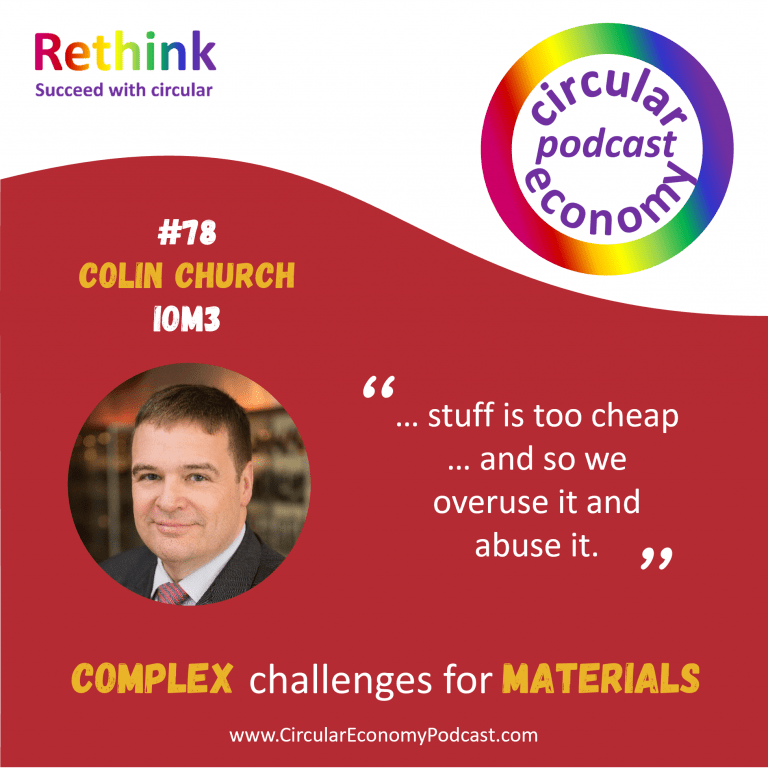
In today’s episode, we’re talking about critical materials, the complexities of modern supply chains, transparency and Life Cycle Analysis, the challenges of how we ensure fair shares of finite resources and much more.
Helping guide us through these topics is Dr Colin Church, the Chief Executive of the Institute of Materials, Minerals and Mining, the global network for the materials cycle – also known as IOM3.
Colin moved to IOM3 in late 2018 from CIWM, the professional UK body for resources and waste management. Before that, Colin spent over twenty years in the UK Government working on a range of issues at the borders of science, engineering and policy. He is also Chair of the Green Alliance Circular Economy Task Force.
Podcast host Catherine Weetman is a circular economy business advisor, workshop facilitator, speaker and writer. Her award-winning book: A Circular Economy Handbook: How to Build a More Resilient, Competitive and Sustainable Business includes lots of practical examples and tips on getting started. Catherine founded Rethink Global in 2013, to help businesses use circular, sustainable approaches to build a better business (and a better world).
Stay in touch for free insights and updates…
Read on for a summary of the podcast and links to the people, organisations and other resources we mention.
You can subscribe to the podcast series on iTunes, Google Podcasts, PlayerFM, Spotify, TuneIn, or search for “circular economy” in your favourite podcast app. Stay in touch to get free insights and updates, direct to your inbox…
Don’t forget, you can use our interactive, searchable podcast index to find episodes by sector, by region or by circular strategy. Plus, there is now a regular Circular Economy Podcast newsletter, so you get the latest episode show notes, links and transcript delivered to your inbox on Sunday morning, each fortnight. The newsletter includes a link to the episode page on our website, with an audio player. You can subscribe by clicking this link to update your preferences.
Links we mention in the episode:
About Colin Church
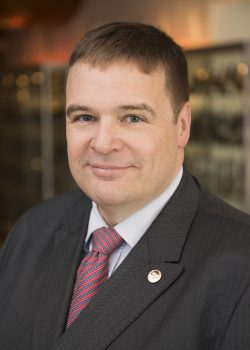 Dr Colin Church is the Chief Executive of the Institute of Materials, Minerals and Mining, the global network for the materials cycle. Dr Colin Church is the Chief Executive of the Institute of Materials, Minerals and Mining, the global network for the materials cycle.
Colin is also Chair of the Circular Economy Task Force, a business led group convened by Green Alliance that aims to lead policy discussions with ambitious business thinking. He is a Trustee of CHEM Trust and a Board Member of the Society for the Environment and of the Materials Processing Institute. Colin is also a member of various industry-academia advisory bodies. He is a Fellow of IOM3, a Chartered Environmentalist and a Chartered Resource and Waste Manager.
Previously, Colin was the CEO of CIWM, the professional body for resources and waste management. Before that, he spent 21 years in the UK Civil Service working in a range of areas including climate change, the theory and practice of regulation, and environmental protection including resource and waste management.
Colin was also a non-executive director of WRAP, the waste reduction and resource efficiency body and the Carbon Trust, the carbon reduction and resource efficiency body.
Interview Transcript
Provided by AI – add ~2:12 mins for the finished episode
Catherine Weetman 00:00
Colin, welcome to the circular economy podcast.
Colin Church 00:03
Thank you for having me.
Catherine Weetman 00:04
It’s good to see you today. And it’s unfortunate that people listening won’t be able to see the rather dramatic materials background that you’ve got behind you. I’m curious to even know what that is it’s multicoloured.
Colin Church 00:17
Yes, we have a range of backgrounds that we use, here IOM3, because we’ve got a range of different technical areas that come together. And this particular one is some iron ore actually. So, again, for the listener who can’t see it’s striations of green and gold and brown, and it’s one of my favourite visual ones, as well as being representative of one of our techno communities.
Catherine Weetman 00:41
Yes, very artistic and spectacular, even though it’s completely natural. So perhaps we could start by asking for a bit of background about IOM3, what kind of members join up? What kind of jobs do they have? And what about the range of materials covered?
Colin Church 00:59
Okay, so IOM3 is the global network for the material cycle. It’s got about 15,000 members and our members work across all aspects of that material cycle, by which I mean, they might be involved in finding metals and minerals in the ground, extracting them, processing them, turn them into bulk products, into detailed products, working out how to make better use of them, and then handling them at the end of life. So very, very wide set of, of technical interests. And about a third of our members work in academic institutions, about two thirds in other institutions, apart from those who are not employed as students and retired and wherever else. And about 80% of our members are based in the UK and about 20% are based in 90 plus other countries around the world. In terms of materials rather, ironically, probably the, the material that we do least on is material as in cloth. But apart from that, absolutely everything from wood to the most advanced of nanomaterials and everything in between.
Catherine Weetman 02:03
So a really wide range of interests then, amongst the members. And what are the hot topics for people at the moment of what concerns do those hot topics tend to raise?
Colin Church 02:15
Yeah, so at one level, because of the breadth of our membership. They share the concerns of most people in society if you like. And so certainly concern about the sustainability issues, the climate crisis, biodiversity crisis, very high on a number of our members agendas. And but in terms of more specific things in terms of materials, minerals, and mining and Sakana. Me type issues, I think there are a number of things that people are worried about specifically. One is what we call critical raw materials. So those materials, which for some reason or other, are at risk in global supply chains, but are essential for the kind of society we either have now or want to have in the future. People are also very much concerned about the future of what we call foundation industries. So the Heavy Industries of making steel and cement and chemicals and plastics and paper and glass. And in particular, how we’re going to decarbonize those to live within our net zero targets going forward. All engineers and scientists, when you talk to them will also tell you that they’re always worried about skill supply. And increasingly, that gets bound up with inclusion and diversity issues. Although, you know, there are separate aspects as well. So skills is a big issue for us. And one particular area of skills. that’s of concern to I am three at the moment is the looming dearth of skills of people who understand geology and applied earth science. It’s really not a popular course it’s at school or university. They used to be a very active community of mining engineering courses across the UK, there are now at undergraduate level, and we’re actively recruiting. And I think we’ll probably come on to talk about it. But you know, not having the skills to find an extract material properly and sensibly is going to be an issue for us going forward. Our members are also involved in packaging issues, for example. So here in the UK, there are some big changes coming along to the rules of how one pays for and handles packaging at the end of life. And that’s a big issue for our for our members as well. So, quite a few of the issues are very closely related to sustainability, in lots of different aspects. And really, the members of our industry are fundamental to a lot of those transformations. We like to say that our role our own three is to support professionals in materials, minerals and minerals to be heroes of the transition to a low carbon and resource efficient society and not villains. And and actually, you know, when you think about it, so much of this transition into a low carbon and resource efficient, circular, more circular economy and society depends on stuff, materials, things, whether it’s lithium for batteries, or silicone for power for solar power, or new forms of composites to lightweight vehicle, you know, all sorts of different things. It’s all about material stuff things. And we’re moving from a world, which is using fossil fuels to transfer energy to a world that’s using metals and minerals to transfer energy. So even more important in the future will be stuff.
Catherine Weetman 05:34
Absolutely. And we’re realising that the demand of all these new renewable technologies probably exceeds supply. And certainly I was just reading something from Green Alliance, saying that the projected use of renewable electric vehicles, what else was allow solar solar panels and something else, just those three things that the UK exceeded its fair share of key minerals. So there’s that aspect of it as well, isn’t there not just what’s available, but how to distribute it fairly.
Colin Church 06:10
And absolutely, and then of course, tackling sorry, I say tackling climate change is a global issue. And even if the UK totally decarbonize, which we need to do, if we in decarbonizing the UK economy, stop another economy from decarbonizing because we’ve taken all the materials necessary for that process, then there’s still too much carbon dioxide in the air or too many greenhouse gases. So absolutely, that that fair share argument is, is it’s not just ethical, it’s also deeply practical.
Catherine Weetman 06:42
And it really brings home the need to move to more circular ways of doing things so that we’re designing things so that if something better comes along, we can get all the key resources out of the first product, instead of discarding them and get them get them used again. And absolutely. Over the last couple of decades, resource issues have surfaced in a variety of different ways. But back in 2011, I remember being really struck by McKinsey talking about a century of price declines AI in the 20th century, reversed in a decade. What’s happened since then what what does the picture look like?
Colin Church 07:21
I think the main dominant feature, if you look at materials prices, resource process, is actually fluctuation. And quite often for businesses you can you can find a way to deal with almost almost any price level, so long as it’s predictable and stable. What’s really, really difficult is to deal with fluctuating price levels, particularly when they go from low to high, obviously, because you haven’t got it priced into your into your services and products. So that fluctuation that we see over the past decade and a half, two decades is really troublesome. And of course, a lot of that is driven by Why did your political circumstance and we are recording this podcast, particularly tense, geopolitical moment, but there have been plenty of others that have impacted on supply of one or the commodity or resource over time, and that that’s really hard for businesses to deal with.
Catherine Weetman 08:12
And we’re seeing a similar thing, aren’t we with competing industries, you know, over the last year or so, the car industry has lost out for access to chips because other industries have been able to afford to pay the premium to get get access to those materials in in the product. So there’s there’s kind of a whole range of issues of demand and supply imbalance. And when we spoke ahead of the podcast, you mentioned that the IOM three members cover the full value chain circle from mining right through to recycling. So how are you helping them close the loop on resources and bring the circular economy into reality?
Colin Church 08:54
Yeah. For me, one of the great, I joke that the greatest strength of v is the breadth of technical interests of its members. And one of the greatest weaknesses of v is the breadth of technical interests of its members. And this is definitely one of those topics that falls into that, that joke dichotomy, because on the one hand, we within our membership can find people at every point of that value chain. And if we can bring them together to talk about that, in a way that is outside of commercial world, because we are a little charter company and a charity and all the rest of it. That can be incredibly powerful. And that’s one of the things that we’re constantly trying to do is to help our members come together and talk about these issues in a way that’s, that’s pre competitive or outside of the competitive space, and therefore that they can find good solutions. And but at the same time, what it shows is just how complicated those chains are. I mean, if you just think about, we mentioned lithium for batteries, for example. And it’s much lithium is mined in either Australia or in the lithium triangle in South America, although we have now got some happening in here in the UK, which is really good news. And it’s then converted into lithium carbonate usually transported to China, where it’s processed into battery elements. And then it gets shipped to different places to be then turned into batteries and then turned into cars. But various of those stages, various streams of material will be coming in together, and then going out again, mixed, crossed, over, split, whatever it might be. And you’ve just think about that, and the different professionals who are involved in each of those stages, who are making decisions about how they put things together, or how they take things apart, that then have implications much further down the supply chain. But that supply chain is so fragmented and difficult to follow through, but they have no idea of the impact of those decisions. And then the people five steps down, just receive what they receive, and have to work out the problems. I mean, this the classic one that people will talk about most of course, is waste management companies who are very often in the the vein of just receiving whatever comes into the bin and then having to work out what the heck that is and how you deal with it. And the more we can connect along that chain and get people to talk and understand, the better, but it’s bloomin difficult.
Catherine Weetman 11:29
I can imagine this incredibly complicated, even. I remember doing a case study on Fairphone, a few years ago, and the difficulties that they had even establishing which country the raw materials came from, you know, nevermind what had happened to them after that. But you know, was it? Was it a fair mined process or, or not? On? How do you certify that?
Colin Church 11:55
Absolutely. And I think that that whole area of transparency, labelling certification through the chain is really important. And people are very excited about things like blockchain technology, but even blockchain it’s not a it’s not a silver bullet, and B, it has its own potential downsides, because it can be very energy intensive, for example. So is is a lot of iron ore mined in Australia and tracked by blockchain better or worse than some iron ore mined in Sub Saharan Africa, not prepped by blockchain. Because it’s, you know, you’ve got all sorts of different factors. And it’s really important to try and look at things like lifecycle analysis, but even there, it can be really difficult. So I was doing some work with one of my members last year sometime. And he was saying that he was looking at a data set for lifecycle analysis around sets of different metals. And what he found was that the data that the world was using to identify the lifecycle impact of a particular metal was based on one mine in the middle of Africa, which produced maybe 10% of the global production. So that’s, you know, substantial. But there’s 90% is produced elsewhere. And we all know that the climate and social and other constraints and opportunities in Sub Saharan Africa will be different from, say, the southern tip of Argentina or the centre of the US or, you know, pick any other country that you might want to pick. And so even using a tool that could be so rich as lifecycle analysis to understand some of these impacts, and some of these supply chain issues, can be confounded by the data not being good enough in the first place. It’s a huge challenge. But it’s vital that we get on top of it to the extent that we can.
Catherine Weetman 13:46
And I think that’s where it comes back to the transparency around that, isn’t it being able to see what the data is, in the LCA, I’ve seen quite a bit of criticism of the Higg index, recently, with their comparison of organic cotton versus conventional or industrial cotton. And I remember looking at that, when I was first first researching the circular economy and looking at the difference, because organic cotton, ostensibly used an awful lot less water, you know, kind of 10% of the water versus conventional and kind of thinking, Well, why would that be because, you know, maybe the plants are a bit shorter, but surely it can’t be that different. And it turned out that these figures are based in a similar way to the example you just gave. There’s, you know, there’s one organic farm that’s been used to do the LCA for organic cotton. And that happened to have plenty of rainwater, so there was no need for irrigation. So they’ve kind of you know, scaled that out and applied it to every place that’s growing organic cotton, which which isn’t right. But to not even kind of make that clear and have the caveat around it. doesn’t allow anybody to kind of think, Oh, well, I need to know that bit of information. You know, it’s it’s, it’s, it’s critical to what I’m doing. So I’ll go and do some more research. So I think the whole, the whole thing about LCA is I think there should be like Wikipedia, it should be open access data that a |



.png)
 More
More
 Religion & Spirituality
 Education
 Arts and Design
 Health
 Fashion & Beauty
 Government & Organizations
 Kids & family
 Music
Music News & Politics
 Science & Medicine
 Society & Culture
 Sports & Recreation
 TV & Film
 Technology
 Philosophy
 Storytelling
 Horror and Paranomal
 True Crime
 Leisure
 Travel
 Fiction
 Crypto
 Marketing
 History
 Comedy
 Arts
Arts Games & Hobbies
 Business
 Motivation