|
Description:
|
|
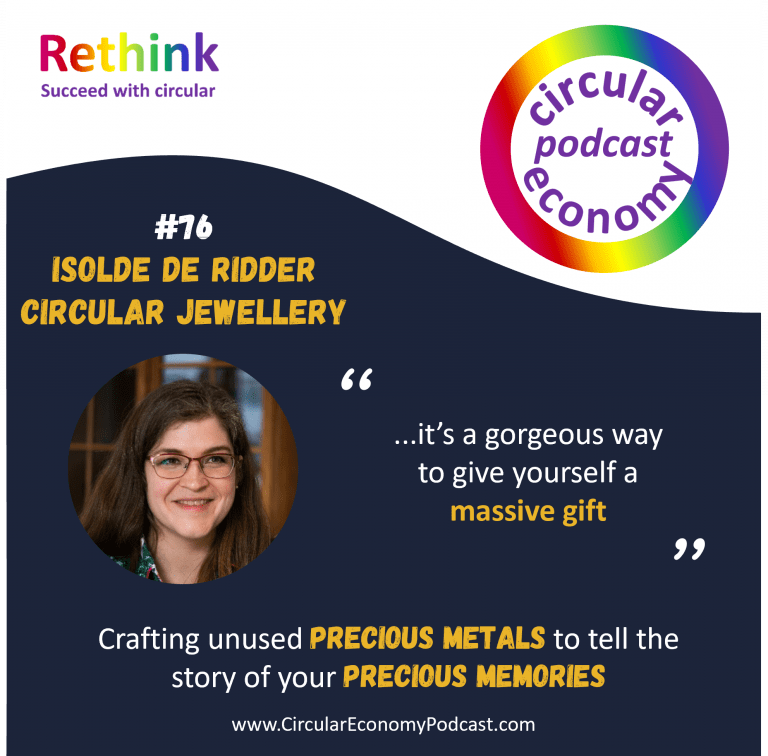
Isolde de Ridder is a circular jeweller and goldsmith. She founded her business – Isolde de Ridder Sieraden – in 2017, to create high-end jewellery with the greatest care for both people and planet. Isolde gives discarded metals and other materials a second life, contributing to a better world for future generations.
Isolde began her education to become a goldsmith in 2006, to combine her passion for gemstones, creativity and working with her hands. She’s inspired by Nature, gemstones, ancient civilizations and also more recent art movements.
We talk about why reusing discarded precious metals is more complicated than it sounds, and how Isolde is encouraging people to bring old jewellery back to life, using her storytelling and design skills to help people repurpose jewellery and other materials into things they will treasure, and that remind them of their loved ones.
Isolde tells us about her early interests, and how they led her to start this business, how she became disillusioned with the ethics of Fair Mined and Fairtrade Gold, and how that sparked the ideas for becoming a circular economy jeweller.
We hear about some of the kinds of jewellery Isolde designs, and how she uses old objects to embed precious memories into the finished product.
Podcast host Catherine Weetman is a circular economy business advisor, workshop facilitator, speaker and writer. Her award-winning book: A Circular Economy Handbook: How to Build a More Resilient, Competitive and Sustainable Business includes lots of practical examples and tips on getting started. Catherine founded Rethink Global in 2013, to help businesses use circular, sustainable approaches to build a better business (and a better world).
Stay in touch for free insights and updates…
Read on for a summary of the podcast and links to the people, organisations and other resources we mention.
You can subscribe to the podcast series on iTunes, Google Podcasts, PlayerFM, Spotify, TuneIn, or search for “circular economy” in your favourite podcast app. Stay in touch to get free insights and updates, direct to your inbox…
Don’t forget, you can use our interactive, searchable podcast index to find episodes by sector, by region or by circular strategy. Plus, there is now a regular Circular Economy Podcast newsletter, so you get the latest episode show notes, links and transcript delivered to your inbox on Sunday morning, each fortnight. The newsletter includes a link to the episode page on our website, with an audio player. You can subscribe by clicking this link to update your preferences.
Links we mention in the episode:
About Isolde de Ridder
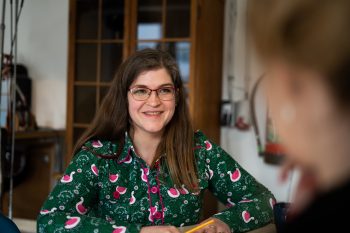 At Isolde de Ridder Sieraden, founded by Isolde de Ridder – Le Creurer in 2017, creating high-end jewellery with the greatest care for both people and planet, is our mission. At Isolde de Ridder Sieraden, founded by Isolde de Ridder – Le Creurer in 2017, creating high-end jewellery with the greatest care for both people and planet, is our mission.
We strive to make the world more beautiful with our unique jewellery. Our unique pieces are crafted by hand in the Netherlands. Jewellery that gives discarded metals and other materials a second life and that contributes to a better world for generations to come.
Isolde started her education to become a goldsmith in 2006. Her passion for gemstones, working with her hands and creativity were the initial reason to start this education. Nature, gemstones, ancient civilizations but also more recent art movements have always been a great inspiration.
In the past 15 years Isolde developed a love for telling a story in the form of jewellery. Whether it’s a pair of engagement or wedding rings that perfectly describes the loves of a couple, a mourning ornament made out of the jewellery of a lost parent that tell the story of the love of a child for its parents or a birth ornament that is a perfect resemblance of the love of a parent for its child. All are important parts of our lives and these memories deserve to be remembered.
What better way than to remember by means of a beautiful ornament that you can carry with you daily?
Interview Transcript
Provided by AI
Isolde de Ridder
of course, we can start with that. I’ll try to keep it short. I design and make jewellery out of discarded materials. It’s as simple as that.
Catherine Weetman
And you’re at the base at the UpcycleCentrum in Almere. And we’ve already heard from one of the entrepreneurs there. And also, we had a really great interview with Hede Razoky, who’s the customer manager there. And she kind of explained the whole premise of the Upcycle Centrum, which is that it does three things, but one of those things is it acts as a recycling centre centre for the, for the municipality. So people are bringing back waste materials and so on. And the entrepreneurs that it’s supporting are working with specific niches in those waste materials to create something of high value. So it’s definitely not down cycling. No, but your your business struggles a bit with that. Because the well, there is some recycled gold and silver isn’t there coming back in a waste? Yeah, but there are, can you can you explain the issues with with if you know, if you were trying to build a jewellery making business around reclaimed materials, from e-waste, what complexities would that create
Isolde de Ridder
That has been my main focus for the past almost one and a half year, because I thought, since there is quite some precious metals in E waste, I would extract it and just take that and make it into new jewellery. But the precious metals are so embedded and impossible to regain access to them in both small business we, of course, there’s the big E waste companies that process it. And
Catherine Weetman
yeah, and having having equipment worth hundreds of 1000s of pounds, that’s all set up to do it. Yeah,
Isolde de Ridder
to do it. And for me, I found it super challenging to take it back into circulation because it’s a very thin layer or of silver or gold on top of another material which has very similar melting point. So I had, I had hoped that it would be possible to thermally remove the precious metals and discard the rest. So sadly, that was not as easy as I had hoped. And in the past more than a year, I have not been able to regain any precious metals that way.
Catherine Weetman
And it’s not so this kind of goes back to the design of the electronic materials in the first place, doesn’t it and when we’re not going to the details of that, but it kind of speaks to the need for circular design. So designing with the next use in mind making things that are much easier to take apart not you know, try not to blend materials trying to use fixings like in my Fairphone where a single screwdriver will take out the module although that’s still the module it doesn’t get you to the the base metals inside so there are all sorts of issues there. So how have you had to pivot in terms of finding materials to make your jewellery What what are you doing instead?
Isolde de Ridder
Well, first of all, there’s people that g otword that I am one of the entrepreneurs in the Upcycle Centrum. And so they actually handed in their old precious metals, especially silver, it’s way easier to discard of silver than it is to discard of gold because of the value we put on gold. But yeah, so there’s people actually coming to me with a bag full of old silver jewellery, and saying, Hey, maybe you can use this. In the clothing container, there’s very often also jewellery discarded. So the second way I get my materials is digging through all the jewellery that are being brought in. And picking out the ones that I suspect, firstly, that are silver or gold, and then testing them. And if they prove to be precious metals, and we use them.
Catherine Weetman
So so you’re having to be pretty enterprising, aren’t you in terms of spotting waste streams, or encouraging people to think differently about stuff that might be laying in the, in the back of drawers? Or that? You know, Granny left to them 20 years ago, and they’ve never actually worn it? Yeah. And I’m curious to know what what led you to create the business the jewellery business?
Isolde de Ridder
Well, then we go way, way back, because I, I started my education 16 years ago. And I started because I did another, another education first, which didn’t spark any joy when I had finished it. And I thought, if this is what I need to do for a living, for the rest of my life, I’m going to be so unhappy. So I was looking for something that would feed my creative putty would give me the freedom to make my own choices, be my own boss. Still, I enjoy working with people or four people. So that was something that I took into account as well. Now I just started looking through creative education’s. All of them, didn’t appease me, until I was at a wedding had a talk with someone who was in the school for jewellery makers. And at that moment, I was intrigued. And I thought, I’ll just have a look at the school. And I just fell in love with the profession. It’s a, it’s creative, but it’s also technical. So there’s so much to learn out. I think I’ll never get bored.
Catherine Weetman
Yeah, and that’s, that’s a great ambition in life, isn’t it to have a job where you never get bored? That’s yeah, that’s fantastic. And I love the way that you were so clear about what it was you needed from a job? You know, that’s, yeah, that’s it, because I didn’t really discover that till I was in my 40s. So it’s great to hear about somebody kind of starting off on the, on the on a clear, yeah, way.
Isolde de Ridder
I was, I was 21. And I was just not I’d finished my education. And working it was just, it was a dread.
Catherine Weetman
So, so yeah, so that that’s kind of how I had to do something else. So so that that led you to the jewellery making, and the kind of the, you know, the craft and the skills around that. But what about the, you know, making jewellery from waste metals? And where did where did that angle come from?
Isolde de Ridder
Um, in 2017, I started my company. And I had heard that there was the option of working with Fair Trade metals. So I signed up for that. And by the end of 2019, I got a letter from from the company that provided this service, that they would stop this within Benelux. So Belgium, Netherlands and Luxembourg. Because a was not profitable enough. And I thought asking questions is always the best way to expand your knowledge. How How did they come to this decision? Well, it was actually their profits when where I made the decision to work with Fairtrade metals, because I wanted to improve the working conditions and fees were Keep fees for the people involved. But apparently, not enough goldsmiths were making the transition to fair trade. So within, within the Netherlands, they stopped. So I had a look into the new company that rose up for this demand, which is called Fair Mined. And I discovered that it’s mainly white people working under absolutely better conditions, and earning decent Western fee for their labour. But still, it does nothing for the people that inhibits the country, or the area where the gold is found. So it still didn’t feel very fair to me. And in my research, I also discovered that, well, we’re depleting the earth quite fast and quick, from from what we have, or the materials that are available. And yes, I just heard recently, we discovered a new vein. But and we’ll probably keep on discovering new veins in natural environments that we just better leave alone. So that’s when, at the end of 2019, with the research I was doing, I came to the conclusion that I was not okay with being a part of that anymore. So I came to a turning point. Do I want to keep on doing the work I do? Or am I going to go in a completely different direction, because this doesn’t sit well with me at all. And this is not how I want to contribute to earth, and the people inhabiting it. So I started puzzling on how to not use fair mind, not use new materials, because that might be considered even worse. And the only conclusion I came to is, there’s so much jewellery in everyone’s possession, just lying around doing nothing. And it’s so easy actually to renew the metals and make new stuff out of it. That I saw this as, as my only option to keep on doing what I love doing. Yeah,
Catherine Weetman
there’s a professor in Cambridge, who’s done calculations to say that we already have enough steel in the world to never need to create any more steel. And I think there are probably lots of other metals, minerals resources, that we could look at differently and look at how can we do something with what we already have? And of course, that’s at the heart of the circular economy, isn’t it? So that was
Isolde de Ridder
I discovered that about a couple of months after I made the decision to work solely with discarded materials. So I discovered February 2020, there was actually a term for what I wanted to do, right. I was at a festival which was, which is held yearly, in the on later. I had a couple of talks with other circular entrepreneurs. And he was such an inspiration to see that I was not the only one trying to save the planet and do that in a way that it is. Well, causing less impact. I will never say I don’t cause any impact because yes, I still work with chemicals. I still work with gas to heat up the metals. So yeah, there’s no no guarantee it’s zero emission. But I’m very conscience of bad contribution you make with another decision.
Catherine Weetman
Yeah, and I think it’s, it’s another one of those circular economy businesses, you know, that might be a solopreneur or a very small micro business. But what it’s helping to do is start conversations with people, people who hadn’t ever thought that you know, something could be made from recreated by recreating using the resources that we already have. And realising that the story around that is is more interesting than the thing that you’ve just walked into a standard jewellers, jewellers and book from the shelf. And that that they probably then tell that story to so many more people because it’s more uplifting
Catherine Weetman
I think it’s so important to get those stories out there and to help lots of other people think differently about this the value in what we already have, and the value of keeping the legacy going, even if you recreate the material into something new, the still the legacy there and the story there, and the fact that every one of your customers has done something to help make a better world and, you know, reduce our impact on the world. So I think it’s, it’s, it’s really important. So,
Isolde de Ridder
and I never expected that I would change the world with what I’m doing. I just want to change the mindset of people.
Catherine Weetman
Yeah, and I’m, and I’m sure, I’m sure you’re doing exactly that. And I think the power of these stories, you know, there’s a lot more energy in those stories, and people tell somebody else who then just just as happened with people suddenly getting to hear what you were doing and bringing you silver, you know, people like to spread interesting stories and good news, and particularly like to spread stories of things that are better for people and planet. And that’s what that’s what we need more of is more of those stories and more of people starting to think differently. Because the way we’ve been educated by marketers and big businesses isn’t the only way that we can live and work. You know, there are different ways and those ways can be more fulfilling and sometimes cheaper and more interesting and all the rest of it. So that that brings us on to the you know what, tell us a bit about what kind of jewellery you you make and what kind of old items have come into your hands. Tell us a few a few stories about that.
Isolde de Ridder
Well, I’m not sure if I can take this as one of the examples but I’m actually having conversations with you and your husband to renew your wedding rings because he lost his and so I I’m working on with both of you to figure out first of all a good design and then I have old white gold because because the rings will be white gold again. All the white gold that I stocked up on because I was able to get my hands on some and yeah, so your rings will be made from someone else’s old jewellery plus, plus combined combined with my combined with your own wedding ring, my wedding
Catherine Weetman
ring that wasn’t low and was fair trade
Isolde de Ridder
and will still complement the story you’ve had so far. And that yeah, I love I love weaving the stories into the jewellery. Last year I had another customer that had quite some old gold from his mother and his father lying around with old fashioned designs so no one was wearing them and I made it into a bracelet very modern very finding not the word right now how do you say that? Very manly. Yes, yeah. And in this bracelet, and maybe we should redo this whole part, I don’t know. But in this bracelet, there’s, there’s the stone a gemstone from his dad’s ring, the ring here, his dad wore for ages, he, as long as he remembered his that was wearing this ring. And so it got a special place in the bracelet. Because, well, that is something that is the legacy of his parents. But now he can walk around with it on a daily basis.
Catherine Weetman
Yeah, that’s so such a nice story, isn’t it about finding a way to, again, get something out of the back of the drawer, or even worse being sent off to auction because you can’t think of a way of, of, you know, of using it. And it’s just, it’s just laying there forgotten, but suddenly having something from somebody very close to you. And something that was precious to them? To stay with you. Yeah. So, yeah, and I’m sure there are, I’m sure. It really gets people’s imagination going about how they can have something that reconnects with th |



.png)
 More
More
 Religion & Spirituality
 Education
 Arts and Design
 Health
 Fashion & Beauty
 Government & Organizations
 Kids & family
 Music
Music News & Politics
 Science & Medicine
 Society & Culture
 Sports & Recreation
 TV & Film
 Technology
 Philosophy
 Storytelling
 Horror and Paranomal
 True Crime
 Leisure
 Travel
 Fiction
 Crypto
 Marketing
 History
 Comedy
 Arts
Arts Games & Hobbies
 Business
 Motivation