|
Description:
|
|
Episode 75 Helena Norberg-Hodge – the future is local
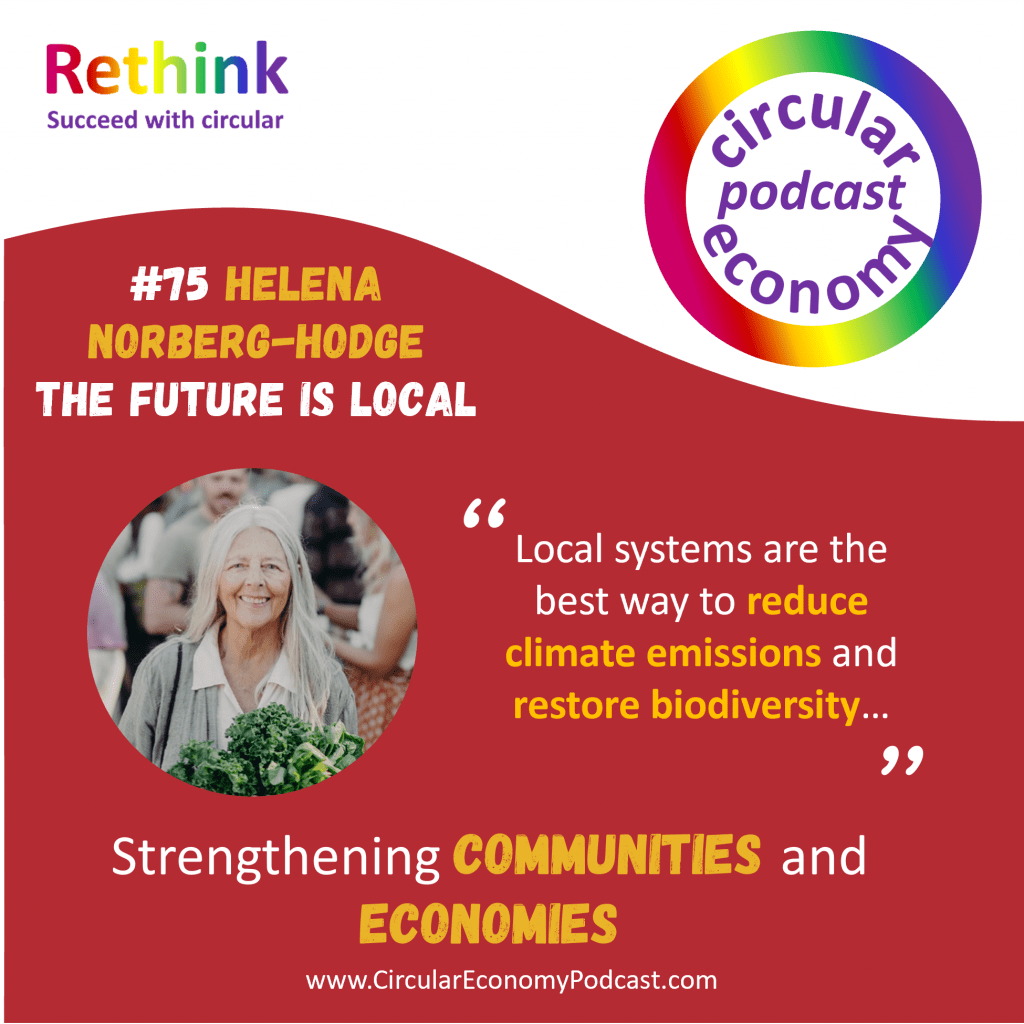
Catherine Weetman talks to Helena Norberg-Hodge, a pioneer of the new economy movement and recipient of Right Livelihood Award (aka the “Alternative Nobel Prize”), the Arthur Morgan Award and the Goi Peace Prize for contributing to “the revitalization of cultural and biological diversity, and the strengthening of local communities and economies worldwide.”
Helena Norberg-Hodge is also an author, and her most recent book is Local is Our Future. This book connects the dots between our social, economic, ecological and spiritual crises, revealing how a systemic shift from global to local can address all of these seemingly disparate problems at the same time.
Helena is also the author of the inspirational classic Ancient Futures, and producer of the award-winning documentary The Economics of Happiness.
Helena explains why local, small-scale, ‘traditional’ farming is better for farmers, for animal and human health, and for our planet, and how it helps strengthen local communities.
We talk about why local food is one of the simple solutions to our interconnected, systemic problems, and why connection with soil, with nature, with the process of growing food, is essential for our health and wellbeing.
Helena highlights how the centralised, highly integrated, top-down global food economy, which is subsidised by our governments through subsidies for research and development at universities to infrastructure, and through imposition of regulations at local and national levels.
Helena explains why we need to be doing everything we can to support local food systems worldwide, with shorter distances and supporting smaller diversified farms. The agricultural biodiversity also helps increase wild biodiversity. Local food reduces the plastic, it reduces the emissions, it reduces the need for refrigeration. We’re talking about massive, multiple benefits.
Podcast host Catherine Weetman is a circular economy business advisor, workshop facilitator, speaker and writer. Her award-winning book: A Circular Economy Handbook: How to Build a More Resilient, Competitive and Sustainable Business includes lots of practical examples and tips on getting started. Catherine founded Rethink Global in 2013, to help businesses use circular, sustainable approaches to build a better business (and a better world).
Stay in touch for free insights and updates…
Read on for a summary of the podcast and links to the people, organisations and other resources we mention.
You can subscribe to the podcast series on iTunes, Google Podcasts, PlayerFM, Spotify, TuneIn, or search for “circular economy” in your favourite podcast app. Stay in touch to get free insights and updates, direct to your inbox…
Don’t forget, you can use our interactive, searchable podcast index to find episodes by sector, by region or by circular strategy. Plus, there is now a regular Circular Economy Podcast newsletter, so you get the latest episode show notes, links and transcript delivered to your inbox on Sunday morning, each fortnight. The newsletter includes a link to the episode page on our website, with an audio player. You can subscribe by clicking this link to update your preferences.
Links we mention in the episode:
About Helena Norberg-Hodge
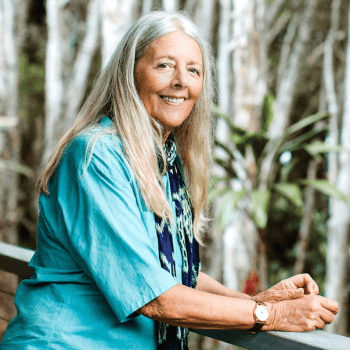 HELENA NORBERG-HODGE is a pioneer of the new economy movement and recipient of the Alternative Nobel prize, the Arthur Morgan Award and the Goi Peace Prize for contributing to “the revitalization of cultural and biological diversity, and the strengthening of local communities and economies worldwide.” She is author of the inspirational classic Ancient Futures, and Local is Our Future (2019), and producer of the award-winning documentary The Economics of Happiness. HELENA NORBERG-HODGE is a pioneer of the new economy movement and recipient of the Alternative Nobel prize, the Arthur Morgan Award and the Goi Peace Prize for contributing to “the revitalization of cultural and biological diversity, and the strengthening of local communities and economies worldwide.” She is author of the inspirational classic Ancient Futures, and Local is Our Future (2019), and producer of the award-winning documentary The Economics of Happiness.
Helena is the founder and director of Local Futures and The International Alliance for Localisation, and a founding member of the International Commission on the Future of Food and Agriculture, the International Forum on Globalization and the Global Ecovillage Network.
Interview Transcript
Provided by AI
Catherine Weetman
So, Helena, welcome to the Circular Economy Podcast. And perhaps I could start by asking you to give us an overview of what local futures is all about.
Helena Norberg-Hodge
Well, Local Futures is all about a very, very big area we are so big picture that we deal with almost everything in the world. And it’s because I ended up in this remote part of the world called Ladakh, in the mid 70s, and also in Bhutan. And both of these were areas that had not been affected by the global economy, neither colonised nor developed, and my eyes were open to the impact of the global economic system. And it led within a few years to my conviction that we need to strengthen with local economies worldwide. So for more than 40 years, I and my organisation have been focused on that. And we’ve been focused on doing that. Around the world on every continent, we’re tiny organisation, but we’re, we have impact and contacts and networks on every continent. And in doing the work of strengthening local economies, we are also strengthening cultural self respect, the regeneration of biodiversity, more localised food systems, and also community energy schemes, a whole range of activities that are needed to strengthen local economies. And we also deal, you know, with a lot of you who are primarily focused on critiquing the expansion of the global economy and looking at its impact on human wellbeing, on democracy, and of course, on climate on the planet. So we we cover a very, very broad area in terms of the topic, and we work globally. And one thing we did a couple of years ago was to launch Word localization day. And we’re collaborating with hundreds of groups around the world. And we’ve recently launched a localization action guide, that hopefully can be helpful for people who are interested in this type of activity.
Catherine Weetman
Well, we can certainly put a link to that in the show notes. And I was just making a note, I can’t remember if I mentioned this, when we spoke ahead of the podcast, but a group in the UK called Totally Locally, that works with local towns to help help them
Helena Norberg-Hodge
Absolutely – we’ve been in touch with them and collaborated with them
Catherine Weetman
Great stuff. And so one of the things that you’re particularly exercised about is, is what’s wrong with our food system and the way it’s developing, you know, the global north model that’s being exported, if you like elsewhere, and kind of a guest lots of issues around food. Could you unpack that a little bit for us?
Helena Norberg-Hodge
I would love to. I would also urge people to look at our very short little video about three minutes, where we contrast the global food economy with local food economies plural.
Helena Norberg-Hodge
We are showing that in this global food economy, which is a highly integrated, centralised, top down corporate system, unfortunately, supported by our governments, subsidies for everything from research and development at universities to infrastructure, also to the imposition of regulations at the local and even national level. While global businesses, global corporations are being deregulated through free trade treaties. We have a system where our governments are systematically supporting the separation of between us and the source of our food, absolutely, systemically and systematically. We’re getting food from further and further away and food is being imported and exported the same product, beef in, beef out milk and milk out. Water in water out just recently 20 tonnes of bottled water to Australia from the UK, and about 20 tonnes of bottled water from Australia to the UK. It’s mad but it’s logical, according to the way that GDP is measured, and the way that governments are working added to the notion that more global trade is the way to increase GDP. In the meanwhile, at the local level from around the world, you know, in every continent there is a resurgence there is a constant flowering of initiatives trying to re establish healthier food systems where we shorten the distance from plant to table. And we people in the West are also waking up to the need to support so called peasant farmers or smallholder farmers in the so called third world or in the so called undeveloped parties, where hundreds of millions of farmers are struggling to raise awareness about the fact that these trade treaties are destroying them. And that these subsidies for the global infrastructure for global trade means that important food costs less than local food. It’s nothing to do with efficiencies at scale, nothing to do with supply and demand. It’s to do with top down control. And global food economy is the biggest contributor to climate change, to mountains of plastic to destroying the life in the soil, to bringing in junk food that is destroying the biome in our gut, along with destroying the soil. It’s it’s it’s a thoroughly destructive system. And it’s now escalating because corporations as blind organisms, it’s not really so much about bad people with people, it’s about bad policies and blindness. So in the meanwhile, at the local level, more localised systems are the best way to reduce climate emissions, the best way to restore biodiversity. And most importantly, if you take any two bits of land, and one, you do diversity, ideally as diverse as possible, ideally, including animals, maybe it will be ducks, eating the weeds in any rice paddy, maybe it will be just to go eating waste that human being planted that producing fertiliser, and milk and all kinds of other valuable benefits that increase the productivity. So diversity on one piece of land monoculture on the other, you will always be able to produce more if you go for diversify production. word that’s very popular these days is agro ecology. In other words, it’s it’s ecological. It’s adapted to local ecosystems. From my point of view, the more important language we need to be focusing on is that we need to be doing everything we can to support local food systems worldwide. They need to be wedded to shorter distances and to supporting smaller diversified farms. The biodiversity on the farm, the agricultural biodiversity also helps increase wild biodiversity. It reduces the plastic it reduces the emissions, it reduces the need for refrigeration. We’re talking about massive, multiple benefits. Another huge benefit that we see, particularly in the West, is that as people start connecting across food across soil, you start seeing a healing among depressed people, prisoners, juvenile delinquents, because we’re in touch with one of the most fundamental, productive, meaningful activities that we spend most of our time engaged with, in our entire evolution.
Helena Norberg-Hodge
Cut off from the food, cut off on the soil, cut off in the land, doing meaningless work where we don’t even see the end result of what we do. That’s unnatural. It’s been a very short blip in our evolutionary development. We can see around the world the healing that happens around community gardens, local farmers markets, Community Supported Agriculture, permaculture initiatives, slow food initiatives, the healing benefits on people as well as ecosystems is so inspiring. Well, one final say on the very long winded. But a final thing I want to say is that for me, the most inspiring thing, most inspiring movement I know of is the young people who are returning to farming. At that level with that diversify, localised Community Supported Agriculture, they’re so wonderful, really inspiring movement of young people really seeing a future and engaging in something that is fairly healthy and meaningful.
Catherine Weetman
Yes, and I think locally, I’m seeing some some examples of that. I live in the, in the uplands of the of the UK. And yes, so it’s, it’s, I guess, I’m still seeing a bit of a split, though, in terms of what the younger farmers are looking at some of them are still following the industrial agriculture model. And going, you know, bigger and more machinery and more intensification, but others are definitely moving towards a much more regenerative, mixed diverse farming and realising that less can be more, you know, less less animals grazing means less inputs means less work means less housing, and all the rest of it, but certainly not all of them. And I guess, you know, that brings me on to why mixed farming is is misunderstood in many circles, possibly, because some of the propaganda that comes out from Big Ag and the seed companies and fertiliser companies and so on. But there are, you know, people people object to mix farming, because of, you know, they use the production of methane, methane as a, as a barrier that veganism is is better. You know, there are lots of people arguing that we could just go completely plant based. And that would be fine. What, what would you say to those arguments?
Helena Norberg-Hodge
Well, first of all, I’m very sympathetic to people who don’t want to kill animals and who are appalled by the conditions in these animal factories, they are absolutely horrific. And, tragically, we do not hear about the voices that are trying to get us to distinguish between these hideous animal factories, cruel to the animals, hideous structure to the land of very bad for our health. And the diversified farming that was part of traditional agriculture for generations, for 1000s of years, actually, in almost all traditional systems. In every indigenous culture, people ate animal products. And there are quite a lot of, there’s quite a lot of evidence that those that particularly animal fat is actually very good for health. There’s also records of big corporations using advertising and persuading doctors to promote vegetable fat instead of animal fat, in order to be able to sell trans fats as healthier than animal fat. So it goes back quite a long time, that big business realise that if they heated up fat, they could keep it on the shelf much longer. And they started marketing this pure white Crispo. You know, probably like 40 years ago, or so much healthier than animal fat, this type of corporate propaganda basically, again, we have to remember it’s not individual people, we’re talking about entire institutions that are in many cases more powerful and what they’re wealthier than nation states were not harmless corporations with all kinds of specialists, very narrowly focus and many of the scientists that would be involved in creating the changes for genetically modifying food and, and you know, thinking genetically modified food is better for our health, or creating, you know, the trans fats so that food can be stored on the shelf. They were led to believe that this was in the best interest of people and there was almost no research on the health impacts. So we talking about a lot of blindness here, but I said, an end result has been disasters. And right now, from our point of view, spend a lot of money promoting a plant based diet and veganism because in this global food system that is so based on corporations gaining control, and ensuring that smaller businesses, smaller farmers, smaller towns even can’t compete with their wealth creation, which is linked to driving most farmers off the land. If this continues, we will be in a world where people will have been driven into a AI driven cities. And we will be surrounding perhaps with a little bit of rewilding, and then the farming will be done primarily by robots. Now, the men and the institutions that are pushing this, first of all, its zone of machine like the pushing in this direction, there is a link between the growth of mega cities like Beijing with now. What is it about 60 million people, there are 18 satellite towns with about 2 million. So the total conglomeration is about 60 million. Now this monstrous growth is entirely a consequence of this corporate system, which is driving people off the land into doing meaningless factory labour for a high tech industry, where creating video games and consumer goods that are crumbling, not not only useless, but harmful. The whole gaming industry, and it’s highly addictive, it’s linked to serious health problems and mental problems. Anyway,
Catherine Weetman
< |



.png)
 More
More
 Religion & Spirituality
 Education
 Arts and Design
 Health
 Fashion & Beauty
 Government & Organizations
 Kids & family
 Music
Music News & Politics
 Science & Medicine
 Society & Culture
 Sports & Recreation
 TV & Film
 Technology
 Philosophy
 Storytelling
 Horror and Paranomal
 True Crime
 Leisure
 Travel
 Fiction
 Crypto
 Marketing
 History
 Comedy
 Arts
Arts Games & Hobbies
 Business
 Motivation