|
Description:
|
|
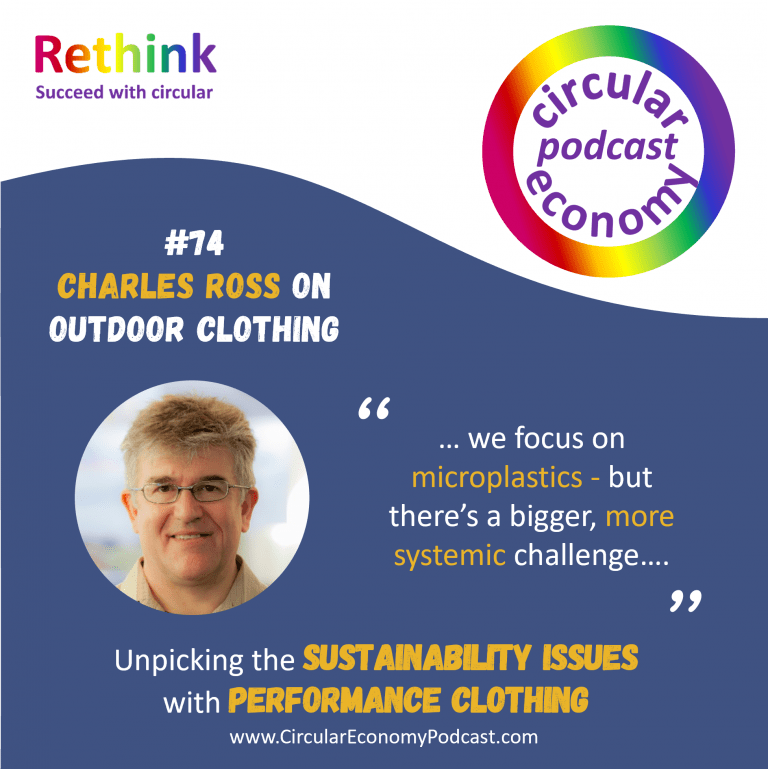
Charles Ross talks to Catherine Weetman about Performance Sportswear Design & sustainable matters for outdoor gear and clothing.
Charles has worked alongside some of the better thinkers of the industry, like Sarah Howcroft (co-founder of Rohan), & the sustainability team at the European Outdoor Group trade association his passion for more responsible product development grew. However he kept returning to the concern from his students: How is selling more Product going to Save the World?
We talk about fibres, including petrochemicals and bioplastics, why microplastics are not the biggest problem, we discuss trends for rental, reuse and repair. We discuss false solutions, and why emotional durability is the key to reducing our clothing footprint.
Podcast host Catherine Weetman is a circular economy business advisor, workshop facilitator, speaker and writer. Her award-winning book: A Circular Economy Handbook: How to Build a More Resilient, Competitive and Sustainable Business includes lots of practical examples and tips on getting started. Catherine founded Rethink Global in 2013, to help businesses use circular, sustainable approaches to build a better business (and a better world).
Stay in touch for free insights and updates…
Read on for a summary of the podcast and links to the people, organisations and other resources we mention.
You can subscribe to the podcast series on iTunes, Google Podcasts, PlayerFM, Spotify, TuneIn, or search for “circular economy” in your favourite podcast app. Stay in touch to get free insights and updates, direct to your inbox…
Don’t forget, you can use our interactive, searchable podcast index to find episodes by sector, by region or by circular strategy. Plus, there is now a regular Circular Economy Podcast newsletter, so you get the latest episode show notes, links and transcript delivered to your inbox on Sunday morning, each fortnight. The newsletter includes a link to the episode page on our website, with an audio player. You can subscribe by clicking this link to update your preferences.
Links we mention in the episode:
- A Circular Economy Handbook: How to Build a More Resilient, Competitive and Sustainable Business – buy from any good bookseller, or direct from the publisher Kogan Page, which ships worldwide (free shipping to UK and US) and you can use discount code CIRCL20 to get 20% off. It’s available in paperback, ebook and Kindle. If you buy it from online sources, make sure you choose the new edition with an orange cover!
- Sign up to get the podcast player and shownotes for each new episode emailed to your inbox
- Charles Ross on LinkedIn https://www.linkedin.com/in/charles-ross-1464714/
- Email Charles@email.com
About Charles Ross

Charles Ross is just a lucky guy – he keeps on being at the right place & the right time. Whilst adventuring around the world he ended up in the US & joined the staff at Outward Bound. On returning to this country the cold, wet, windy & dark location of work did not appeal so much, so he diverted into the apparel side of the Outdoor Industry just as Goretex & fleece were taking hold.
He completed his education just as the new MA in Performance Sportswear Design was started, so was ‘volunteered’ to deliver some of the modules & has been associated with the graduates of it ever since.
Working alongside some of the better thinkers of the industry, like Sarah Howcroft (co-founder of Rohan), & the sustainability team at the European Outdoor Group trade association his passion for more responsible product development grew. However he kept returning to the concern from his students: How is selling more Product going to Save the World? The advantage of having some of the best graduates has always raised the bar!
Issues like the Forever Chemicals (highlighted by the movie Dark Waters), the Plastics-in-the-Ocean, ReGenerative Agriculture, and the such like always seem to be on his desk. He teaches all over the world (mainly by Zoom), has been recruited to the Royal College of Art to lead on Performance Sportswear Design, lobbies on textiles via UK Government APPGs (All-Party Parliamentary Groups) & Select Committee appearances, but is most proud of being one of The Do Lecture team. His most visible role is as the moderator of the presentations at the Ingredient trade fairs of Performance Days & the Functional Fabric Fair
Interview Transcript
Provided by AI
Catherine Weetman
Charles, welcome to the circular economy podcast.
Charles Ross
Thank you, Catherine. And can I say what an honour this is. And I’m going to have imposer syndrome, because I use your podcasts to listen to people that I really admire. So I do not feel unworthy to be on the same stage as a couple of your previous guests. But I’ll do my best to try and keep up the standards.
Catherine Weetman
That’s very nice of you to say, so Charles, I’m just reading your bio, you describe yourself as just a lucky guy, feeling like you keep being at the right place at the right time. So maybe that’s one of these happenstance occasions, not not that I would put my podcast up with some of the other stuff that you’ve done. But maybe we could start with a quick overview of your background, because it’s quite, you do have a kind of a nice meandering story of, of how you how he got to where you are now. So tell us a little bit about that, please.
Charles Ross
Without going into great detail, I grew up in a military environment. And I was unable to join the military. So I went travelling, and somehow I ended up as an outward bound instructor within America, where it was glorious. And I eventually returned to this country on November the first when it was dark, wet, windy and cold. And I decided being an outward bound instructor wasn’t really what I wanted to do. But I had a passion for the community that I’d been experiencing. And this was at the end of the 80s. So it timed with fleece arriving on the market with gore tex arriving on the market and there was energy in this sector. So I went to look at the textile side of the industry and fell on my feet and and I’ve I’ve stayed within that area ever since.
Catherine Weetman
So Charles now you specialise in performance sports, where could we start with an overview of some of the sustainability challenges and I’m guessing we won’t even get near all them. But I know people have concerns about things like waterproofing, the dyes and coatings, microplastics, and lots of other things.
Charles Ross
The list is endless, and they are all challenges. And it’s all where it goes wrong. Performance, sportswear essentially gives you microscopic improvements in most cases, more often there’s more enthusiasm to the marketing of them than there actually isn’t the performance difference. But the whole industries designed to make you consume more. Now, some of it really important, in the situations where clothing is used as life saving equipment, or for the top athletes, it does make a difference. But the majority of the use is what we call outside use, rather than outdoor use. And there is the desire, mainly led by the marketing telling you to consume more. And yes, so without knocking the whole industry, but the the model is broken, because all we’re told to do is to consume, consume, consume, which I’m, I’m not sure fit, sits well, in my mind.
Catherine Weetman
Now, me neither, and I guess nearly every consumer facing industry I look at is more and more following the fast fashion model of you know, planned obsolescence and creating, creating trends out of nothing but creating trends. Were one of the criteria seems to be hardly anybody will have this in their wardrobe, you know, from years ago. So we’re so we’re safe to introduce this in the knowledge that people won’t just get out the ones they’ve already got of, you know, this colour or this shape or whatever. So coming back to some of those the specific sustainability challenges, which which do you think which are the companies focusing on most? Is that microplastics? Because perhaps their customers are worried about that? Or is it more to do with the chemicals used in waterproofing dyes and coatings? What what do you see them focusing on
Charles Ross
the big areas at the moment, the media has made out plastic in the ocean, which is the micro filaments, or the fibre fragmentation to be the big problem. But actually, plastic in the ocean is only the third biggest problem within the ocean. We have global temperatures, we have overfishing, and then we have pollution in the ocean. And we know from wash test, the guys at University of Leeds, have actually done the research. And we know that most cellulosic or natural fibres are weaker than the synthetic fibres. So when you do your laundry, there is more there’s more cotton breakoff than there is polyester break off, which makes a bit of a foolish awareness of the situation. I’m really interested in the chemical situation. And just before locked down, there was actually a popular movie called dark waters, based on the book expose, which was about du Pont’s leaking of chemicals into ground soil within America. And it’s the PFCs the PFOA is that is a massive problem. And most people interpret it as we will just get a white, a white coated laboratory genius to substitute the chemicals for less bad chemicals. But we’ve got so used to the technology, the new generation of chemicals can’t perform as well as the old chemicals. And then the most current thing coming through at the moment is that we’re using that many synthetic fertilisers, pesticides and dyes. Some are now reassessing that actually some natural materials which have been grown in this way or processed in this way, actually bear more resemblance to a synthetic fibre than they do to an actual fibre. So what we all learnt in school that cotton biodegrades if you just leave, it is no longer true. I mean, it’s going on for decades. So you’ve asked me what the biggest problem is? I don’t know there’s a whole array of problems. And I would not say that that’s our biggest problem is actually the cheapness of textiles, just like food. Because they become cheaper. We now own twice the amount of garments that we did at the millennium, which are doubled from the 1970s. So to me, the biggest problem is the overconsumption of textiles on potentially an overpopulated world. But that is extrapolated, because we have extended supply lines, I have just been talking about Spring, Summer 2023. trends, and we’re still in 2021. And the only way to make sure that you don’t run out of stock, if you overproduce soap, because if you lose the famous shelf space, it’s your rival brands that will move into that area. So our biggest problem to me is the cheapness of textiles. And the model that we’re having to push them to, which is a really depressing answer. Sorry, Catherine.
Catherine Weetman
That now it’s, it’s not, it’s not particularly a surprise, I think it’s it’s interesting that you’re focusing on on the same areas that I’m starting to talk about more and more, which is, the most important thing we’ve got to do is reduce our footprint, you know, whatever kind of footprint that is, whether it’s about energy or chemicals or land use whatever it is, we’ve got to come up with ways of reducing the footprint. And the only way we’re going to make a big enough impact is by consuming less. And that means to two things in terms of design. It’s either more durable products, which doesn’t fit with the the trends and the fast fashion and all the rest of it and the marketing, or it’s producing products that can can have, can be used by more than one person over the product lifetime through sharing, renting, exchange systems reuse or you know, resale, all that kind of stuff. So we get more use out of the same product. And only those two things will slow down the flow of materials, and shrink our footprint. I guess, I guess what I was asking was out of those problems. Where are the manufacturers focusing most what what are they seeing as the as the number one thing for them to do better?
Charles Ross
It’s emotional obsolescence. I call it emotional durability, which is how long do I love this garment for to keep wearing it? Or as the fashion trade want to refer to it as emotional obsolescence. How quickly can they make this garment unloved so that you will buy a new a new product instead?
Catherine Weetman
Wow, is that is that a real thing? They’re not just they’re not just focusing on new trends, but that I do think designers are actively focusing on how do we make this emotionally obsolescence as fast as possible. You
Charles Ross
you’ve you’ve used again another particular word do I think designers are doing it? No. And I think as in brilliant cases from especially the outdoor and sports industry, but how the designers want to make it last emotionally for as long as possible. But I would not See the same of the trend of big business. And if I could just give an example, To illustrate this, the top of the mountain brand at the moment is recognised to be Arcteryx, Canadian company, really decent company. And they even have manufacturing over in Canada. So they’ve got their social network built up on on that side of it. But they had a fair amount of staff Chief of Staff churn. And they noticed that people were joining the company or wanting to join the company, because they loved the values of the company. But when they got there, they found the company wasn’t actually living up to the other side to the to the quant side, or being a really active player within the community. And not so much the lead athletes who were choosing to work there, but the rest of the team wanted them to pay more attention to the footprint of the apparel. So there was this contrast between they wanted to use the best materials, but they also wanted to be responsible. And they had a project which you can look up on bird’s nest, you can look up on YouTube, they don’t actually talk about it publicly. It’s called bird’s nest, which is when they pull all their spare bits of GoreTex together from off cuts. And in October each year, the whole of factory goes to work on a Sunday, unpaid. They, they make all the off cuts of Gortex into rain, capes, ponchos. And the following month, they go and distribute them towards the hobos of Vancouver. And since they’ve done this and found their place in the community, two things have happened. One Arcteryx Are the testbed for the new type of GoreTex. So if you ever want to be an industrial spy, the easiest way to do it is to become a hobo within Vancouver, but also the company reconnect to their society in their community. And their staff churn shot down rapidly. Because although they weren’t publicly talking about it, the employees knew the company was playing a decent well within their society.
Catherine Weetman
Yeah, that’s really interesting. And there is more evidence that employees want to work for companies that, you know, fit their values and and people are thinking much more carefully about who they want to work for, and whether they’ll be proud of working there. And you know, it’s not just about the pay the benefits, where it is and so on. These things becoming more and more important. So let’s, let’s move on to good stuff now. What do you think the key players are doing to go more circular? Are you seeing anybody offering rental in the outdoor market or proper take back and resale schemes? I know there’s Patagonia worn wear but that only really exists in America. There’s no he can’t come by worn wear if you’re not living in America. What are you seeing out in the market?
Charles Ross
I’m actually seeing a massive explosion of this very area over in Scandinavia, especially Sweden, places like Haglofs, Houdini, each is born all of a rental models Fjallraven have gone for the long term durability and for sizing, you know if you have 30 or 40 year garments, we will help to repair them keep them going. Ortovox, the German company, is just doing such good social responsibility with their supply chain. Patagonia are the default answer when when anyone ever asked someone in a school of fashion. Can you example, a sustainable clothing company? They say Patagonia and Patagonia have very good practice, but they excel at the communication of it. But I can also look towards a German brand like Vaude and I would actually challenge and say Vaude, they actually have better product. So environmentally lower impact. It’s just their communication isn’t good. But that’s ignoring all the brands within this country. People like Rab, Mountain Equipment, Alpkit , Rohan, Berghaus – All the big ones are doing much improved practice. Rab have just committed to becoming a Climate Neutral company within the next couple of years. Mountain Equipment are also on the journey. They’re the people who instituted what has become the Responsible Down standard. So the RDA they they were the people who were first in the market with a standard. Alpkit have their continuing project. In all their shops, they have a repair centre, which just like Worn Again, you can take any goods into and they will place zips and buckles. So definitive stare within all their retail outlets Berghaus, Rohan, I mean, you can actually, it makes me proud to go through the list of all the brands. And because they will staffed by what I call decent people, there is no brand not trying to make progress in this area. And even those brands who are more on the athleisure side brands like the north face, and Christopher Raeburn, they still have wonderful practice going on. So I almost see the outdoor industry as being very much the early adopters of this. And it now integrated itself into the more high street side. So I can’t think of a brand off the top of my head, who what they’re doing, I am ashamed of, I would actually like to say the outdoor industry as a whole actually have good practice. And if you look underneath the cover, almost every company will do something good.
Catherine Weetman
Huh, that’s interesting. And it’s good to see lots of them making making solid progress. What do you think? Are the key trends on textiles? Are companies being pushed away from using synthetics? Or are they trying to find ways of using set synthetics that avoid some of the issues around you know, synthetic dyes and finishing and also the the micro fibres that that don’t degrade? And as as, as you mentioned before, carry lots of chemicals? And I know that that happens for cotton as well. But you can’t it’s there isn’t technology so far that I’ve seen that allows the use of naturally derived dyes for synthetics, What trends are you seeing on the textiles?
Charles Ross
That’s a really good question to ask in December 2021. Because we’ve just finished two big themes on the future sustainability of nylon, as was the theme. Polyester we all know about. And everyone’s very aware of the recycling of polyester, which is not so much the recycling of polyester but the down cycling from the drinks industry. So there’s a lot of PET out the |



.png)
 More
More
 Religion & Spirituality
 Education
 Arts and Design
 Health
 Fashion & Beauty
 Government & Organizations
 Kids & family
 Music
Music News & Politics
 Science & Medicine
 Society & Culture
 Sports & Recreation
 TV & Film
 Technology
 Philosophy
 Storytelling
 Horror and Paranomal
 True Crime
 Leisure
 Travel
 Fiction
 Crypto
 Marketing
 History
 Comedy
 Arts
Arts Games & Hobbies
 Business
 Motivation