|
Description:
|
|
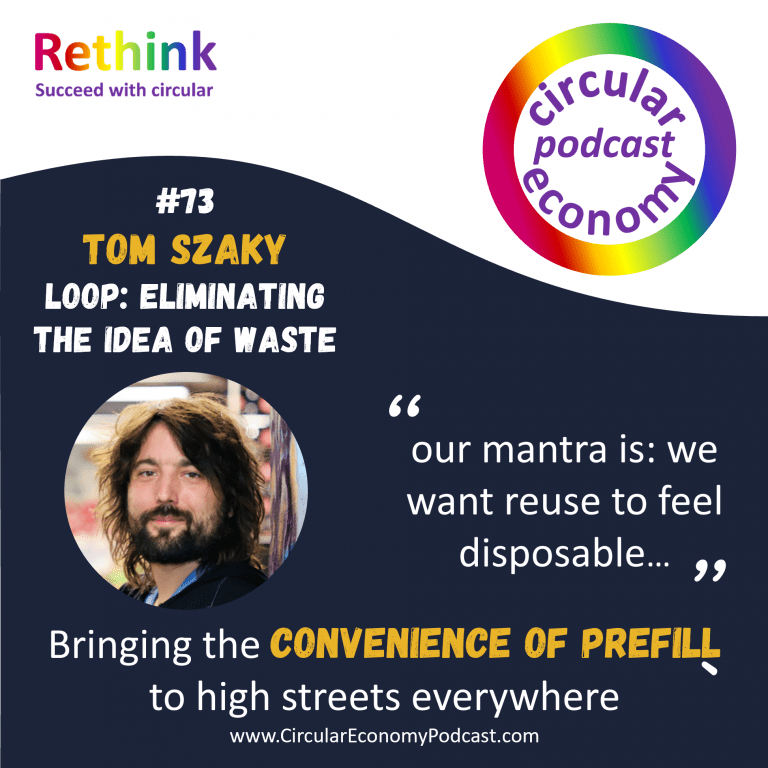
Catherine Weetman talks to Tom Szaky, founder of TerraCycle and Loop. Tom tells us how the Loop reusable packaging platform is bringing the convenience of prefill to high streets everywhere. TerraCycle and Loop are tackling the root causes of waste, including single use and disposable items.
We hear why they chose prefill, and why reuse needs to ‘feel disposable’. Tom explains how they are helping big brands and retailers to make the business case, feel confident about moving forward, and scale up from pilots to in-store roll-outs.
We hear why both profit and purpose are essential, and Tom describes the progressive steps in TerraCycle’s evolution. The next step, with Loop, is how to tackle one of the root causes of waste – single use and disposable items.
TerraCycle and Loop have evolved by being clear – forensically clear – on the most convenient solution for the customer, AND for the brands and the retailers. That convenience has to match or improve on the convenience of the current, disposable system. As Tom said, ‘reuse needs to feel disposable’, and for the last few decades, disposability has won out over frugality and greener options that need more effort.
Prefill was chosen, rather than refill, because it provided the widest breadth of opportunity, and because prefill systems have been around, successfully, for centuries. TerraCycle looked at those systems, and worked out how to evolve them for a retail supply chain.
The TerraCycle team thinks carefully about how to scale up, what brands and retailers need to see before they can build the confidence to move forward, and create the business case for investment.
Podcast host Catherine Weetman is a circular economy business advisor, workshop facilitator, speaker and writer. Her award-winning book: A Circular Economy Handbook: How to Build a More Resilient, Competitive and Sustainable Business includes lots of practical examples and tips on getting started. Catherine founded Rethink Global in 2013, to help businesses use circular, sustainable approaches to build a better business (and a better world).
Stay in touch for free insights and updates…
Read on for a summary of the podcast and links to the people, organisations and other resources we mention.
You can subscribe to the podcast series on iTunes, Google Podcasts, PlayerFM, Spotify, TuneIn, or search for “circular economy” in your favourite podcast app. Stay in touch to get free insights and updates, direct to your inbox…
Don’t forget, you can use our interactive, searchable podcast index to find episodes by sector, by region or by circular strategy. Plus, there is now a regular Circular Economy Podcast newsletter, so you get the latest episode show notes, links and transcript delivered to your inbox on Sunday morning, each fortnight. The newsletter includes a link to the episode page on our website, with an audio player. You can subscribe by clicking this link to update your preferences.
Links we mention in the episode:
- A Circular Economy Handbook: How to Build a More Resilient, Competitive and Sustainable Business – buy from any good bookseller, or direct from the publisher Kogan Page, which ships worldwide (free shipping to UK and US) and you can use discount code CIRCL20 to get 20% off. It’s available in paperback, ebook and Kindle. If you buy it from online sources, make sure you choose the new edition with an orange cover!
- Sign up to get the podcast player and shownotes for each new episode emailed to your inbox
- Tom Szaky on LinkedIn https://www.linkedin.com/in/tomszaky/
- Instagram and Facebook @chooseloopuk
- Twitter and LinkedIn @chooseloop
- Recommended guest – Paul Hawken, founder of Project Drawdown, and co-author of Natural Capitalism, Drawdown, and Regeneration https://paulhawken.com/
- Episode 66 Alyssa Couture – Healthy Fashion is better for all of us, and our planet https://www.rethinkglobal.info/episode-66-alyssa-couture-healthy-fashion-is-better-for-all-of-us-and-our-planet/
- Episode 42 – Brian Bauer of Algramo – solving the ‘poverty tax’ with reusable packaging https://www.rethinkglobal.info/episode-42-brian-bauer-of-algramo/
About Tom Szaky
Tom Szaky is founder and CEO of TerraCycle, a global leader in the collection and repurposing of complex waste streams. TerraCycle operates in 21 countries, working with some of the world’s largest brands, retailers and manufacturers to create national platforms to recycle products and packaging that currently go to landfill or incineration.
In May 2019, TerraCycle launched Loop, a circular reuse platform that enables consumers to purchase products in durable, reusable packaging. Loop is available in France, the UK, Canada, Japan and the 48 contiguous U.S. states, and is a key step in helping to end the epidemic of waste that is caused by ‘single-use’ consumption. In 2022, Loop will become available in Australia.
Tom and TerraCycle have received hundreds of social, environmental and business awards and recognition from a range of organizations including the United Nations, World Economic Forum, Schwab Foundation, Fortune Magazine, Time Magazine and the U.S. Chamber of Commerce.
Tom is the author of four books, “Revolution in a Bottle” (2009), “Outsmart Waste” (2014), “Make Garbage Great” (2015) and “The Future of Packaging” (2019). Tom created, produced and starred in TerraCycle’s reality show, “Human Resources” which aired on Pivot from 2014-2016 and is syndicated in more than 20 foreign markets on Amazon and iTunes.
Interview Transcript
Provided by AI – approximate timings for the finished episode
Catherine Weetman 03:05
Tom, welcome to the circular economy podcast.
Tom Szaky 03:08
Thanks for having me.
Catherine Weetman 03:09
It’s great to see you today. And you’re one of the pioneers starting a circular business way back in 2001. So I’d love to start by asking a bit about your background and how you got here.
Tom Szaky 03:21
Yeah, absolutely. So, you know, I’m originally from Hungary, born in Budapest. And that’s only really relevant because back in the early 80s, I was born in 82, was still communist at the time. And Chernobyl happened in 86. My parents were able to escape with me as four years old, and we landed as refugees in Germany that fall in Belgium. And then finally, Canada. And I mentioned this because I went from effectively communism to capitalism, fell in love with entrepreneurship. Probably for more ego centric reasons, you know, like fame and fortune pursuit, I found that was a easiest ticket for me to, you know, to, you know, to those more, you know, personal dreams. And I had this big turning point, to be honest, you know, in my first year of university, I was down in the US at this point. And when they were teaching business, you know, one of the ways they taught it was that the purpose of business is to maximise profit to shareholders. And, you know, I had a fundamental problem with that, because, you know, today when I say talk at schools and universities and ask students, what’s the point of business they never say an answer like that. They say, it’s about making the world better or society better or somehow solving the problem and improving but the, but the way business interacts today is it’s it’s, it’s, that’s nice, but the fundamental purpose is profit to shareholders. And I wanted to sort of reevaluate the purpose of profit in my mind, and I sort of see it as a very important thing, but as an indicator of health, right? If you’re profitable, you’re going to flourish and grow. And if you’re not profitable, the opposite will occur. And and so I wanted really desperately to sort of think about business models that put purpose first and then can do so at a profit. So can’t flourish and grow. And that started a lifelong fascination with waste. Because garbage is a huge, purposeful issue, you know to solve, right? It’s a big problem. But there’s, you know, it’s also devoid of innovation, perhaps because it is literally smelly, nasty, gross, and we avoided, even professionally avoided. And there are so many interesting ways to elevate or eliminate waste that can be done in a for profit context. And so that’s been how TerraCycle began. And you know, that’s been 20 years. And now we’re about 600, team members across 20 countries doing this, this work.
Catherine Weetman 05:38
Wow, that that’s expanded really impressively hasn’t it. And when I was doing the research for the podcast, and looking at the website, for what Loop was doing, which is what we’re going to focus on today, then the mission statement on the Loop site, outlines the challenge that we all face, highlighting the proliferation of single use products enabled by marketing campaigns that define them as a transformative modern convenience. So we’re all kind of you know, being convinced that convenience is the most important thing. And from that, we’ve seen exponential increases in single use products over the last few decades. And that’s now led us to this to where we are now, which is a global waste crisis that threatens our oceans, our ecosystems and human health. So there’s some powerful stuff there. In that mission statement, and you’re pointing out that today, less than 10% of all single use packaging is recycled. So that leaves the remaining 90% in landfills, incinerated or discarded, and then ending up ultimately in our oceans. And we’ve you know, we’ve seen the pictures of that. And we know it’s not just about fish swallowing plastic, it’s all the microplastics and the chemicals leaching out of those micro plastics and much worse. So I guess the inconvenient truth is that we can’t continue using and disposing all of those highly convenient single use items. So so how, how did the idea for loop evolved from all of those issues?
Tom Szaky 07:08
Yeah. So you know, the journey of how loop came to be, you know, started and how it loop is Tara cycles, third division. So it’s important to think about the context of how we evolved, because loop is the next progressive step in our evolution. So we first began by saying, how do we move from linear take, make waste systems to more circular ones. And the first step was, how do we figure out how to collect and recycle anything that is not recyclable. That’s not necessarily fully circular, but it starts bending the the linear system into into a slightly more circular. And what we realise there is that what makes something recyclable is whether a local garbage company can make money recycling that object. And what makes something not recyclable is the inverse, that it would cost more to collect them process than results are worth. And the challenges is it’s getting worse, you know, oil prices are low, relative to where they were five years ago. And markets are more difficult to access, many countries stopping the importation of waste, which they did for very good reason. But it also still does hurt recyclers who used to export you know, around 40 50% of their waste to these markets, who paid for it. And then the third is, and this is the most important is that the quality of our waste, visibly how profitable it is for recyclers to recycle is diminishing. Because as products become lighter and cheaper, there is objectively less value to recover. And that’s this big challenges of, of disposability. What disposability brings about, is phenomenal convenience, and affordability, which are major virtues, right? These are things that are very important, you know, to access things cheaply. And in a convenient way, those are probably the two biggest drivers of how we use products. To make things cheap and convenient, we typically take value out of it, which makes it fundamentally less exciting for recyclers to bother even trying to recycle, because there’s just less value. So that was the first sort of part. From there. We said once we got that going, Well, now let’s work on companies integrating waste into their products. So they’re not just making sure their product is recycled, but that they’re also a demand for recycled materials because you need both. And that’s sort of what became the TerraCycle business and grew. And then we had, you know, maybe four years ago, a big thing and ask ourselves, is that enough? And we realised recycling is an imperfect solution to waste. It’s a bandaid. And it’s an imperfect solution, because you’re still managing waste. It’s perhaps the best way to manage waste. But it’s not a you’re not solving the concept of waste, right? You’re not eliminating the idea of waste. You’re just managing the problem. And so we then took a think on well, how do we get a step deeper and solve for the idea of waste, right? And so there we landed on the root cause of waste, we believe is this concept of single use or disposability. Those are somewhat synonymous. Those came about in the 1950s. Before then, you know we’ve cobbled our shoes We mended our clothes, we bought milk from the milkman and all the derivatives thereof. And as we looked at reuse, we then evaluated you know what is going on in reuse, right and what’s happening. And we looked at there’s many ways that that we use models can exist today, you can have refill stations at stores, you can buy, concentrate and fill at home, you know these models. But then when we look at what is the biggest scaled we use system in the world today, we realise that it’s prefilled, like products that are already full, ready to purchase. Those are the biggest scale system, it’s Canadian beer. It’s German beverages, it’s even here in the US propane tanks and beer cakes. And this then led to the what’s the macro challenge in the reuse economy is that every reuse apparatus, whether it’s a refill station, or concentrate, or pre fills are what you would call mono supply chains. In other words, you got to take the beer keg back to the beer store, you got to take the propane tank back to the propane tank store, you got to remember to go to that refill station for that product. And it’s not scalable. Like one of the nice things about disposability is your garbage can doesn’t care where you bought the object, your recycling bin only cares if that bottle is recyclable, it doesn’t care what was in it, or where you bought it. And that’s what we felt we use needs the platform for reuse, that effectively enables a simple idea, by anywhere, return anywhere, for as many types of products humanly conceivable. And that really is what loop is trying to achieve is to is to be that platform, where any brand can participate, traded reusable version of their product from orange juice to laundry detergent, and any retailer can can make that available, you know, to their consumer. And the consumer can simply you know, buy it at McDonald’s and return to a Tesco.
Catherine Weetman 11:43
Yeah, that’s a really, that’s a really interesting way to look at it to kind of look at look at these prefilled systems and how convenient they are. But there are limitations around the single supply chain as you say. And that’s not something I’d I’d kind of thought about the kind of nuances between just taking any old empty container and then having to fill it versus just you know, dumping the empty container and you know, grabbing a fresh one prefilled, as you say, from the from the shelf. And so when I read first read about the the US launch of loop, I noticed the solution involved home delivery of the products in the loop containers via a parcel courier. And then once you’d finished, you presumably use an app to say, you know, this needs refilling, and then you schedule a delivery. But in the UK, the model there’s refill stations in Tesco stores, and I think in France, it’s at Carrefour stores, is that right? So it’s a slightly different model. So is this an evolution of the offer based on how customers have interacted with it so far? Or is it about different models for different demographics or cultural patterns?
Tom Szaky 13:02
It’s a very good question. And I would say to answer a Backward Loop is now live in Japan, France, UK, US and Canada. And soon lunch in Australia. And we’ve seen no difference in cultural approaches, right. So it’s actually pretty synonymous how consumers behave in all these markets and what drives them. Now in all countries, including the UK and France, we started as an online learning model. So the way we launched in the US is exactly how we launched in France in the UK, where the retailers and the brands wanted proof right that there is consumer appetite before they would invest into making this physically in store and put all that commitment against it. So we launched loop store.com in the US and then UK, France, Canada, Japan, and learnings were very similar. They were all very positive that basically showed consumers care and they’re willing to do it. And so what has happened then in all markets is that the retailers like Tesco in the UK, Carrefour and France and others have now gone in store. And as they have done that we’ve been able to close down these online learning platforms. And we’ve already done that in France and all of them will be closed down by the end of this year as they make way for consumers being able to access the loop system physically in store. Now just one clarification there are no refill stations. If you go into a Tesco you’re going to see a shelf of about 100 products from tomato ketchup by Heinz to personal by Unilever you know you name it, even private label products in prefilled containers you buy those you pay a deposit you and then when you’re done, you can deposit the empty dirty containers back into a loop in and get your deposits back. And then from there we clean and it gets refilled and sold to someone else. And that’s really the model that is scaling now all over the world. Now some of these retailers may choose to also make it available online and some have but it seems like the appetite from retailers is really to scale the in store version only because is still the majority of how people shop for the groceries? Is it in store environment?
Catherine Weetman 15:04
Yeah, I guess there’s also the potential attraction of having the loop stations in the loop store in within the store. Increasing the footfall within the store. Because as you probably no in the in the UK, I don’t, I don’t know how it works in other countries, but in the UK, we’ve ended up with a online supermarket delivery model that loses money for the retailers because they don’t charge for it. So, so yeah, they kind of need to bring people back into the stores. So yeah, that’s, that’s, that’s interesting. And, and you’re right it is, we do need to think about it differently. Because there are these refill stations where you take in your own packaging, and you refill bulk, pasta, rice, whatever. And, and then other ones with the ecover and other and you know, sort of household products where you take in any you know that that packaging or any similar packaging, as long as it’s the right size, and refill your laundry liquid and things. And that’s a different model, isn’t it?
Tom Szaky 16:10
Well, and just to build on that, if I may, like what’s quite exciting about the to you l |



.png)
 More
More
 Religion & Spirituality
 Education
 Arts and Design
 Health
 Fashion & Beauty
 Government & Organizations
 Kids & family
 Music
Music News & Politics
 Science & Medicine
 Society & Culture
 Sports & Recreation
 TV & Film
 Technology
 Philosophy
 Storytelling
 Horror and Paranomal
 True Crime
 Leisure
 Travel
 Fiction
 Crypto
 Marketing
 History
 Comedy
 Arts
Arts Games & Hobbies
 Business
 Motivation