|
Description:
|
|
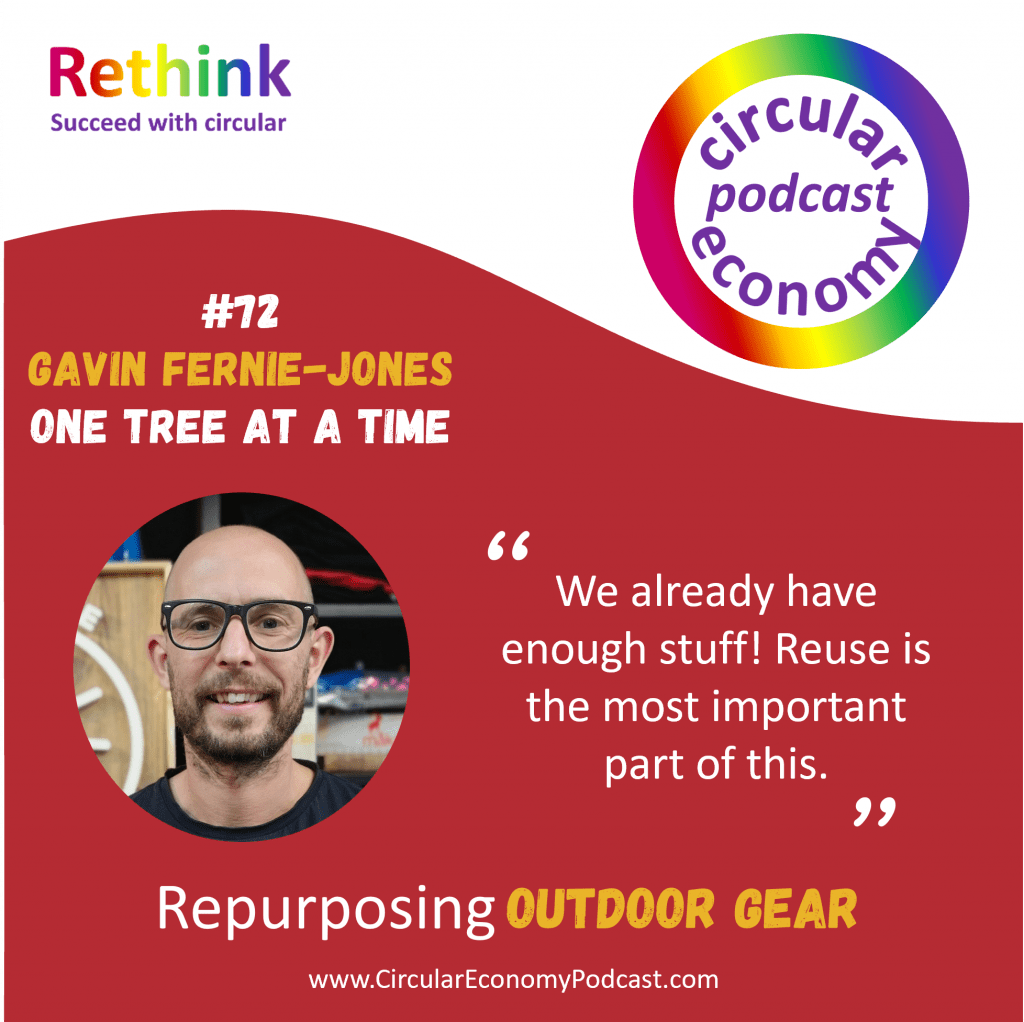
Gavin Fernie-Jones is building an amazing social enterprise to create a circular economy for outdoor gear and ski-wear.
Living in the Alps, Gavin has seen for himself the impact global warming has had in the mountains he calls home. He’s always loved the outdoors, having grown up living in an outdoor centre, but it was while running his bootfitting business The Boot Lab that he realised the impact his business was having on the environment.
Gavin started making small changes to the way that business operated, and seeing the results of this inspired him to start a social enterprise called One Tree at a Time.
One Tree at a Time is embedding circular approaches to change behaviours, build community and protect the mountain environment. The One Tree team has tapped into some surprising sources of ‘waste’ to create value for local people and help build and strengthen local connections. On top of that, One Tree at a Time supports businesses and individuals to change behaviour and protect their mountain environment.
Podcast host Catherine Weetman is a circular economy business advisor, workshop facilitator, speaker and writer. Her award-winning book: A Circular Economy Handbook: How to Build a More Resilient, Competitive and Sustainable Business includes lots of practical examples and tips on getting started. Catherine founded Rethink Global in 2013, to help businesses use circular, sustainable approaches to build a better business (and a better world).
Stay in touch for free insights and updates…
Read on for a summary of the podcast and links to the people, organisations and other resources we mention.
You can subscribe to the podcast series on iTunes, Google Podcasts, PlayerFM, Spotify, TuneIn, or search for “circular economy” in your favourite podcast app. Stay in touch to get free insights and updates, direct to your inbox…
Don’t forget, you can use our interactive, searchable podcast index to find episodes by sector, by region or by circular strategy. Plus, there is now a regular Circular Economy Podcast newsletter, so you get the latest episode show notes, links and transcript delivered to your inbox on Sunday morning, each fortnight. The newsletter includes a link to the episode page on our website, with an audio player. You can subscribe by clicking this link to update your preferences.
Links we mention in the episode:
About Gavin Fernie-Jones
Living in the Alps, Gavin’s watched at first-hand the impact global warming has had in the mountains he calls home. He’s always loved the outdoors, having grown up living in an outdoor centre, but it was while running his bootfitting business The Boot Lab that he realised the impact his business was having on the environment. Inspired to act, Gavin started implementing small changes in the way their business operated, and it was this action that led to him founding social enterprise One Tree at a Time in 2019.
Adopting a circular economic model and through the creation of a connected community, One Tree supports businesses and individuals to change behaviour and protect their mountain environment.
Interview Transcript
Provided by AI
Catherine Weetman
So, Gavin, welcome to the Circular Economy Podcast.
Gavin Fernie Jones
Hi, Catherine. Thanks for having us on.
Catherine Weetman
Yeah. And you’re talking to us today from Courchevel in the French Alps. And hopefully you’ve got nice autumn weather like we have in the UK. But can you start off by telling us a bit about one tree at a time? When did it start? How did you get it going? What’s it all about?
Gavin Fernie Jones
Yeah, cool. So one two at a time is an environmental not for profit that we’ve set up operating in such operates in a small village called Bozel, which is just on the doorstep of the Trois Valley, the biggest ski resort in the world. And we we sort of noticed a few years ago that had a hell of a lot of waste in our industry. So very wasteful, sports getting a lot, a lot of excess, especially in a result that cause Chevelle. And we started to work with local businesses and local community to see how we could help them to manage this waste and also cut waste out their, their revenue streams. So we activated a pledge system to start with, and then that’s evolved from there on until we now own a community space, which is really focused on circular models and recycling and repurposing ski gear.
Catherine Weetman
And when we’re talking about waste, that’s primarily what you’re focused on, isn’t that the ski gear, and particularly some of the ski gear that comes from the instructors who are quite often given, you know, lots of nice new kit every season. So tell us a bit more about the kind of things that that come in, as, you know, waste in one sense, but still got plenty of life in them.
Gavin Fernie Jones
Yeah, sure. It’s what a waste of this product is almost a strange term to me because it shouldn’t be waste. Because it’s a really hard wearing well made fabric. In general, this used in ski gear we do, we do ski gear, but we also do ski equipment, so ski boots, and skis again, even even harder hardware materials and a lot of value in them. And currently, this product is just it’s getting chucked into landfill, or it’s getting sent abroad to be incinerated and burnt. And we just have a huge, huge excess of it in not just our community, but across the outdoor industry. And we found this out firstly by running it fix it day, up in resort. So I actually have another business which is a ski boot fitters, and we decided that we would run a day outside that store and sell gear, to fund tree planting, and sell secondhand gear. And we do fix and repair in a bit like the the pattern of Patagonia born wet or I’m sure you’ve heard some similar idea to that. We actually did it on the first Brexit day, which was never actually Brexit. It was one of many. And we sort of did it in our local resort because we want to do summit positive on that day. There wasn’t going to be loads of guests in the resort because people for flights wouldn’t want to fly in so people didn’t come out. So we did this day. And we just got swamped with clothing. We couldn’t believe it. We sold this clothing and we used all the funds to plant trees we actually raised 9000 euros on the day which sort of says two things says our community is really given an instant interested in the subject but also that our community has far too much clothing and far too much product. And then from there, we just carried on forward really and we sort of noticed that there was a locket coming from ski instructors and and sort of sponsored athletes and professionals. So I think a purpose for a sponsored athlete, for example is to wear that seasons clothing, last season’s ski gear, to promote it in videos and photos. And then for that company to be able to sell more that product. It’s kind of almost the same for ski school. brands want the ski schools to be skiing in the latest kit. And for them their customers to see for example, as an instructor might be skin and North Face jacket and their customer then like Hawaii, the ski school customers might go and buy a north face jacket. And so these type of people have a lot of lot of excess. I mean it’s not it’s not just because the brands are demanding that they wear a different colour each year. The brands are, you know they the SKU scores aren’t necessarily the problem but they have a problem in the fact that the brands make a new Colour each year. So you won’t get the same, say in our uniforms blue, they won’t get a blue the following year. So if an item is damaged by one ski instructor, they can’t replace that blue garment easily. And then ski instructors do 120 days on a mountain, it’s not sunny all the time, it does rain more often now than it used to. So they do need a product that’s going to be safe to use on a mountain landscape when leading groups. But that doesn’t mean that that product isn’t still have real value to somebody else. So we found that for me, for example, I work alone resort, LM skis much they used to. And if it’s raining, I probably wouldn’t go skiing. So a garment like that, for me, is perfect, because I would go out skiing in the sunshine, for example. And if it’s lost a little bit of its waterproofness, I can reward with it. But if it’s lost a little bit, its performance. It’s not, it’s not the end of the world. So we found an avenue for collecting gear, and it came from sort of schemes, doctors and professionals. When this stuff comes to us, though, it’s logoed up. So it’s carrying the ski schools logo. And the ski school has a problem then because they don’t want that garment on the mountain. Because someone might not ski very well when that garment they might be doing some dangerous. And so what we started to do is patch over these these logos, rewards proof the garment on the inside, so that we would be waterproof stitching, and then sell it to fund our community space that we were running.
Gavin Fernie Jones
And then it just kept exploding. From there. We’ve now received loads and loads of garments from different types of companies, and other ski instructors. We get them from Challis companies. An example another one that just received recently is fleeces that were made for Shell a company, the shell companies have these pieces made and loaded up. And they’re quite a high end Charlie Company A nice fleeces don’t have very high end, like it’s bad ordering. It’s not the right product for them. So these places weren’t really worn by their staff. So we’ve got box boxes, logo fleeces, they’ve been sat in store rooms now for five years longer. And we’ve taken those we’ve patched over them, we’ve donated, about half of them towards refugee charities that are operating around here in the French Alps has a really good organisation called riders for refugees that is collecting on winter clothing. So we donated a substantial amount to those. And then we loaded up the rest of them resell them for your store.
Catherine Weetman
So there’s a strong element of trust isn’t there between the donators and you they, they need to know that you are going to remove their logo and you know that they’re not going to either lose their reputation because somebody is, you know, not adhering to their brand values in in the logo clothing or, or worse, that they’re breaking some terms of the clothing company that’s given them the kit in the first place. So that’s, that’s important. So there’s the the, the native clothing, and then also, I think you do, you’re working on repairs as well with repair services and repair classes.
Gavin Fernie Jones
Yeah, so we’ve been using the funds and reinvest them straight back in our community. So any money that’s been raised? Well, a portion still goes to tree planting, which we do for an organisation called trees for the future. I don’t know if you’ve heard of them, but they are cited by the UN as the perfect way we should plant trees. They, they create these forest gardens in Africa. So they work with a community for four years to take a sort of monocrop parcel of land and turn it into a land that has trees, but also they can grow and grow crops on they increase their yield by about 400% in four years. So that’s what we used to do tree planting. So like the rest of the money we use to invest straight back into the community. So we’ve got some community also machines in the space. We want what we run workshops, the workshops or pays you for your workshops. So, you know, if you can’t afford to pay for the workshop, that’s not a problem. If you can’t afford to, then that’s great that can keep going back into the kitty. And we’ve actually now been able to employ free or four different seamstresses now, on part time, well, some of them working nearly full time at the minute but sort of part time full time. Repairing clothing, yeah, like you say, we we used to actually have in the very village that we’re operating in opposite us we have a seamstress. I don’t know how long she’d been there for years, but she closed down two years ago. Just because he wasn’t making enough money to operate. So we’ve kind of filled that void a little bit as well. So We’re able to was kind of able to use the funds that were receiving from the businesses from the local community to plough back into the community and provide services that they needed on a high street. Really?
Catherine Weetman
Hmm, that sounds good. And maybe I could post you one. I’ve got a zip repair to do. And I thought it was going to be easy. And it looks like the a, you know, it’s a sweater. And it looks like the bottom of the zip is kind of glued into the sweater somehow. So yeah, look where that one
Gavin Fernie Jones
is, it repairs. Interesting, when you talk about repairing there, when we’re looking to repair and zip from a circular aspect, what we do is we, we take it out of another item McLovin. So some of those, I it comes back to the instructor uniforms, when we’re patching over the instructor uniforms, we’ll take one of the uniforms and use that to create the patches. So that we’re not creating, we’re not using any more fabric, we’re not using any more materials, the same if we’re replacing a zip or then take the zip part of that jacket that we’ve cut up for action, and we’ll use that zip in it in a repair. And we’ve kind of found that because I think if you went to a repair shop your your automatic responses to buy the velcro as a repair shop, what’s a buy in a zip so that the citizens go in it is brand new, but our response is to just use all the materials we have in our community. Yeah. And use them to fix and repair stuff. And it works fine. The customers don’t mind at all.
Catherine Weetman
Hmm, that sounds sounds like a good policy. And I think you’ve also mentioned that you help children who are kind of, you know, growing rapidly and burning through their outdoor clothing at a rate or not. So you’ve got a swap rail.
Gavin Fernie Jones
Yeah, outside front of star without swap rail is one of my favourite parts of the sort of space because it kind of just changes weekly, I have very little interaction with it, because I’ll be working inside the shop space. And it’s literally swap or take something off, they don’t have to swap, you just take some if you need it. And that sort of just changes regularly. There’s some amazing bits and pieces on there. And it’s kind of important again, here because we ski for five months a year. As a child, when you get to ski in seven months time, there’s a big chance that you’re not going to fit that ski boot or that bit of outerwear. So it’s just a way of trying to help our community to share I mean, that this kind of thing is done on groups on Facebook and stuff, but it does it it does seem to work a little bit better. He’s got a physical space where people can just come and easily collect and drop off just by providing that service it seems to make the whole thing a little bit smoother.
Catherine Weetman
Yeah. And I think it’s less you know, that the whole thing around reuse the can still be a little bit of a stigma around it. And yeah, I think kind of having things set out on a on a rail just as they would be if they were new, that sort of normalises it doesn’t it rather than having to make a special trip to somebody’s house and then be be perhaps embarrassed if you know, either it doesn’t quite fit or, you know, you thought it was going to be in really good neck and actually it’s you know, it’s not as described and when you’ve had to go personally and collect that thing. The whole exchange can become a bit awkward sometimes.
Gavin Fernie Jones
Yeah, no, I totally agree. I definitely agree. And that’s we’ve actually focused on that a bit when we set the shop space up. So I’d say eight times out of 10 When people walk in they have no idea that it’s secondhand. So like for example some of those ski jackets were received from ski schools access stocks and never ever been skied in so they’ve got tags on when you walk in we’ve made sure that display everything can be done and put everything out in the racks in it in the sense that you wouldn’t sort of in a normal shop so we’re kind of making sure the products look really smart and and now it’s gone a long way to to helping people make that decision to buy secondhand I think because it doesn’t really smart it looks clean it looks like you’re buying a new product you haven’t you haven’t exactly the same shopping experience, as you would do say if he walked into Primark but on top of that, you shouldn’t be feeling any guilt really?
Catherine Weetman
Yeah, and maybe just the opposite. So what what kind of reactions are you getting from people? Have you had lots of repeat customers and what kinds of things are they saying?
Gavin Fernie Jones
Yeah, loads of repeat customers. It’s really nice in the store because it’s it’s been operating all the way through lockdown and COVID and I’ve got a lot of older French people in the village pop in and discuss secondhand buy secondhand, the French as a society. They tend to buy new and look for really, really well made So you’ll often see if you’re on the ski hill here, and there’s someone skiing in 80s, one piece ski Sue, there’ll be French, probably the majority of times, there’s someone skating this season’s gear, there’ll be English, or American, and that and that says different sort of culture. So, amongst the French, it’s taken a little bit of time for them to click on to the fact that they can get quality secondhand. And that they tend to tend to buy and keep for like, a long, long time.
Catherine Weetm |



.png)
 More
More
 Religion & Spirituality
 Education
 Arts and Design
 Health
 Fashion & Beauty
 Government & Organizations
 Kids & family
 Music
Music News & Politics
 Science & Medicine
 Society & Culture
 Sports & Recreation
 TV & Film
 Technology
 Philosophy
 Storytelling
 Horror and Paranomal
 True Crime
 Leisure
 Travel
 Fiction
 Crypto
 Marketing
 History
 Comedy
 Arts
Arts Games & Hobbies
 Business
 Motivation