|
Description:
|
|
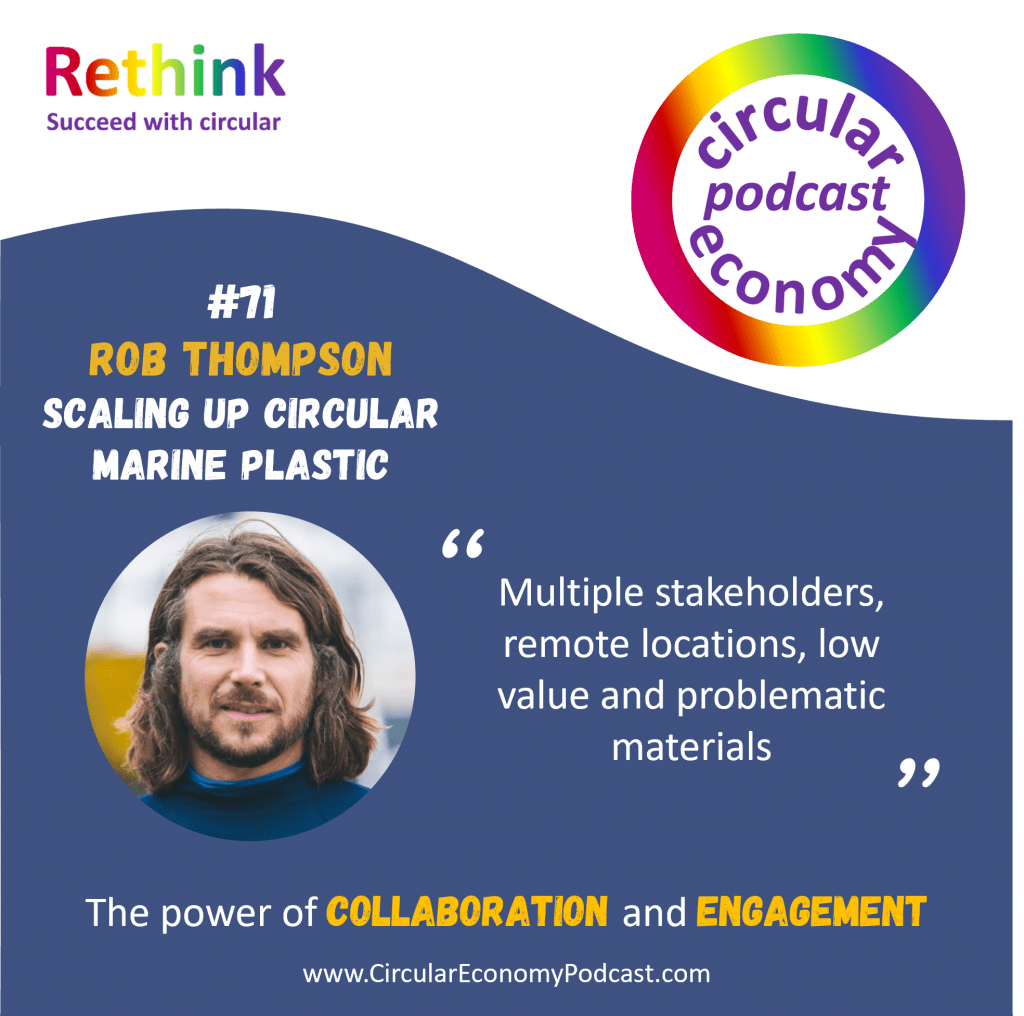
When we first interviewed Rob Thompson of Odyssey Innovation in 2020, we heard how he’d been involved in lots of beach clean ups around the south west tip of the UK, where he lived.
You probably already know that waste plastic is in all of our oceans and seas, and some of it washes up on beaches. It’s packaging, it is from the fishing boats and it’s other plastic waste.
Back in Episode 39, Rob told us how he’d been puzzling with how to solve the beach and marine plastics issue, and realised there were three key problems:
- First, How to cover the inaccessible coves, estuaries and other areas that regular beach cleaners couldn’t get to;
- Secondly, How to dispose of the plastic collected from the clean-up operations;
- Finally – and critically – How to pay for the running costs of doing everything.
Out of that set of problems, Rob founded Odyssey Innovation, which collects and recycles marine plastic into kayaks and other products.
Since then, Rob’s been working on how to expand this to help the fishing industry recycle more of their end-of-use nets and other plastics. He’d already come up with a solution that could apply to other areas of the UK – but how would he make it all work practically at a much bigger scale?
Rob tells us about The Net Regeneration Scheme, which is the 3rd project to be officially endorsed by the Global Ghost Gear Initiative (GGGI)
Rob explains some of the challenges involved in expanding the scheme, tells us more about the complexities of the materials they’re collecting, how they’ve set up recycling solutions for the easy and difficult-to-recycle materials, and how they’ve developed an exciting new product made from the recycled marine plastics.
Podcast host Catherine Weetman is a circular economy business advisor, workshop facilitator, speaker and writer. Her award-winning book: A Circular Economy Handbook: How to Build a More Resilient, Competitive and Sustainable Business includes lots of practical examples and tips on getting started. Catherine founded Rethink Global in 2013, to help businesses use circular, sustainable approaches to build a better business (and a better world).
Stay in touch for free insights and updates…
Read on for a summary of the podcast and links to the people, organisations and other resources we mention.
You can subscribe to the podcast series on iTunes, Google Podcasts, PlayerFM, Spotify, TuneIn, or search for “circular economy” in your favourite podcast app. Stay in touch to get free insights and updates, direct to your inbox…
Don’t forget, you can use our interactive, searchable podcast index to find episodes by sector, by region or by circular strategy. Plus, there is now a regular Circular Economy Podcast newsletter, so you get the latest episode show notes, links and transcript delivered to your inbox on Sunday morning, each fortnight. The newsletter includes a link to the episode page on our website, with an audio player. You can subscribe by clicking this link to update your preferences.
Links we mention in the episode:
About Rob Thompson
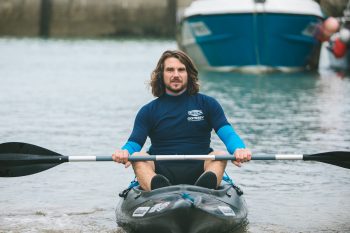 Rob Thompson says: “I’ve always been passionate about making a difference in the world. The problem of plastic pollution in the ocean is a critical one so I started doing clean ups by kayak. Rob Thompson says: “I’ve always been passionate about making a difference in the world. The problem of plastic pollution in the ocean is a critical one so I started doing clean ups by kayak.
I realised that there were three recurring obstacles I encountered:
* How to access the inaccessible coves, estuaries and other areas not frequented by the regular beach cleaners;
* How to dispose of the plastic we generated through our clean-up operations;
* How to fund the running costs of doing this.
I had the idea of combining the elements of all three problems and by using the concept using circular economy and Odyssey Innovation was born to recycle marine plastic into kayaks and other products.
We now collaborate with Surfers Against Sewage, Plymouth University, The Indigo Project, charities, NGOs, government bodies, the fishing industry, recyclers, manufacturers, Innovators and businesses, in order to find long-term sustainable solutions to tackle marine plastic pollution by incorporating the circular economy into our operations.
Interview Transcript
Provided by AI
Catherine Weetman
Rob Thompson is a Multi-award winning Innovator, a Marine Conservationist, and a Social Entrepreneur. Rob, welcome back to the circular economy podcast! In Episode 39, we heard how you created a brilliant circular model (using plastic waste to help collect more plastic waste!) and how you found ways to develop viable recycling routes for many of the wide range of plastics getting into the oceans.
You’d already developed kayaks made from recycled marine plastics to raise awareness and help fund the operations, and you were starting to talk to other councils around the UK. Could you pick up the story from there, and tell us what’s happened since?
Rob Thompson
Okay. Yeah, no, it’s good to be back. I can’t believe it’s been 18 months. Yeah. I mean, there’s been a lot of changes. I mean, with us as a company, but also sort of environmentally and globally with all the various challenges that’s been going on. So it’s, it’s good to see there’s still so much interest in the circular economy, and it’s still been progressing in the right direction through all that, really?
Catherine Weetman
Yeah, I’m finding lots, lots more interest. And I think people are really starting to, you know, switch their radar on for all the things that that are coming into our houses that aren’t recyclable. And I’m wondering why they’re not and so on. And so maybe, maybe you can start by talking about the work that you’ve been doing with the other, the other councils and kind of how that’s how that’s progressing.
Rob Thompson
Okay, so one of our ambitions really has been to try and create a scheme that’s reputable that we know what we’re doing, and provides a valuable resource to charities in different communities for the beach, being plastic, but also very importantly to us to the fishing communities. And we’ve been trying to develop a scheme which we can replicate around the UK because there’s obviously sort of a huge need for this everywhere really, we’re regularly contacted by different members of communities wanting to become involved in this. And we’ve recently been supported by the Welsh Government through a successful government tender to try and replicate their net regeneration scheme up and throughout the coastline of Wales. So over the last several months, what we’ve been doing is where the initial outreach and engagement and starting to put some infrastructure in place to start recycling some of the fishing gear, and try and do the same as what we’ve done. The Southwest also have a community element to that of tying that back in with some of the other charities like surfers against sewage and keep Wales tidy, are also a partner there. And from the fishing industry perspective, sea fish also to help with this scheme, and obviously the Welsh Government to try and create a ski which helps with prevention of marine waste through offerings, free recycling of fishing gear, and also the recovery of waste by having those recycling routes in place to be able to sort of add beach green waste into an any fishing gear that might be being recovered from fishing operations. Because we also, it’s also good to remember that the fishermen often recover fishing gear through that’s been lost previously, through their various fishing operations. And what we basically do is remove a cost barriers involved in recovery of plastic by offering free recycling facilities.
So initially, a 12 month pilot projects supported by the Welsh Government to help us put the infrastructure in place, do the outreach and get those recycling routes up and established. And, again, proof of concept that we can make it work that it’s a new region for us. The challenge in that obviously, working with different stakeholders, doing a lot of more engagement, we’re trying to make sure the schemes accessible. So we’ve had back all the all of our sort of recycling guidelines and things translated into the Welsh language as well to make sure that it’s accessible for all. And the idea is we’ll be continuing initially to be working with our partner, extra City Council. And we’ll be taking the waste to be going down, we’ll be sorting through everything it will be identified into its different polymer types weighed, bailed unnecessary, we’ll be finding the various appropriate routes for that material. And we’ll have the data from that as well then to help sort of, well, evidence for supply chains, I suppose, and the material supply chain, and the potential recycling routes for that gear. And help us we’re building that evidence, obviously work with Plymouth University as part of the Indigo project, which is based mostly around sustainability within the fishing industry, when it comes to gear types. So it’s looking at the recycling routes, how much potential gear is out there, what the potential is for getting that back into the circular economy, how the circular economy can work with other elements as well. So looking at the actual design of gear in the first place, you know, if the composition of fishing gear is a challenge to its recyclability, then maybe there could be some work around gear design, to make it more recyclable in the first instance, and also look at potentially going as far as developing new alternatives to traditional polymers, which are biodegradable, which is more the sort of French counterpart. So we’re looking at developing an alternative tonight on fishing line, trying to create a biodegradable alternative dine on fishing line, which is sort of early days yet, but they’re having some successes with it. So yeah, the Indigo project is very much around the sort of sustainability and the circular economy within the fishing sector and how to sort of increase sustainability and recycling rates. Yeah, because we’ve had a lot of
Catherine Weetman
when we were talking ahead of the podcast, you know, I was kind of initially shocked and then you kind of think, well, you know, why wouldn’t it be complicated, but the number of different materials, I think you said 600 different types of materials in various types of fishing gear, so, like, like most things, once you once you kind of know more about it, you realise just how complicated it is. And I think, again, a lot of people probably won’t realise that fishing crews, if they if they’re bringing back nets that that, you know, have they’re damaged or whatever, and they need to go into a recycling system that they have to pay for that. And so then when fishermen are seeing other discarded nets in the in the water, not only have they got to make an extra effort to collect those, but they know there’s going to be a cost when they come back into harbour so, you know, it’s really stacked against isn’t it? Bringing back those those? That ghost gear I think is the is the industry to Isn’t it that, you know, the, the nets and the discarded gear that’s out there that nobody knows who they belong to?
Rob Thompson
Yeah, there is definitely financial challenges with recycling anything that comes from the fishing industry. It has the worst elements that you could have really, when trying to create recycling scheme, you’re working with a problematic material to recycle in the first place, due to sort of mixed compositions and one of our recycling partners plastics, they’ve identified up to 900 different combinations that make up the fishing gear they’ve had in recycling. So that’s one of the big challenges because most of your, most of our recycling routes in the UK are based around very standard guys materials, it’s your sort of PET bottles and your HDPE s. And it’s going to that extent of trying to recycle sort of mixed materials of a low value is a real challenge economically. And the other challenges with trying to create recycling routes are usually remote locations, obviously making the logistics more expensive, which is one of the largest overheads and the low value of it. So you’ve got low value material from remote locations, which is problematic recycles, it’s got all this sort of worse combinations, it’d be like they’re trying to get this into recycling routes. But that doesn’t make it not valuable, it makes it more valuable, kind of get base recycling routes up and running. That’s the reason there’s such a need for all this really, is to try and create systems which are as low cost as possible that there is simple as possible for people to partake in. And for us, it’s always key to offer, this is a free service to the fishing communities, because we do rely on a lot of goodwill from them in the first place did sort of have that change of practice, if you like and put the extra little bit of effort into back this stuff separately for us. So they’re already sort of doing what they can on that front, and putting in the extra little bit of work. And so for us, it has to be sort of free to them. And it’s nice to be on shows where we can really kind of showcase what they are doing, and that they are now doing the right things when it comes to sustainability. And,
Catherine Weetman
yeah, you know, just making it super easy for people, you know, helps engage them and then and then they realise how much better they feel internally about about doing the right thing. And that’s then starts to build momentum. And I thought it was interesting what you were saying about, you know, even even in the Welsh project, which is quite a long way from from Exeter, that in the pilot stages, you’re going to be partnering with Exeter City Council, and that they’ll be doing the initial recycling and, very importantly, the data collection. And I think that’s, that’s, you know, that sounds like a really good way of proving the case. And, you know, working out where you need investment in what across Wales, and, you know, really helping to make make the business case for what kind of volumes you’re likely to see of each thing, and so on. So that that sounds like a really good way of getting the pilot going and helping build the numbers that you need to then scale it out.
Rob Thompson
Yeah, I think so one of the sort of challenges really is just identifying the different fishing gear types and the different types of materials we’ll be getting through and the volumes of those that you’re really important to recycler. And you can theoretically model this stuff as much as you want. But there’s nothing beats this kind of practically going out there and doing it as a sort of pilot study. And it might be that we then it’d be identified that we have a certain amount of plastic, which is easily processed in the UK, and there’s a partner in Wales that’s capable of recycling those, it’s a lot easier to go to them with that proposal, once you’ve got the data that say this is what we’ve got coming through. And having it is realistic sort of ongoing data as well. So quite often, you might have a surge of material come in, when you first engage in new harbour, there’ll be a legacy of waste that’s been kicking around for a long period of time that those we know how to deal with, and we might get an upsurge material, then it might take several months before you get the idea of how regularly this material is coming through. And the types of materials it can take up to 12 months to kind of get a clearer picture really, of the sort of material flow if you like. And it’s that kind of data that’s really more attractive to recyclers bear to know will consistently be having these materials coming through the sort of periodic times throughout the year.
Catherine Weetman
Yeah, definitely. I can see see the sense of that. And you’ve also been working on r&d for products made out of recycled plastics and moving on from the kayaks and into it into something new.
Rob Thompson
Yeah, so a couple of things actually. Again, the same principle that was working with the kayaks, we want to make something that is relevant to different demographics and helps push home the story around of marine waste and that it can be utilised well with the kayaks for recreation, but also for recovery of marine waste. So we’re using those for our panel for plastic campaign to recover waste from around the coastline. And since then, we was working with another company to make recycling bins and litter bins and they’ve been put out on in some of the harbours like for on their Marina, they put some on their floating pontoons. But for when they sailing boats come in, it’s got somewhere to put the material that they’re bringing in and recycled the waste. And obviously, it’s a nice little story there around the fact that bins are made. And they’re made partly from fishing nets as well. We’ve done that in the past as well with some we’ve made Griffin’s to go on beaches next to things like two minute beach clean boards for people to put the beach green plastic in. And the latest product, which we recently launched only a month or two ago was a surfing handplane. So most people say what’s your surfing campaign?
Catherine Weetman
Yeah, me too. And we’re not we’re not putting the video out. So even if you had one, you’re still gonna have to describe it. For those who were who were sitting there like me going, huh? What on earth is that?
Rob Thompson
Okay? Well, if you can pitch your body surfing to going in surfing without a board whatsoever, ju |



.png)
 More
More
 Religion & Spirituality
 Education
 Arts and Design
 Health
 Fashion & Beauty
 Government & Organizations
 Kids & family
 Music
Music News & Politics
 Science & Medicine
 Society & Culture
 Sports & Recreation
 TV & Film
 Technology
 Philosophy
 Storytelling
 Horror and Paranomal
 True Crime
 Leisure
 Travel
 Fiction
 Crypto
 Marketing
 History
 Comedy
 Arts
Arts Games & Hobbies
 Business
 Motivation