|
Description:
|
|
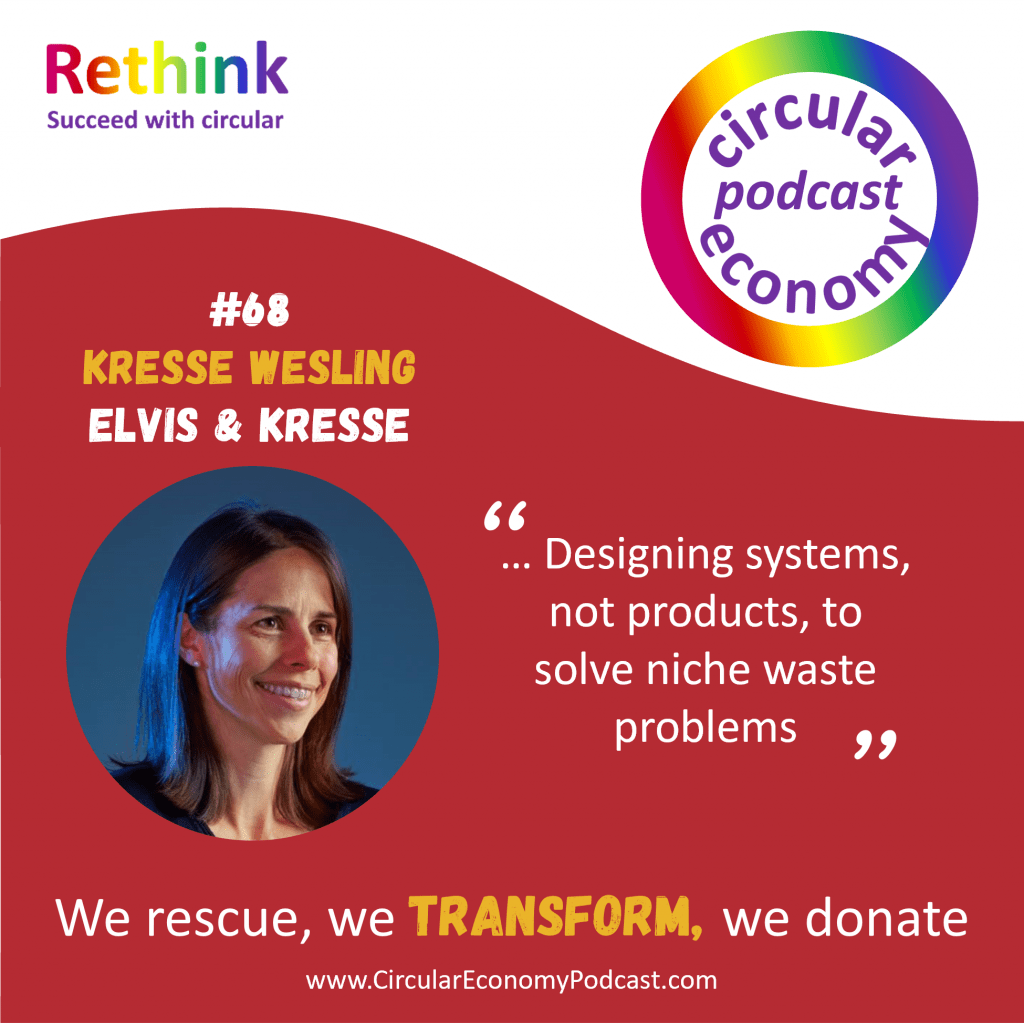
I’m in conversation with one of my first circular economy heroes, Kresse Wesling, CBE. Kresse is co-founder of Elvis & Kresse, which rescues and transforms discarded materials into innovative lifestyle products.
Kresse was one of the first circular economy entrepreneurs I met, when (in 2015) I heard her tell the story of how she started Elvis & Kresse back in 2005, to rescue and transform decommissioned fire hose, from the London Fire Brigade, into bags, wallets, belts and other high-quality products. I loved it so much that I bought my husband one of the wallets for Christmas.
I’d not yet dared to invite Kresse onto the podcast… so I was very impressed when Nicole Rudolf, who joined our team earlier this year, got in touch with Elvis & Kresse after researching it for one of our case studies for the Circle Lab Knowledge Hub. Thanks Nicole!
We hear about the ‘why’ of Elvis & Kresse, and how the company has evolved, now collecting 12 different waste materials to transform into high-quality, durable, beautiful and engaging lifestyle products. It’s a B Corp, and donates 50% of the profits from its collections to charities related to those rescued materials.
Kresse explains the company ethos, plus its belief in collaboration and why it’s important to design a system, not just a product.
Podcast host Catherine Weetman is a circular economy business advisor, workshop facilitator, speaker and writer. Her award-winning book: A Circular Economy Handbook: How to Build a More Resilient, Competitive and Sustainable Business includes lots of practical examples and tips on getting started. Catherine founded Rethink Global in 2013, to help businesses use circular, sustainable approaches to build a better business (and a better world).
Stay in touch for free insights and updates…
Read on for a summary of the podcast and links to the people, organisations and other resources we mention.
You can subscribe to the podcast series on iTunes, Google Podcasts, PlayerFM, Spotify, TuneIn, or search for “circular economy” in your favourite podcast app. Stay in touch to get free insights and updates, direct to your inbox…
Don’t forget, you can use our interactive, searchable podcast index to find episodes by sector, by region or by circular strategy. Plus, there is now a regular Circular Economy Podcast newsletter, so you get the latest episode show notes, links and transcript delivered to your inbox on Sunday morning, each fortnight. The newsletter includes a link to the episode page on our website, with an audio player. You can subscribe by clicking this link to update your preferences.
Links we mention in the episode:
- A Circular Economy Handbook: How to Build a More Resilient, Competitive and Sustainable Business – buy from any good bookseller, or direct from the publisher Kogan Page, which ships worldwide (free shipping to UK and US) and you can use discount code CIRCL20 to get 20% off. It’s available in paperback, ebook and Kindle. If you buy it from online sources, make sure you choose the new edition with an orange cover!
- Sign up to get the podcast player and shownotes for each new episode emailed to your inbox
- Kresse Wesling on LinkedIn https://www.linkedin.com/in/kresse-wesling-cbe-0933646/
- Elvis & Kresse https://www.elvisandkresse.com/
- Instagram, Facebook and Twitter: @elvisandkresse
- Books – Less is More by Jason Hickel
- People mentioned: Peter Desmond from the African Circular Economy Network https://www.acen.africa/
- Jo Chidley from Beauty Kitchen https://beautykitchen.co.uk/ https://www.linkedin.com/in/jochidley/
About Kresse Wesling
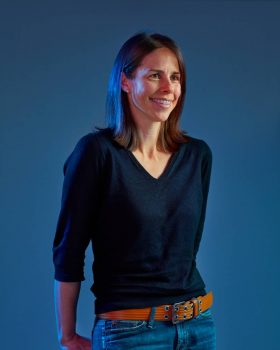
Kresse Wesling, CBE, is a multi-award winning environmental entrepreneur and Young Global Leader with a background in venture capital and significant start-up experience.
After first meeting with the London Fire Brigade in 2005, Kresse launched Elvis & Kresse, which turns industrial waste into innovative lifestyle products and returns 50% of profits to charities related to the waste.
Elvis & Kresse’s first line is made from decommissioned fire hose, 50% of the profits from this line are donated to the Fire Fighters Charity.
The company now collects 12 different waste streams, has several charitable partnerships and is involved with collaborations across industries, including most recently a five year partnership with the Burberry Foundation.
Interview Transcript
Provided by AI – DEDUCT ~1.15 mins for the finished episode
Catherine Weetman 04:08
Kresse Wesling CBE is a multi award winning environmental entrepreneur. After first meeting the London fire brigade in 2005, Kresse launched Elvis and Kresse, which rescues and transforms decommissioned fire hose into innovative lifestyle products and returns 50% of the profits to the firefighters charity. The company now collects 12 different waste streams, and has several charitable partnerships and collaborations across a number of industry sectors. Kresse, Welcome to the circular economy podcast.
Kresse Wesling 04:41
Hi, Catherine.
Catherine Weetman 04:42
And I’m impressed with how Elvis and Kresse has evolved since we first met at the Institute for manufacturing back in 2015. For those who’ve not heard of Elvis and Kresse, can you explain what kinds of materials you use and give us a few examples of the products that you make?
Kresse Wesling 04:58
Absolutely. So we have Kind of a very simple business model, we do three things, we rescue, we transform, and we donate. We always start by looking for niche waste problems. So these are materials that are not finding their way into traditional recycling. Whether that be because they can’t be recycled, or because they’re not being recycled effectively. Then we transform them into beautiful things and give 50% of the profits to charity. Our first material was London’s decommissioned fire hoses, which can’t be recycled, because it’s a nitrile rubber jacket surrounding a nylon woven core and you can’t unmarried these two wonderful materials. So you can shred it, melt it and start again, we turn that into a range of luxury goods. So this is handbags, luggage, belts, wallets, things like that. And then we donate 50% of the profits to the firefighters charity, and then we duplicated that model. Across Yeah, about 12. I think, at any we’ve done 15 materials are in all, but sort of on a regular basis, I would say we’re collecting 12
Catherine Weetman 06:03
Hmm. So can you give us an example of some of the other materials so that people have got a picture in their minds?
Kresse Wesling 06:10
Yeah, it’s kind of a it’s a it’s a broad mix. And so we we collect tea sacking, which is how we make a lot of our packaging. And it’s a waste that no one’s really aware of, because you know, it’s how tea is imported into the country, it goes directly to the tea blender. And consumers don’t ever see that raw material. So the reason that goes to waste because you’ve got a four layer sack, three layers of brown craft paper, food grade paper, which is lovely and delightful and would be recyclable if it weren’t for the fourth layer, which is laminated to foil and polyethylene. And because these these paper sacks are are tightly bonded at the top and the bottom, the entire sack gets scrapped. And what we do is collect directly from the tea blenders. In our case we collect from clipper tea, which is a wonderful Blender based in Dorset. And they come to us smelling of tea, often filled with the dregs of tea leaves, we cut those layers apart, I run them flat, and then use them for our packaging and our leaflets and things like that we have also made lanterns out of them and I think that will be that will be a product we reintroduce as homeware in the next several months.
Catherine Weetman 07:31
Wow fascinating and it’s and it’s horrific, isn’t it to hear how complicated things that that we imagined to be quite simple. And I guess I guess the foil and the polyethylene are relatively new introductions in the in the lifetime of tea importing to, to the
Kresse Wesling 07:51
tea is to come in these beautiful wooden chests and the chest would arrive in the UK would be emptied and it would go back on the ships to be refilled so so yes, they used to be desirable and reusable items and and a lot of people say to us Oh, but are isn’t tea important teach us and that’s because at some point, one of their grandparents would have had one in the house. But no, it hasn’t been that way for a very long time. And yeah, Tea sack, parachute silk, printing blanket, Coffee sacks, auction banners, what are some – Yeah, we just got a life raft from the Royal Marines, which is an emergency vessel that is past its sell by date past its health and safety life. And it would be the kind of vessel that 25 people could could live in for a period of time their proper boat had sunk. But having seen it, I guess this is this is why you know, it’s definitely a last resort and something you would want to step up into, from a sinking vessel rather than out of choice because it’s, yeah, very, very, very basic. But that was a fascinating bit of scrap for us to receive. Luckily the Marines took the explosives from it before they brought it over. But it does still have food packets in it. Safety lanterns are nice. Yeah, fascinating. We get some fascinating things.
Catherine Weetman 09:24
Yeah, I can Well, I can imagine the kind of range of kit you’d need on a life raft to keep going for a few days in in possibly very inhospitable conditions. And a few years ago, you started a project with Burberry, the luxury fashion brand. Yeah. Is that still going and can you tell us a bit more about that?
Kresse Wesling 09:49
Yeah, that’s that’s, that is still going. So we we once we got to 2010, the business started in 2005. And our first mission was the fire hose, but by the time we got to 2010 we were easily capable of recycling and reusing all of London’s hoes every year. So it was time for us to broaden our horizons and start thinking about another marquee waste that we could bring into the collection. And that was a sort of at the same time that a saddle maker had sent us a bag case of scrap leather. So we knew that leather off cuts was also a problem. We started doing some research on it and discovered a UN report that was written in 2010, that that estimated the global leather waste issue, just off cuts. So this isn’t old jackets, and airline seats. This is just off cuts because a cow hide is a certain shape. Companies cut up the pieces they want and the rest falls to the cutting floor. But the UN report estimated that there was 800,000 tonnes of this kind of off cut being produced here. So we’re used to talking about things like single use plastics, but this was never been used leather. And, and I just thought it’s kind of criminal. And we need to develop not a product for this. Because if you sort of cast remember back to 2010. Nope, some people were starting to talk about the circular economy, but people weren’t designing for it. So it was still a very novel concept that only a relatively few people understood it was talked about in academic circles more than anything else. We were aware of it because the work, the work we had done with firehose we’ve been you know, following Ellen MacArthur has transitioned to this space, that kind of thing.
Kresse Wesling 11:41
And I said, Let’s not design a product this time. Let’s design a system. Let’s think about what the circular economy demands demands designed for deconstruction. It it wants you to make sure that the raw materials involved can be used again and again and again and again and again in multiple different guises and lives. So that was the design brief that I gave to Elvis a sack of leather and some words sketched on the back of an envelope that were like, shareable swappable, DIY. And in many, in many ways, this is this is definitely what we came to call our perfect product. Because Elvis Sure enough, went away. And he took that inspiration and that bag of leather, and he came up with three geometrics shapes, that you could cut the leather into, to create whole new heights of any size that you could use for making rugs. And if you didn’t like those rugs anymore, you could take them apart and make curtains. And if you didn’t like those curtains anymore, you could upholster a chair, you could make a bag, you could make a doorstop, you know, kind of anything where you see leather, you could use these pieces. But not only that, let’s say, let’s say you do make one big rug out of your pieces. And actually you love that rug. But it gets old, what you can do is take high traffic pieces and move them to low traffic areas. So you can dramatically extend the life of the road. If your dog pulls up to corner pieces and you know shreds them, it doesn’t mean that the rug has to die just means you have to call me and we’ll send you two or pieces. So it was it was a I suppose it was a revolutionary new concept. And we introduced that at an event in let’s say 2012. And then a lot of people want to be to talk about it and speak about it at various events. And at one event in 2013 we were approached by some lovely women from Burberry, who said now this is wonderful and great. Would you like to work with us we have leather off cuts. And we would like to help you scale this solution. And then because they’re 7000 times larger than we are It took four years, negotiate out we would collaborate.
Kresse Wesling 13:59
But by 2017 we we’d formed a partnership between ourselves and the Burberry foundation. And we got going in earnest and, and it has been a brilliantly successful programme that has not only focused on leather rescue, but also creating apprenticeships that are at our site in Kent. And also 50% of the profits from this project are donated to Barefoot College where we train women as solar engineers so instead of leather going to ground and I suppose what I’m always excited about this is that when you bury a tonne of leather, it costs you 410 pounds minimum just landfill costs eight v Wow. If that same tonne of leather comes to us, we can generally turn that into approximately 100,000 pounds of revenue. So often in circular economy. chit chat we’re told that spent textiles could be worth two to $3,000 a tonne and I guess I’ve said stuff and nonsense Because we’ve shown it could be worth 100,000 pounds per tonne. It just, it’s just a question of creativity. It’s just a question of the right solution for the right problem. And certainly it has allowed us to create, I think, almost 20 scholarships for women to train and solar engineers. Fantastic. So yeah, it’s pretty, it’s pretty obvious what your decision should be buried in the ground, or do all of this is good and create all of this value? I think I think we all know what choice we should make.
Catherine Weetman 15:34
Yeah, definitely. And I bet from Burberry’s perspective that’s given them a much better story to tell them. Some of the press that was that’s come out over the last few years about what what they were doing with some of their other other ways that they didn’t want to get into the grey market. And talk about the Barefoot College in the solar engineers. When we were talking before, you mentioned a solar forge project that came about during the pandemic.
Kresse Wesling 16:00
Yeah. So this is this is a fascinating one, because I’m, I guess, once you start having this view, where problems are your raw material, where where problems are, or how you think of your next product line, then you start to see the world like that. And we had always wanted to make our own hardware. So belt buckles, and things like that. Because, you know, for from a luxury goods perspective, there’s a few suppliers that pretty much all of the brands work with and everyone in that industry says yes, 70% of it will be recycled, because metals are generally recycled, but they’re, they’re relatively unprovable assumption. So just based on industry standards for recycling in whatever country you might be operating from at any given time. And I just think we wanted to do something more interesting. And at the time, I was given this absolutely incredible report that was commissioned, and shared by Keep Britain Tidy, which is a really, I don’t know, it’s probably one of the most well known environmental charities in the UK. And it campaigns for love of place, and love of space, and people associated with, you know, collecting rubbish, and, you know, tidying up our parks and beaches. And the report that they commissioned had this incredible group of statistics about how much we litter in terms of drinks containers into our public spaces, it’s about 32 million drinks containers a year, around half of that are aluminium containers. And this results in the death of between three and 4 million small mammals a year. So it’s not just the litter issue, it’s that little creatures like newts and shrews are crossing roads and getting hit by cars and getting stuck in cans and bottles. You know, so it’s, it’s a, it’s a, it’s a biodiversity issue. And it just, it just pissed me off, I guess. And I thought, of course, this is what everyone was talking about 3d Printers. So I thought I’ll just get some 3d printer, and you’ll be able to chuck cans and went in. And you’ll be able to get belt buckles at the other end. And of course, there was one sort of weird website in America that said they had a machine that could do it, but whenever you called, there was nobody answering. So I call it a lot of and this is one thing I absolutely love about being in the UK, there are experts in this country in everything. So I just googled journal articles written about 3d metal printing, and I called some of the professors who were researching it. And I kind of got the same response saying that something like that metal to metal 3d printing might be possible in the future 10 years away. And it’s going to be a really expensive machine, because we have 3d metal purchase now, but you have to put refined metal powder in one it so not a waste can. And the machines cost about 340,000 pounds. I didn’t I wasn’t prepared to invest that much in in my, my next crazy idea.
Kresse Wesling 19:05
And I thought, Well, how do we do this cheaper? And how do we do this in a in a much more interesting way. And I was very lucky to have at that particular time, run into someone who was working at the University of the Arts in London, who said we’ve got this incredible programme called the BFTT programme where we match fashion entrepreneurs, with research teams to solve certain problems. And I said, Oh my god, this is incredible, because I could go out and try and find R&D people to help me. But that’s going to take three years to find the right team. They just had the right team lined up and they were at Queen Mary University. And over the course of the pandemic, this incredible team. I gave them again, basically a brief on the back of a napkin and |



.png)
 More
More
 Religion & Spirituality
 Education
 Arts and Design
 Health
 Fashion & Beauty
 Government & Organizations
 Kids & family
 Music
Music News & Politics
 Science & Medicine
 Society & Culture
 Sports & Recreation
 TV & Film
 Technology
 Philosophy
 Storytelling
 Horror and Paranomal
 True Crime
 Leisure
 Travel
 Fiction
 Crypto
 Marketing
 History
 Comedy
 Arts
Arts Games & Hobbies
 Business
 Motivation