|
Description:
|
|
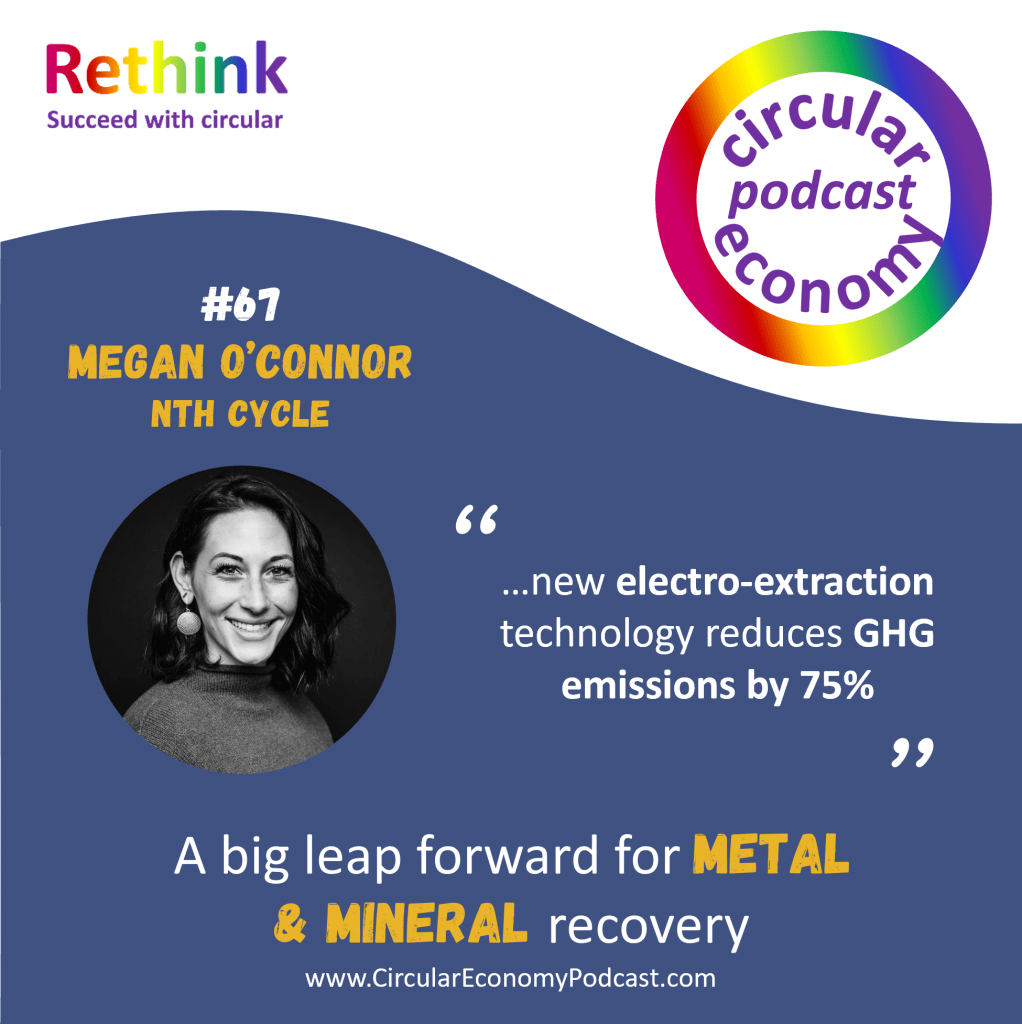
Dr Megan O’Connor is the co-founder and CEO of Nth Cycle, a metal processing company that has developed technology to enable a clean, local, and streamlined supply of critical minerals for the clean energy transition.
We hear how Dr. O’Connor begged her professors at Yale to let her attend the Green Electronics Summit, where she heard big tech brands and manufacturers talk about all the risks and pain points they were up against as they tried to respond to increasing demand for tech, whilst reducing their footprints and improving sustainability.
The quantities of materials we need are mindblowing –for cobalt alone, Megan quotes figures of a 50% supply shortage by 2030.
Basically, we’ve found, and mined, all the easy-to-access sources of many materials, so we’re getting less of each metal or mineral from the same amount of base material. In the shownotes, I’ve included a link to a report from the United Nations Int’l Resource Panel – Decoupling II – which highlighted these issues back in 2014. The report shows that for many minerals, to get the same quantity of metal extraction as a century ago, we now have to process about three times as much material. And of course, that brings associated increases in fossil fuel energy use, land disruption, chemical release and impacts on groundwater and freshwater.
Megan tells us how she came up with the idea for using electro-extraction, a technology developed by her co-founder for a completely different application, and how she then pivoted the entire focus of her PhD to develop this.
We hear about the different challenges in recovering metals from waste, and how the Nth Cycle technology solves these challenges in a more efficient and sustainable way than other recycling methods, such as hydro and pyrometallurgy.
Megan talks us through the range of applications, from e-waste to mining, and how the Nth Cycle technology is developed to be suitable for smaller-scale applications.
Podcast host Catherine Weetman is a circular economy business advisor, workshop facilitator, speaker and writer. Her award-winning book: A Circular Economy Handbook: How to Build a More Resilient, Competitive and Sustainable Business includes lots of practical examples and tips on getting started. Catherine founded Rethink Global in 2013, to help businesses use circular, sustainable approaches to build a better business (and a better world).
Stay in touch for free insights and updates…
Read on for a summary of the podcast and links to the people, organisations and other resources we mention.
You can subscribe to the podcast series on iTunes, Google Podcasts, PlayerFM, Spotify, TuneIn, or search for “circular economy” in your favourite podcast app. Stay in touch to get free insights and updates, direct to your inbox…
Don’t forget, you can use our interactive, searchable podcast index to find episodes by sector, by region or by circular strategy. Plus, there is now a regular Circular Economy Podcast newsletter, so you get the latest episode show notes, links and transcript delivered to your inbox on Sunday morning, each fortnight. The newsletter includes a link to the episode page on our website, with an audio player. You can subscribe by clicking this link to update your preferences.
Links we mention in the episode:
About Megan O’Connor

Megan O’Connor is co-founder and CEO of Nth Cycle, a metal processing company that has developed technology to enable a clean, domestic, and streamlined supply of critical minerals for the clean energy transition.
Dr. O’Connor leverages years of experience working on sustainable technology in many of America’s top research labs, where she helped develop the electro-extraction processes she and her team are commercializing at Nth Cycle.
Prior to founding Nth Cycle, Dr. O’Connor was an Entrepreneurial Fellow in the Innovation Crossroads program at Oak Ridge National Laboratory and was a visiting researcher at Yale University’s Center for Green Chemistry & Green Engineering.
Dr. O’Connor received her PhD in environmental engineering from Duke University and was recognized by Forbes on its “30 under 30” energy list in 2019.
Nth Cycle is based in Boston, Massachusetts, and is supported by a world-class team of investors including Clean Energy Ventures, the Department of Energy, and Creative Destruction Lab.
Interview Transcript
Provided by AI – add ~2:30 mins for the finished episode
Catherine Weetman 01:05
Dr Megan O’Connor is the founder and CEO of Nth Cycle, a company that’s developed and deployed an electrode extraction technology to recover critical materials from battery waste. Megan built up years of experience working on sustainable technology in many of America’s top research labs, where she helped develop the electrode extraction processes that she and her team are now commercialising at Nth Cycle. Megan, welcome to the circular economy podcast.
Megan O’Connor, Nth Cycle 01:34
Thank you, Catherine. I’m very excited to be here today.
Catherine Weetman 01:37
Yeah, and I’m really looking forward to this I was blown away to use the colloquial term when I was reading about Nth Cycle and what you’ve been able to develop. And when we when we chatted before you were telling me about the backstory to this and and how you came to do this. So maybe you could share a bit of that with us and explain what and cycle does.
Megan O’Connor, Nth Cycle 02:03
Absolutely, I’m happy to. So Nth Cycle’s overall mission is to create a very sustainable, efficient supply of all critical minerals that are needed for the energy transition. And we’ve developed, as you mentioned before, a new technology called electro extraction, which is really an alternative or replacement to the very antiquated refining technologies that we use today called Hydro and pyrometallurgy. And my co founders and I originally developed this technology over 10 years ago. So my co founder, Chad Vecitis, was a full time professor at Harvard University. And he actually developed this technology for a completely different application in wastewater treatment. I met him in 2014, I saw him give a presentation on this and around the same time is when I really started to become passionate about the circular economy and metals recycling. And, you know, my passion really expanded from there, when I was able to attend this summit called the green electronics summit when I was up at Yale University. And a professor had invited, you know, some of the folks from Apple, Dell, Intel, Samsung, at the the major electronics manufacturers and semiconductor manufacturers you can think of around the world, they were invited to Yale to talk about the major sustainability issues they saw coming over the next five to 10 years, you know, with their corporate hats on. And this was really to help Yale, direct all the research and you know, it wasn’t open to students, it wasn’t even open to other faculty, but I, you know, knew I had to be in in this session to really hear you know, what the real industrial problems were, because that’s originally why I wanted to go to graduate school. And so I begged my way. And it took me about three weeks to convince the professor that I should be in this meeting. So he finally led me in as a scribe to take notes. And it was amazing, just being like a fly on the wall and listening to all of these, you know, corporate folks talk about, you know, recycling, right, recycling kept coming up over and over again, waste management was an issue, they knew it was going to continue to be an issue as more folks get new phones every year, and TVs come out and right, it’s just a larger form of electronics waste, which a lot of people don’t necessarily think of them in that way. And paired with that, you know, waste management issue, no current recycling technologies was the issue that we have with the critical minerals supply chain, right, everybody saw the shortage of cobalt and nickel and rare earth metals coming down the pipeline. You know, by 2030, there’s predicted to be a 50% supply shortage for cobalt alone. And so they were thinking, how are we going to, you know, both recycle these materials in an efficient way. And while also creating a new supply of these materials, enough so that we don’t have to slow down in terms of our development for the clean energy economy. And so I walked out of that meeting and really thought, you know, I think I could try and at least develop a technology to solve this issue. You know, can we create a very economical way to pull these materials out in a form that can be simply put back into the supply chain to create that secondary source that was sort of the other pain point they discussed. And so that’s what I decided to do for the rest of my PhD work. Again, I had met my co founder Chad Vecitis, and asked him if I could use the technology and ‘spin it’ for metals recycling. And he agreed. And you know, we spent the next three years developing it. In about the day after I graduated, we started Nth Cycle we actually sat down at a bar in Boston and had a beer and you know, decided to go for it. And we’ve been trying to develop and commercialise it ever since.
Catherine Weetman 05:20
Wow, what a story and you kind of pivoted your entire PhD, didn’t you towards that you’d already been working on something else and decided that this was so important that that you had to refocus.
Megan O’Connor, Nth Cycle 05:33
I did Yes, in my third year, which a lot of people thought I was crazy, but I really saw a need and thought we could really develop a great solution. Because this would be, you know, a growing problem. And, you know, here we are today where, you know, a lot of the government’s both in Europe and in North America are really, really focused on this. So
Catherine Weetman 05:51
yeah. So you started the business the day after the PhD finished. So no time for rest and recovery. And now it’s it’s developing fast in in a few different ways, isn’t it? Maybe you could explain how it works, what different types of customers because there are at least two distinct groups of customers and and what you actually provide for your customer base.
Megan O’Connor, Nth Cycle 06:18
Absolutely. So at a high level, you can think of the electrode extraction system as an electrified water filter. So a basic water filter you’d see like in a Britta or if you have a pool at home, or well, water, if you think of it that like that, and we figured out a way to electrify it. And by electrifying it with different voltages, we can actually select and selectively recover these different materials based on that voltage that we apply. And so that’s how we’re able to collect and recover these cobalt, nickel and manganese. materials from the batteries and other mines sources that we that we look at very efficiently because our only input is a very low amount of electricity, versus the very high volumes of chemicals that the other technologies I mentioned earlier use the types of customers that we work with, again, we work across the entire supply chain. So we look for this cobalt, nickel, manganese, all these materials and any sort of feedstock, as we like to call them that we can possibly find. So we focus a lot on battery recycling. A lot of folks like to call it urban mining, because there’s a very high content of cobalt and nickel in these devices. And so we work our direct customers are the folks who are collecting these materials, shredding them down into what we call a black mass waste material. And so this is really just a mixture of the cathode and the anode materials that currently end up as a waste product. And so we’re turning that waste product into again, these valuable materials that can go back into the supply chain.
Catherine Weetman 07:42
And you also work with mining companies as well, which sort of feels a bit on circular. But with these particular materials that you’re talking about, often, we don’t have anywhere near enough of them already in the system to be able to recycle them. So although you’re recycling at the one end, there’s such a high demand, as I understand it, for these kind of products, that there’s still a need to mine them. And you help that process become much more efficient and effective, too. Is that right?
Megan O’Connor, Nth Cycle 08:17
That’s right, if we don’t have enough of these materials, specifically for the battery industry, to fully transition from fossil for this, you know, push to electrification that we’re all after. And so once we’re able to get these materials into the supply chain, we can eventually become fully circular. But for now, we really need to start mining more of these materials. And right, all the current mining processes can be quite hazardous. So in cycles, technology can also fit within that space, again, making a much more sustainable, efficient way to pull these materials out. So creating much less waste a much lower carbon footprint, but still providing the critical materials we need for this energy transition.
Catherine Weetman 08:55
Yeah, and that’s so important, isn’t it? It was worth as we’re finding out, there’s a whole whole range of different sectors now all chasing after the same critical materials for their for their technology enablers. So, thinking about the the recyclers that are using this, you know, is it is it complicated or you know, difficult for them to integrate Nth Cycle technology in their process? How does it work for them.
Megan O’Connor, Nth Cycle 09:27
So for them, we wanted to make it as easy as possible to integrate our system right on the end. So a lot of folks in the space are very focused on one of the other pain points, which is collection of these materials. You can imagine that lithium ion batteries, right we all saw the stories of these batteries that can spontaneously combust or start on fire. So you can imagine shipping them very far distances to get them to a recycling centre is very hazardous. They’re in trucks, right in the US here. We can’t even ship them via train anymore because so many explosions happened. And so it’s just very hazardous to move these materials to one centralised place. facility and causes these recyclers to really not have any work to put the materials once they are able to get them. So what we do and what we designed the system to do is go on site. So be very modular go on site be easily integrated into these facilities that are collecting smaller volumes of batteries all across the country, and then process them into a much safer material and much higher value. So they can then ship them to, you know, get back into the actual supply chain.
Catherine Weetman 10:27
Right, so that sounds like you’ve really looked at the different pain points for the whole process from a systems perspective, and try to address as many of those as possible. And going back to something you said at the beginning, about the alternatives, the hydro and the kind of meta logical meta metallurgy over there, I’m not going to get that right. But the the other ways of recycling, you mentioned that those are very energy and or chemical intensive. And I guess that’s something that many people don’t know, we just we just hear about recycling, and we kind of think that’s bound to be a good thing. But when I’ve been looking at, particularly how the circular economy can help with zero carbon ambitions, then you start to read more about recycling and some of the disk benefits. So are you able to unpack that a little bit for us?
Megan O’Connor, Nth Cycle 11:26
Yes, absolutely. You’re right, the the current technologies that are used are for recycling are the same technologies that are used for mining. So you know, you hear all this this negative talk about all the waste that’s produced within the mining process, and it’s very similar in the batteries. But in the in the recycling space, in general, I should say, there’s a lot of harsh chemicals and acids that are used in hydrometallurgy. So that’s a lot of the techniques that are used for things like the battery materials, whether they come out of the ground, from mines, or out of batteries from recycling, as well as pyrometallurgy, which is very large furnaces you can think of so very high temperatures, very high pressures very high in terms of our energy intensity and use for those technologies. And so, you know, if we continue to use those, we’re going to end up causing more harm than good to the planet. But we need these materials, right? So that’s again, where psycho came in and thought, how can we efficiently pull these materials out without, you know, generating, you know, tonnes of waste or, you know, increasing our carbon footprint even more than we already are? And that’s really where electro extraction came in, and can significantly reduce greenhouse gas emissions by 75%. Compared to Hydro and Pyro metallurgy alone,
Catherine Weetman 12:36
wow, that’s a really big benefit, isn’t it? Given given how much of this we need to do?
Megan O’Connor, Nth Cycle 12:42
Exactly, yeah.
Catherine Weetman 12:45
So I think we’ve we’ve we’ve talked a bit about how the business creates value for its customers. Is there anything else that, you know, have we missed anything in terms of great reasons for customers to use Nth Cycle technology?
Megan O’Connor, Nth Cycle 13:03
Yeah, I think in the in the recycling space, as well as the mining space, too. I think one of the other big pain points that Nth Cycle tries to solve is that these feedstocks vary almost every day, you can think of all the different scrap materials that a lot of these recyclers get. And even if they get a consumer electronic phone, which has a |



.png)
 More
More
 Religion & Spirituality
 Education
 Arts and Design
 Health
 Fashion & Beauty
 Government & Organizations
 Kids & family
 Music
Music News & Politics
 Science & Medicine
 Society & Culture
 Sports & Recreation
 TV & Film
 Technology
 Philosophy
 Storytelling
 Horror and Paranomal
 True Crime
 Leisure
 Travel
 Fiction
 Crypto
 Marketing
 History
 Comedy
 Arts
Arts Games & Hobbies
 Business
 Motivation