|
Description:
|
|
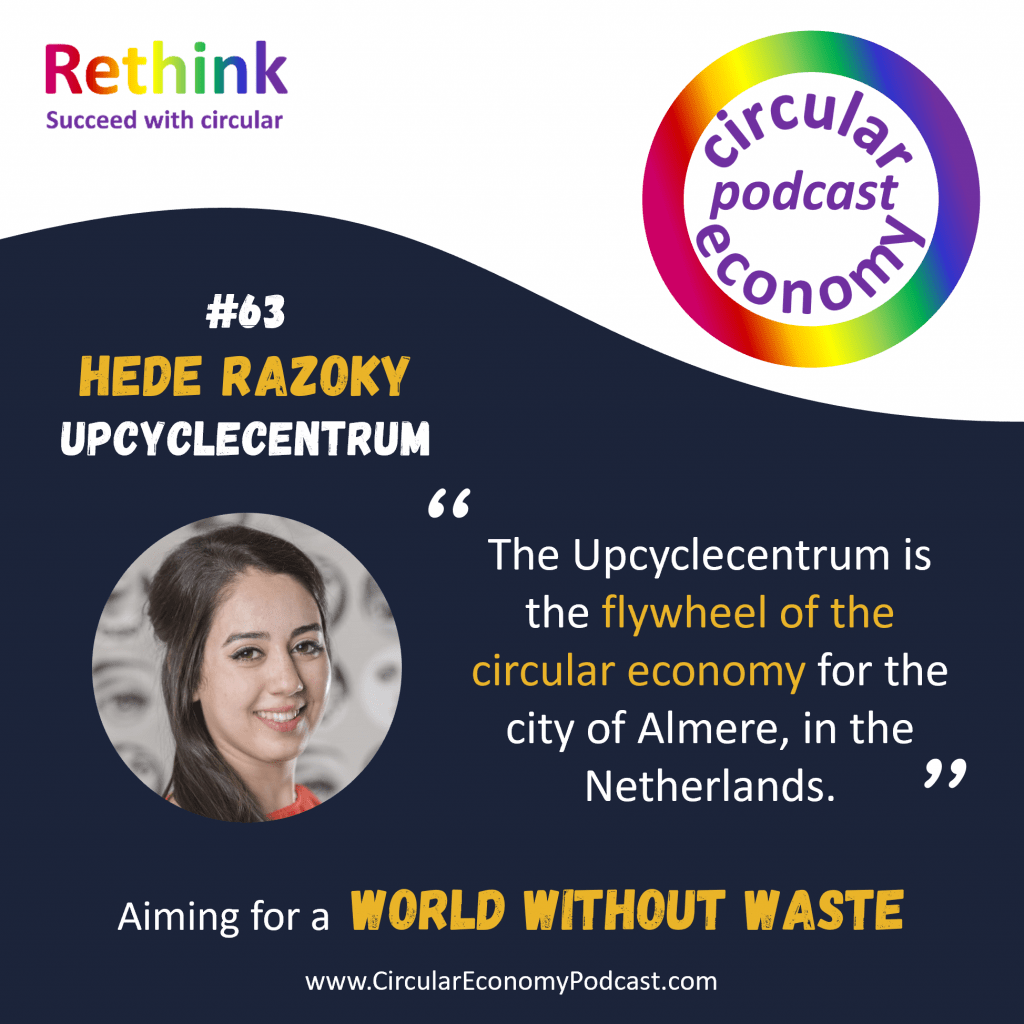
In this podcast, Hede Razoky talks to Catherine Weetman about the Upcyclecentrum in Almere, in the Netherlands.
The Upcyclecentrum is a brilliantly simple way for a town to support circular entrepreneurs, improve recycling rates and help its citizens see how the circular economy supports people, planet and prosperity.
The Upcyclecentrum has three elements: [1] it’s a recycling centre for local citizens, [2] it has an ‘experience room’ made from upcycled materials, for use by local businesses and community groups, and [thirdly] it has a brilliant entrepreneur incubation programme… providing facilities, materials and other support to artisan businesses that turn local waste materials into desirable, high-value products.
As the account manager for the Upcyclecentrum, Hede Razoky has a strong focus on creative entrepreneurship and making connections, for a shared goal of a ‘world without waste’.
Podcast host Catherine Weetman is a circular economy business advisor, workshop facilitator, speaker and writer. Her award-winning book: A Circular Economy Handbook: How to Build a More Resilient, Competitive and Sustainable Business includes lots of practical examples and tips on getting started. Catherine founded Rethink Global in 2013, to help businesses use circular, sustainable approaches to build a better business (and a better world).
Stay in touch for free insights and updates…
Read on for a summary of the podcast and links to the people, organisations and other resources we mention.
You can subscribe to the podcast series on iTunes, Google Podcasts, PlayerFM, Spotify, TuneIn, or search for “circular economy” in your favourite podcast app. Stay in touch to get free insights and updates, direct to your inbox…
Don’t forget, you can use our interactive, searchable podcast index to find episodes by sector, by region or by circular strategy. Plus, there is now a regular Circular Economy Podcast newsletter, so you get the latest episode show notes, links and transcript delivered to your inbox on Sunday morning, each fortnight. The newsletter includes a link to the episode page on our website, with an audio player. You can subscribe by clicking this link to update your preferences.
Links we mention in the episode:
Previous entrepreneurs at the UpcycleCentrum
Current entrepreneurs at the UpcycleCentrum
Events:
The United Nations Climate and Oceans Group, and the UN Association in Scotland free online support event for COP26, Tuesday 19 October, https://www.unhscotland.org.uk/consumption-retail-and-marketing
Shop til we Drop, a free online hackathon, on 7th October at 4pm GMT, aiming to reimagine the future of fashion and textiles for the benefit of our planet.
More info, and tickets on Eventbrite: https://www.eventbrite.co.uk/e/will-we-shop-til-we-drop-tickets-168394224659
About Hede Razoky
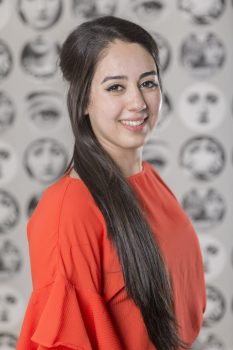 As the account manager for the Upcyclecentrum in Almere, Hede Razoky has a strong focus on creative entrepreneurship and the connection of (external) parties to the Upcyclecentrum in the common goal of a ‘world without waste’. As the account manager for the Upcyclecentrum in Almere, Hede Razoky has a strong focus on creative entrepreneurship and the connection of (external) parties to the Upcyclecentrum in the common goal of a ‘world without waste’.
Educated as a sociologist at the University of Groningen, she began her professional career at a smaller municipality, where she succeeded to transform the local waste policies towards a system founded on the social incentives for waste separation.
Hede believes in creating a sustainable world and the important role of the younger generations in this goal. That’s why in addition to her role of account manager, she is active as a board member of the young division of the NVRD: an organization that connects professionals in the waste sector of the Netherlands.
Interview Transcript
Provided by AI – add 3:47 mins for the finished episode
Catherine Weetman 01:57
Hede, welcome to the circular economy podcast.
Hede Razoky 02:01
Thank you, Catherine for having me.
Catherine Weetman 02:04
Yeah, it’s great to see you. And I’m curious to know a bit about your background and how you came to work at the upcycle. centre.
Hede Razoky 02:12
Yes. So when I was I started sociology. So that’s something very different than what I do now. When I was younger, I was always interested in people and how they behave, how they acted. And that’s actually the reason why I studied sociology. And I never expected to end up in the waste industry. But yeah, here we are. When I graduated from my studies, I started working as a trainee at a much smaller municipality, but in the same province that Almere is also in at the province of Flevoland. And that’s actually when I came in contact with waste and the waste industry. And that’s also when I came in contact with the Upcycle Centrum. And I remember very vividly that I had a meeting with a semi private organisation that collects waste. And they do that for about around 23 municipalities. And I had a meeting there. And I remember meeting an older man who told me, so yeah. Is this your first time? In the waste industry? I say yes, I am very interested. It’s very fascinating. And they looked at me and he told me, once you start here, you will never go back. And I thought, Okay, this man is quite a bit silly. He doesn’t know what he’s talking about. He’s old. I’m young. I’m interested in so many different topics. I want to do something with people and how they behave. And more in that area. But yeah, looking back, he was right.
Catherine Weetman 04:14
‘Cause you’ve been hooked on waste ever since.
Hede Razoky 04:16
Yeah, yeah. It’s like, yeah, you don’t get rid of that of that excitement and that feeling that you get with with waste? It’s very weird to say that but yeah.
Catherine Weetman 04:32
So so so tell us more about the Upcycle Centrum, then, you know, where is it? Why does it exist? What’s Yeah, what’s the what’s it all about?
Hede Razoky 04:43
So the Upcycle Centrum is located in Almere business park only at Haven and Almere, the municipality of a mayor wants to be a circular city and the Upcycle Centrum is one of them. One of the initiatives that contributes to that goal and the Upcycle Centrum is basically the flywheel of the circular local Circular Economy of Almere. And it’s not your typical or traditional recycling platform, you can basically divide the Upcycle Centrum in three parts, we have the recycling platform, three workshops for three startups and an Experience room where you can experience that.
Catherine Weetman 05:36
Great, so I really like that phrase, the flywheel of the circular economy for Almere. But yeah, tell us a bit more about the three different parts then. So the entrepreneurs, and we’ve already interviewed Laura Meijering, of Unravelau, who’s one of the entrepreneurs. So tell us a little bit more about the others what what they do and how that’s circular?
Hede Razoky 06:00
Yeah. So in total, we’ve had six entrepreneurs. And the first three were Ruig en Geroest, Ruik and Seefd. Ruig en Geroest, it basically translates as rough and rusty. He was an entrepreneur who made interior articles. And he’s also the one that made our lamps. In our experience room, he did that with boilers and pressure Valley vessels. Then we have Ruik which translates into smell, they made perfume out of waste, and they used our plastics to make their perfume bottles. And lastly, we also have Seefd and she saved clothing that was brought in by giving them a new print and therefore a new life. And at the end of 2019, they left and these are the three new businesses move in and Laura is one of them from Unravelau. Well, we have also Isolde de Ridder Sieraden and Sieraden means jewellery. And she’s a circular Goldsmith. And she makes jewellery out of waste. And she also tells the yucky side of bling. Actually, that’s quite interesting story that she has. And she tells that
Catherine Weetman 07:31
the what side of the ugly side of bling, bling and gold and silver and the mining process, right? Yes, I know a little bit about gold mining but I can imagine there are similar problems in lots of other mining as well. Absolutely. And, and so sorry, what which was the third one I interrupted.
Hede Razoky 07:56
3-cycle, okay. And they have designed the shredder bike. And with the with that bike, they shredder plastic, and they melt plastic and make new products, such as cutting boards, knives, etc. And all the entrepreneurs make very high end products, and they have excellent quality. And they truly show that waste. It’s not waste, but the resource in the circular economy. And most people think that waste is dirty that secondhand products are dirty, but they show that the products that they make is very high quality is fresh, clean, is very modern, and it opens people’s eyes about waste, and secondhand. And you name it.
Catherine Weetman 08:52
Hmm. Yeah, there’s some really interesting examples there in all sorts of different sectors. And I know when we spoke before header, we were talking about the perfume business. And first of all, I hadn’t realised that they were also using recycled plastics for packaging, which is great. But they had a range of perfumes, didn’t they and one of them was using discarded rose petals from one of the biggest rose exporting businesses in in in, in the Netherlands. And also they’d used waste Christmas trees and all sorts of things like that. So they’re really demonstrating how something that’s about to be discarded can instead be turned into a really valuable, desirable product.
Hede Razoky 09:44
Yeah, yeah. And something that is very high quality. I think that’s also important to note that it’s not something that is it starts with very Low a column economic value, but they turn it in something that has a high economic value. And they create new ways of thinking in the economy. And I think that’s also very interesting. Interesting to note that it’s not only upcycling the waste, but if there’s a whole world around it that they affect,
Catherine Weetman 10:24
exactly. And it can make the the feedstock business more viable as well, can’t it? Yeah. A while ago, I was listening to Dr. Gunter Pauli talking about some of the projects he’s involved in. And he was talking about coffee plantations. And some of the ways that farmers are now able to use the, the coffee cherry, which is the kind of outer casing which is more than 40% of the the volume of what they’re producing. And yet in the past, it all had to go to waste. Because it’s a high volume waste, and it’s quite acidic, it was no good for composting, and just caused, you know, lots of lots of problems if it was left on the farm. Plus, it was very bulky, so moving it away from the farm was expensive and beyond the means of most coffee farmers. So instead, they’ve been developing ways to convert the coffee cherry into things that can go back into food and drinks and so on. And again, it’s become a high value product, because it’s actually full of really valuable nutrients that aren’t in the coffee bean. So this this kind of way of understanding the the full value of what’s going through the supply chain. And making sure that that value is being realised, and also being shared more fairly, I think is really important. And, you know, discoveries like these, the kind of, you know, making perfume out of waste Christmas trees and making making jewellery out of waste and all that kind of thing. It starts to change people’s mindsets about what what’s going through their own supply chains, and how that could be turned into more valuable outputs.
Hede Razoky 12:17
Absolutely.
Catherine Weetman 12:19
Yeah. So So that’s, that’s interesting. So the entrepreneurs, can they stay for longer than a year or so? Or is it just a fixed time thing? And then there is there’s water competition for the next group? How does that work,
Hede Razoky 12:34
they can stay a year and a half with us. And then we start looking for new entrepreneurs, because we want to give them a boost to start their business. But then they have to go do their own thing. And we tried to help other startups with their plans. And actually, we are starting to search for new entrepreneur in February, louder will leave us and then we will have to have a new startup for her workshop. So we we get attendance and people can Yeah, write us their plan. And then we searched the best three plants and they have to pay is a page and then we choose the best one. And we look at the flow that they are targeting the waste flow that they are targeting, because we want to show our residents that every free waste flow that they bring in, that we can do something else about with it. So we don’t like to have like three entrepreneurs that tackle textiles, because that that wouldn’t be interesting. So we look at what kind of entrepreneurship entrepreneurs that we have, what kind of waistbelt did they tackle? And are there entrepreneurs that can tackle something else so we can give our residents another example of what we can do with waste?
Catherine Weetman 14:07
Yeah, so it’s all about firing people’s imaginations in different directions.
Hede Razoky 14:12
Yes, and also one of the two most important concepts that you can find in the Upcycle Centrum is making things visible and tangible that though these concepts are so important, it’s not only you can not only find it in the activities that we develop, but also the walls of the Upcycle Centrum itself are built with the notion of circularity and making that visible and tangible. So it’s very important that we show people what what it is. We have a saying in, in Dutch that goes like you can talk about it till you weigh an ounce. So that means you can Talk about things but you can’t reach anything by it because it’s talking about me. Yeah, you do nothing about me. But if you show people, and you make it approachable, you make it visible, tangible, then you reach people, then you can change behaviour and change the mindsets of people because they can see it, feel it, smell it, taste it, you name it by the shells.
Catherine Weetman 15:24
Yeah, I believe believe it. And I suppose, remember it more easily. You know, we have all these different sensory elements to our memory, don’t we and and often having smelt something or touched it or used it in some way means that we’re not going to forget it. Whereas just just hearing somebody talk about it doesn’t have the same, the same effect? No, no. So you mentioned the walls of the Upcycle Centrum. And you also mentioned earlier some of the fittings in the experience rooms. So what are the experience rooms all about? And, you know, what are they used for? And what’s in them paint a picture for us?
Hede Razoky 16:12
Yes, so the Experience Room is a room that’s fully upcycled. So everything that you see there is upcycled. We have for example, our floor is made out of 13,000 pieces of recycled wood, we have lamps made out of boilers and pressure vessels, our stools are made out of old scar rings, like everything that you see is upcycled. And we offer educational packages workshops in our experience room. And it’s also a place that people can rent, if they are looking for an inspirational room, because they are tackling their sustainability theme or something like that they come to us to have their meeting there. So it’s a very inspiring location. Because if you step into it, you are basically into the circular economy because Everywhere you look, you see products that are made out of waste. But But again, it’s waste, that’s become something beautiful and useful. Exactly. Exactly.
Catherine Weetman 17:34
So have you had |



.png)
 More
More
 Religion & Spirituality
 Education
 Arts and Design
 Health
 Fashion & Beauty
 Government & Organizations
 Kids & family
 Music
Music News & Politics
 Science & Medicine
 Society & Culture
 Sports & Recreation
 TV & Film
 Technology
 Philosophy
 Storytelling
 Horror and Paranomal
 True Crime
 Leisure
 Travel
 Fiction
 Crypto
 Marketing
 History
 Comedy
 Arts
Arts Games & Hobbies
 Business
 Motivation