|
Description:
|
|
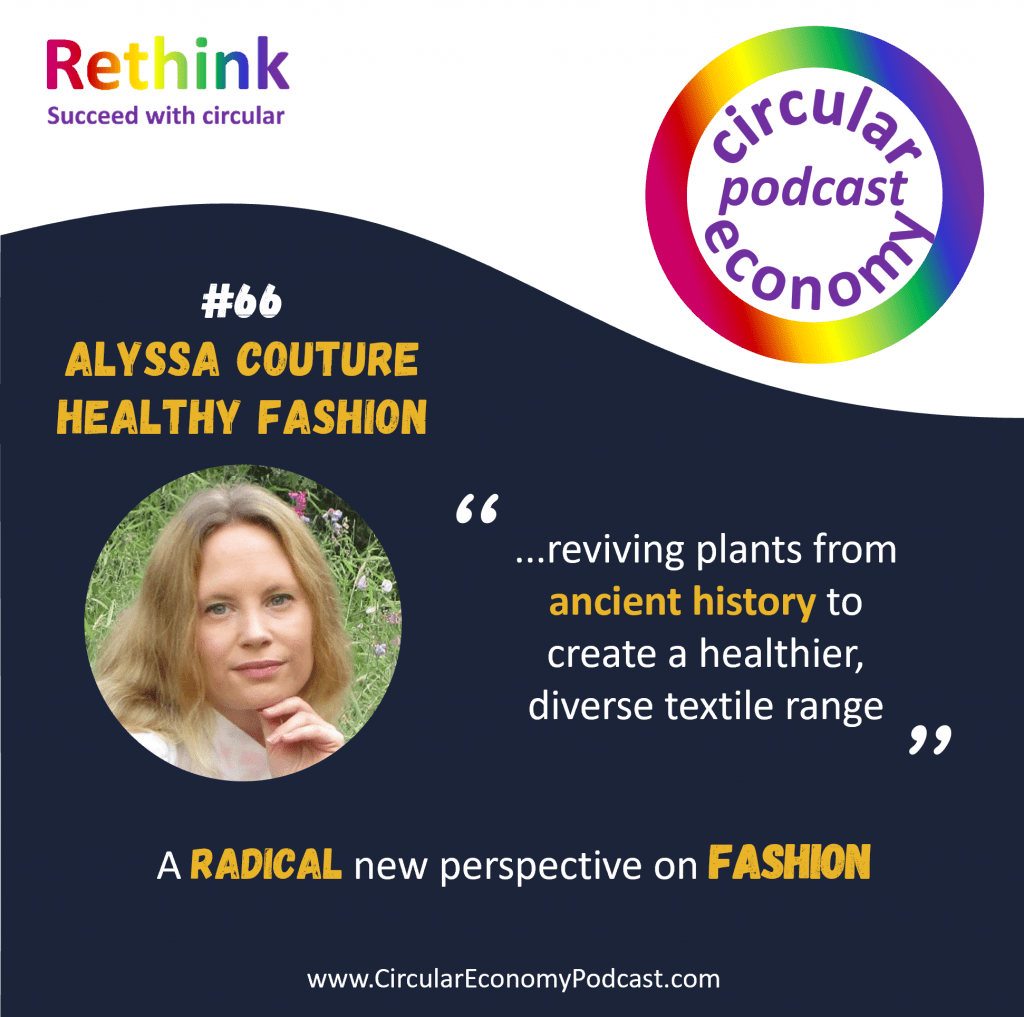
Catherine Weetman talks to Alyssa Couture, the author of Healthy Fashion: The Deeper Truths (published this month). Alyssa’s book is all about fashion for mental health, physical health, spiritual health, and energetic health.
Alyssa brings a radical new perspective to fashion, looking at everything from the textiles and dyes we use, to how our clothes can improve our mental and physical health. Alyssa’s work shows how all of this is connected to our environment and improving sustainability.
We’ll start by asking Alyssa to share some of her research on textiles and dyes, and then discuss a few of the insights from her book, including what ‘unhealthy fashion’ is, and how fashion can evolve to be circular and healthier for us, and our living planet.
Podcast host Catherine Weetman is a circular economy business advisor, workshop facilitator, speaker and writer. Her award-winning book: A Circular Economy Handbook: How to Build a More Resilient, Competitive and Sustainable Business includes lots of practical examples and tips on getting started. Catherine founded Rethink Global in 2013, to help businesses use circular, sustainable approaches to build a better business (and a better world).
Stay in touch for free insights and updates…
Read on for a summary of the podcast and links to the people, organisations and other resources we mention.
You can subscribe to the podcast series on iTunes, Google Podcasts, PlayerFM, Spotify, TuneIn, or search for “circular economy” in your favourite podcast app. Stay in touch to get free insights and updates, direct to your inbox…
Don’t forget, you can use our interactive, searchable podcast index to find episodes by sector, by region or by circular strategy. Plus, there is now a regular Circular Economy Podcast newsletter, so you get the latest episode show notes, links and transcript delivered to your inbox on Sunday morning, each fortnight. The newsletter includes a link to the episode page on our website, with an audio player. You can subscribe by clicking this link to update your preferences.
Links we mention in the episode:
About Alyssa Couture
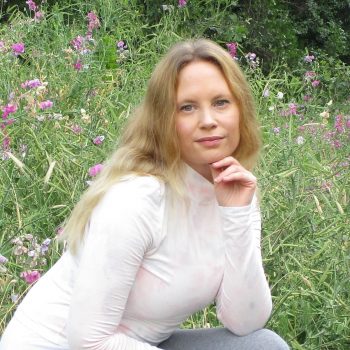
Alyssa Couture is an author, fashion designer, and fashion entrepreneur. She is currently focused on her fresh-inspired Healthy Fashion Campaign in conjunction with promoting her upcoming fashion book. Her upcoming book establishes an alternative approach to clothing.
Alyssa is a fashion industry expert, with over 15 years of fashion industry experience in a number of roles. Some of these include fashion business, fashion designing, creative directing, styling, merchandising, journalism, fashion retailing, and fashion show production.
Apart from fashion, she has a spiritually driven lifestyle, having previously lived in several ashrams and monasteries. She is a professional fine artist/illustrator with published and sold works to follow. She is a major foodie and former chef claiming 5 Star reviews. Alyssa has lived and worked in NH, NYC, New Jersey, West Virginia, Michigan, and in her most favored and current location: California. Her love of travel has given her the opportunity to explore different cultures and influence her outlook.
Alyssa is a fashion intuitive. Her sole motive is to bring fashion into its course as a therapeutic, healing tool. To help initiate the consciousness of the human spirit via fashion into its transmission of divine activity for overall human health and wellbeing, as well as it being contributing factor for ultimate planetary awakening.
She is currently promoting her upcoming soon-to-be-released fashion book. The book establishes an alternative, modern approach to clothing; Fashion deemed medicinal. Check her site for more info. Visit: www.hfcampaign.com or email: alyssacouture11@hotmail.com
Interview Transcript
Provided by AI – add ~3:15 mins for the finished episode
Catherine Weetman 00:01
Alyssa Couture is the author of healthy fashion the deeper truths released on December the first this year. Healthy fashion is all about fashion for mental health, physical, physical health, spiritual health and energetic health. Alyssa brings a radical new perspective to fashion. Looking at everything from the textiles and dyes we use to how our clothes can improve our mental and physical health. Alyssa ‘s work shows how all of this is connected to our environment, and improving sustainability. We’re going to start by asking Alyssa to share some of her research on textiles and dyes. And then discuss a few of the insights from her book, including what unhealthy fashion is, and how fashion can evolve to be circular and healthier for us and our living planet. So Alyssa , welcome to the circular economy podcast.
Alyssa Couture 00:53
Thank you so much, Catherine, for having me.
Catherine Weetman 00:55
Yeah, it’s great to see that today on the other side of the Atlantic. And first of all, I’m really curious to hear what brought you to writing a book about healthy fashion. Where did that come from?
Alyssa Couture 01:09
Yeah, so it is a really interesting question. And I took a long time to get it down on paper, it took a couple years. And it was sort of part of my lifestyle and my experience in life. I have visited many ashrams and monasteries, so it brought us spiritual realm in aspect to it. And then I’ve also sort of produced a handmade fashion brand, which was just a small, small batch handmade, fashion brand, but it was important, it got into Saks Fifth Avenue emerging designer Talent Search competition. So it all was produced with hemp and linen and cotton and plant based material. So it was a plant based brand. So that was another part that launched me into writing this book. So there’s many different aspects, I produced a fashion show in 2014. I’ve been in fashion retail for a very long time. So it was a little bit of a hodgepodge of all my different background and fashion and experience. And I also went to design school and Academy of Art University in San Francisco. And that really led me down the path of questioning and trying to theorise fashion in a new light, new way. And there is a lot of people in the industry that is producing healthy fashion. But it’s still not mainstream, it’s still in its minor stages, minor processes. So really, what kind of brought me into writing this book was also I am a writer, I write short stories and poetry. And I used to do that quite often. So I love to write, and it I have a creative aspect to me, I was a fine artist, I don’t believe I’m an artist anymore, because I stopped drawing. I only sketch very rarely. But I started painting and drawing when I was at art school, and back in high school many, many years ago. So this fine art aspect, this creative energy is brought into the book as well. But there’s a very scientific aspect to the book. And there was a lot of research involved. So I bring in sort of the technical, scientific aspect and the spiritual, more creative realms, and it’s a balanced immersion both.
Catherine Weetman 03:42
Hmm, sounds fascinating. And one of the things that really intrigued me about the book was the focus on what we might call new materials. But really, they’re materials from history that we’ve kind of forgotten about. Maybe you could tell us about some of those, the ones that you discovered and thought were really interesting and wondered why we’re not not using these all the time.
Alyssa Couture 04:10
Yes. So when it comes to circular fashion and sustainability, the most realistic way to beat the pollution and the corruption in the fashion industry is to start a circular fashion economy. And part of that is going plant based. And you really cannot be entirely plant based. If we just focus on cotton and linen, we have to develop and produce multiple different textiles and multiple different types of plants. And so from my research I’ve gathered in South America in history, they used 500 to 700 different types of plants for textile use, and with that type of number. I actually I only gathered 35. But very important plants from history that in that have been produced in minor moderate in major phases of production, mass production and minor production. And some plants are supposed to be produced in minor phases and never be produced in mass phases. And some are supposed to be produced in mass phases, like cotton and linen. So we have different types of fabrics. And I produce this glossary to showcase really what we can do for the fashion industry, what we can do globally at large. And some of the fabrics being nettle, hemp, bamboo, abaca, cactus, Pina, banana, there’s so many, and the only 35 that I’ve showcased are very important, but there’s so many others that I didn’t even talk about. So I’m just giving a little bit of a taste of what we can do. And it would be actually important to start focusing on these 35 types of plants based on the research that I have provided in the book, because they have such therapeutic properties, because they are produced and developed and founded globally in different countries of the world. So we’re really gathering you know, these types of plants that are significant and say countries in America. Sasa washi, and Europe there’s the nettle plant in China, there’s bamboo. In Mexico, there’s Agave. So there’s all these different types of plants and all these different types of countries. And when we all gather together, and we produce these different plants, we’re going to reduce the polyester, which is sort of exploited the industry at two extreme ways. I believe 90% of the industry is manmade Rayon, polyester, acrylic, acetate. And it’s sort of a non renewable resource, which is kind of not circular at all. Even even if we do try to prevent waste and landfill use with polyester that doesn’t biodegrade, we’re still developing a vicious cycle to produce more and more plastic. So really, with when we go plant based, we’re also going to downsize because our products are going to be more precious to us because plants are a sacred medicinal medicine to us, we eat plants, and we should wear plants, plants should be a part of our external environment, in a health pursuit in a medicinal pursuit, and also in an environmental pursuit, most importantly,
Catherine Weetman 08:00
yeah, and I’d like to come come back to that. So thinking about one of the criticisms of of cotton particularly is all the irrigation and pesticide use. And of course, Cotton’s now being produced in very water scarce areas. So it’s, it’s not even a suitable plant for that particular region of the world. And you’ve listed a number of plants from different regions. So I’m assuming that you know, those grow well there. And some of those sounded like they were byproducts of food production anyway, similar to the pineapple leaves for pain attacks. So already we’re starting to support farmers with more profitable ways of growing things because now you’ve got two or several products. And there’s a slide I like to use in in talks with all the different uses of hemp. You know, there’s about 5050 different things you can use hemp for. So suddenly a farmer has got a whole range of different markets he can sell into. So I think that’s that’s really interesting that as well as it being healthier to where there’s the health of the planet, because we’re growing things where they’re, you know, what were they were always grown, where they’re suited to growing. And we’re growing things that don’t require masses of irrigation, pesticides, fertilisers, so it’s lighter on the planet, and it’s lighter on the farmers input costs. Does that does that make sense in terms of your findings?
Alyssa Couture 09:36
Oh, that’s exactly that’s exactly where I’m going and where I’m coming from. And, you know, we’re dealing with planetary awakening here. And this is not just from climate change, or the environmental corruption and pollution in the world. We’re dealing with going into a more holistic, healthier standpoint, you know, no longer we going to be using the plastic knives in Tupperware, we’re going to be using vegetable based Tupperware and vegetable based knives and forks and everything. So different industries are all kind of going onto this plant based process and plan so that we can sort of combat the use of petroleum, which is sort of the worst and non circular thing that we can do for the fashion industry and other industries. And I wanted to break it down a little bit because you had mentioned call in and call in is sort of non-GMO. The non-GMO cotton is really pleasant cotton, about 80 and 90% of cotton right now it’s gentlemen genetically modified, which is a problem because it’s it’s hurting the land, it’s creating issues with, how it’s being grown and how it’s being processed. But where I’m coming from is there’s different categories that we can sort of bring about in making this plant based fashion industry possible. And right now there’s I don’t even believe there’s I think there’s about 5% of plant based fashion being produced at this point, just really not good. But we have different categories like wild weeds, we have ways of permaculture farming. We have natural waste resources. I know that in Europe, they’re using pine needles to be producing a Viscose, but it would be better to use a lyocell process. But pine needles is a natural resource. And it’s a waste of resource and that we can use. There’s also the desert lands that aren’t really being occupied. Mostly they we could be farming cactuses. And we could be using the gel for food and we can use the skin. For textiles. Some of the textiles we can use would be palm, pandan leaf, agave and Aloe Vera. So we have the desert, the wetland, wild weeds, the permaculture, the natural waste plant resources from the food industry and just from the wild forests, we also have seaweed farms, we could develop more and more seaweed farms and not take away from the planet but flourish the planet we can we don’t have to take the resources we flourish and we we act like Native Americans, we only take three quarters or a quarter of what is being harvested, we can do it in a very sustainable way we can do it in a holistic way. And way that doesn’t take but is a receiving in a taking its natural way of life, which is very circular, which is very healthy and is going to I believe just bring the consciousness level on this planet to heights greater heights.
Catherine Weetman 13:17
Yeah, and I think there are some really, really good ways of thinking about those plants. If you think about the, you know, a, is it more attractive for a farmer to go for a multi use plant that can have where you can have markets in in food and medicines and cosmetics as well as apparel? Is there a way of harvesting wild weeds though? I guess we’ve got to be careful there not to make those make those too attractive because then you know what we’re what we’re finding in the UK with foraged food, is that people then start to want to use that as a business and overharvest and then we’re back to things not being sustainable, because, you know, people want to exploit nature for profit. And we’re back to the same, the same problem that we’re that we’re trying to resolve. So I think there are, it sounds like there are, you know, loads of really interesting examples in the book for people to read more about. And one of the things I was interested to explore with you was some of the other issues, even with natural fibres, the way that we produce things currently. And this was a kind of eureka moment for me when I was reading some info from Patagonia a few years ago was that they had some problems with people getting sick in a store that they just stocked with new products, and they didn’t realise it was anything to do with the products did all sorts of tests on you know the decoration and the fittings in the store, and To try and work out what it was, and it turned out to be all the stocks of new cotton clothing that they’ve put in this is probably 2030 years ago this happened. And they did some analysis and realise that although it was organic cotton, it had probably about 30% of the fabric itself was finishing chemicals and dyes, including formaldehyde. So that just completely shocked them to the core when they realised that although they were buying an organic fibre, the processing of that into a textile was anything but organic. And so I know you’ve done some work around plant based and mineral based dyes and finishing chemicals that that could be used instead of the synthetic ones, maybe you could talk us through a few of those.
Alyssa Couture 15:49
Yes, so we have different types. And that was all very interesting, what you said and everything to considering that I believe that there’s needs to be some kind of gove |



.png)
 More
More
 Religion & Spirituality
 Education
 Arts and Design
 Health
 Fashion & Beauty
 Government & Organizations
 Kids & family
 Music
Music News & Politics
 Science & Medicine
 Society & Culture
 Sports & Recreation
 TV & Film
 Technology
 Philosophy
 Storytelling
 Horror and Paranomal
 True Crime
 Leisure
 Travel
 Fiction
 Crypto
 Marketing
 History
 Comedy
 Arts
Arts Games & Hobbies
 Business
 Motivation