|
Description:
|
|
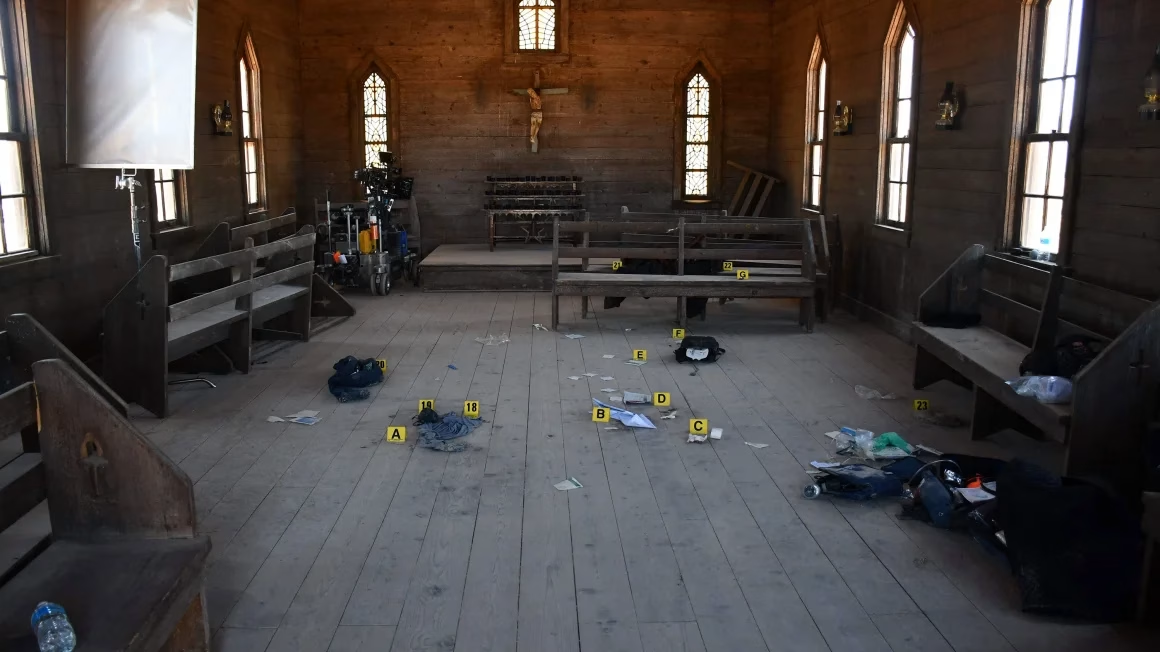
Forensic analysis took center stage in the criminal and legal investigation into Alec Baldwin’s fatal shooting of a crew member on the set of Rust. Michael Primeau shed light on the complexities of interpreting video evidence and contributed to Hannah Gutierrez-Reed, the armorer on the Rust film set, being found guilty in the related case against her. The case highlights how much like a scene from a movie with an actor on the stand, video evidence can be questioned, scrutinized, and misinterpreted.
In October 2021, Baldwin was involved in a fatal shooting on the Rust set, resulting in the death of cinematographer Halyna Hutchins and the injury of director Joel Souza. The incident raised serious questions about on-set safety protocols and how live ammunition ended up in a prop gun. A key issue was understanding the difficulty of distinguishing dummy rounds—used to look real on camera—from the live rounds that caused the tragedy.
Forensic video analysis and forensic image analysis were crucial in reconstructing events, examining Baldwin’s handling of the firearm, and scrutinizing the type of ammunition used. This is where Michael Primeau’s expert video analysis became essential, as he worked to clarify video stills to provide insights into the ammunition’s characteristics.
The Trial of Hannah Gutierrez-Reed
Hannah Gutierrez-Reed, the armorer on the Rust set, was put on trial for her role in the incident. During the investigation, six live rounds were discovered, some in a box of supposed dummy ammunition Gutierrez-Reed had brought to the set. Live rounds were also found in the gun belt worn by actor Jensen Ackles and the bandolier worn by Alec Baldwin.
The Testimony and the Challenge
Primeau’s testimony was central to the trial, as he was tasked with enhancing video frames to identify the ammunition’s primer side. His analysis involved resizing, adjusting light levels, sharpening and pixel analysis to reveal a silver-colored piece of ammunition in multiple stills. This detailed forensic work helped distinguish between live rounds and dummy rounds, providing crucial evidence that impacted the case’s outcome.
One of the main challenges Primeau addressed was combating the “silent witness theory”—the assumption that video inherently represents the truth. His work highlighted how video evidence could be misleading if not properly analyzed, demonstrating that even seemingly clear footage requires expert interpretation to uncover critical details.
The Plot Twist: Validating Video Evidence
Primeau’s analysis provided much-needed clarity during Gutierrez-Reed’s trial. By examining pixel tonal values in footage of Baldwin from October 10, 2021, he identified characteristics similar to the live ammunition and the prop ammunition. This technical process required dissecting each video image (frame) and evaluating the accuracy of what the professional-grade cinematography and behind-the-scenes cameras encoded (captured) as evidence. This was then offered in a report as well as expert testimony to the court, aiding in the court’s understanding of the events.
As the trial progressed, Primeau’s findings helped shift the focus from merely examining the original video to understanding how expert enhancements could alter or clarify previous interpretations. His testimony underscored the importance of using scientifically validated methods to analyze video evidence, ensuring the court had reliable information to consider.
Behind the Camera: Cutting-Edge Video Technology
High-end recording technology, like the cameras used on the Rust set, captures scenes in intricate detail. Forensic analysts like Primeau translate this raw video data into terms that can be easily understood in court. His meticulous approach to validating the video evidence ensured it could withstand cross-examination, illustrating why technical expertise is essential in forensic analysis.
Primeau’s involvement in the Gutierrez-Reed trial demonstrated that forensic video analysis isn’t just about pressing buttons—it’s about understanding recording devices, applying technical methods, and knowing the limitations of enhancement tools. His testimony provided the court with key evidence that ultimately played a part in the jury’s decision to convict Gutierrez-Reed.
Closing Credits: The Reality of Forensic Video Analysis
The Baldwin shooting and trial of Hannah Gutierrez-Reed serve as a reminder that video evidence requires the same scrutiny as human testimony. Whether it’s footage from a high-end Hollywood camera or everyday surveillance, forensic experts like Primeau ensure that video evidence is scientifically validated and accurately interpreted. This work is crucial in preventing misinterpretation and protecting the integrity of the justice process.
So, when video technology takes center stage in a courtroom, remember: the “silent witness” still needs a voice—yours, ours, and the courts’—to ensure it speaks the truth.
|



.png)
 More
More
 Religion & Spirituality
 Education
 Arts and Design
 Health
 Fashion & Beauty
 Government & Organizations
 Kids & family
 Music
Music News & Politics
 Science & Medicine
 Society & Culture
 Sports & Recreation
 TV & Film
 Technology
 Philosophy
 Storytelling
 Horror and Paranomal
 True Crime
 Leisure
 Travel
 Fiction
 Crypto
 Marketing
 History
 Comedy
 Arts
Arts Games & Hobbies
 Business
 Motivation