|
Description:
|
|
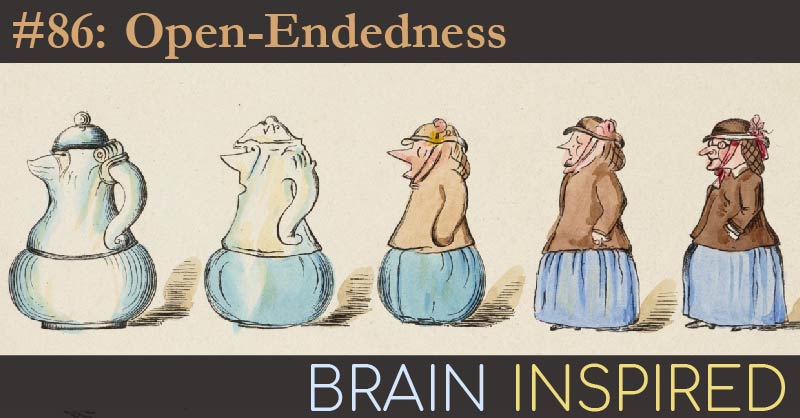
Ken and I discuss open-endedness, the pursuit of ambitious goals by seeking novelty and interesting products instead of advancing directly toward defined objectives. We talk about evolution as a prime example of an open-ended system that has produced astounding organisms, Ken relates how open-endedness could help advance artificial intelligence and neuroscience, and we discuss a range of topics related to the general concept of open-endedness, and Ken takes a couple questions from Stefan Leijnen and Melanie Mitchell.
Related:
Some key take-aways:
- Many of the best inventions were not the result of trying to achieve a specific objective.
- Open-endedness is the pursuit of ambitious advances without a clearly defined objective.
- Evolution is a quintessential example of an open-ended process: it produces a vast array of complex beings by searching the space of possible organisms, constrained by the environment, survival, and reproduction.
- Perhaps the key to developing artificial general intelligence is by following an open-ended path rather that pursing objectives (solving the same old benchmark tasks, etc.).
0:00 – Intro
3:46 – Skip Intro
4:30 – Evolution as an Open-ended process
8:25 – Why Greatness Cannot Be Planned
20:46 – Open-endedness in AI
29:35 – Constraints vs. objectives
36:26 – The adjacent possible
41:22 – Serendipity
44:33 – Stefan Leijnen question
53:11 – Melanie Mitchell question
1:00:32 – Efficiency
1:02:13 – Gentle Earth
1:05:25 – Learning vs. evolution
1:10:53 – AGI
1:14:06 – Neuroscience, AI, and open-endedness
1:26:06 – Open AI |



.png)
 More
More
 Religion & Spirituality
 Education
 Arts and Design
 Health
 Fashion & Beauty
 Government & Organizations
 Kids & family
 Music
Music News & Politics
 Science & Medicine
 Society & Culture
 Sports & Recreation
 TV & Film
 Technology
 Philosophy
 Storytelling
 Horror and Paranomal
 True Crime
 Leisure
 Travel
 Fiction
 Crypto
 Marketing
 History
 Comedy
 Arts
Arts Games & Hobbies
 Business
 Motivation