|
Description:
|
|
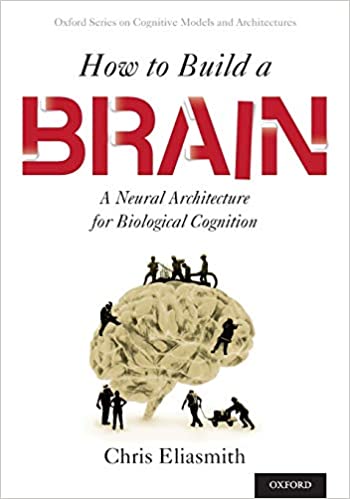
Chris and I discuss his Spaun large scale model of the human brain (Semantic Pointer Architecture Unified Network), as detailed in his book How to Build a Brain. We talk about his philosophical approach, how Spaun compares to Randy O’Reilly’s Leabra networks, the Applied Brain Research Chris co-founded, and I have guest questions from Brad Aimone, Steve Potter, and Randy O’Reilly.
 Some takeaways:
- Spaun is an embodied fully functional cognitive architecture with one eye for task instructions and an arm for responses.
- Chris uses elements from symbolic, connectionist, and dynamical systems approaches in cognitive science.
- The neural engineering framework (NEF) is how functions get instantiated in spiking neural networks.
- The semantic pointer architecture (SPA) is how representations are stored and transformed – i.e. the symbolic-like cognitive processing.
Time Points:
0:00 – Intro
2:29 – Sense of awe
6:20 – Large-scale models
9:24 – Descriptive pragmatism
15:43 – Asking better questions
22:48 – Brad Aimone question: Neural engineering framework
29:07 – Engineering to build vs. understand
32:12 – Why is AI world not interested in brains/minds?
37:09 – Steve Potter neuromorphics question
44:51 – Spaun
49:33 – Semantic Pointer Architecture
56:04 – Representations
58:21 – Randy O’Reilly question 1
1:07:33 – Randy O’Reilly question 2
1:10:31 – Spaun vs. Leabra
1:32:43 – How would Chris start over? |



.png)
 More
More
 Religion & Spirituality
 Education
 Arts and Design
 Health
 Fashion & Beauty
 Government & Organizations
 Kids & family
 Music
Music News & Politics
 Science & Medicine
 Society & Culture
 Sports & Recreation
 TV & Film
 Technology
 Philosophy
 Storytelling
 Horror and Paranomal
 True Crime
 Leisure
 Travel
 Fiction
 Crypto
 Marketing
 History
 Comedy
 Arts
Arts Games & Hobbies
 Business
 Motivation